Abandoned Children and HIV/AIDS in Northern Thailand (Part One)

Authors Note: In 1992, the East-West Center, a federally funded research institution located on the University of Hawai’i in Honolulu awarded me with an academic  scholarship for four years of graduate study and field research towards the degree of Doctor of Public Health.

I was also recruited for a summer research project with the Thai Red Cross Society in Bangkok – interviewing street children, residents of crowded communities (a.k.a. ‘slums’) and social workers to assess the current and future impact of HIV/AIDS on children in Thailand, which also helped to refine the focus of my doctoral research project.

Klong Toey Slum, Bangkok

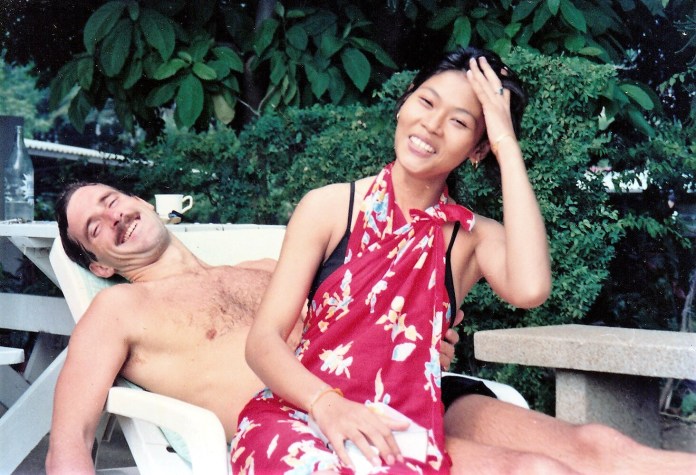
I met Lee at a public swimming pool near my apartment in Bangkok and she graciously offered to assist me with my summer research project. Her excellent English, keen interest in HIV/AIDS and wonderfully supportive and cheerful companionship were a real boost.

416
My research Assistant ‘Lee’, with the Thai Red Cross Society

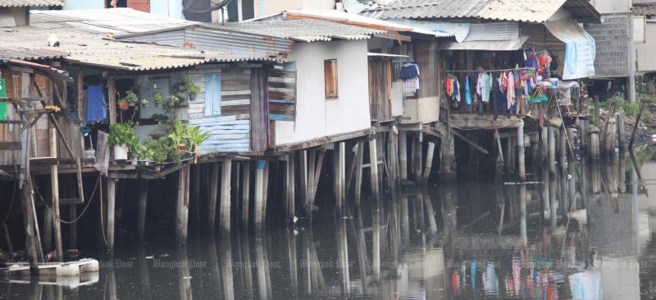
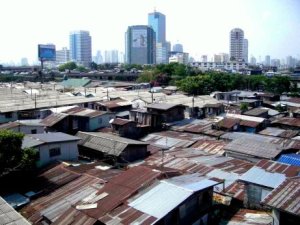
Riding hot crowded buses roaring through the capital city’s choking air pollution and notorious traffic to and from work, our days were spent conducting interviews in the hot, stifling crowded urban slums. Built on a swamp, Bangkok’s largest slum “Klong Toey” is home to over 100,000 residents, crammed into roughly one square kilometer of sludge, rubbish and sewage. Many of the tin-roofed houses are on stilts over stagnant, polluted water, and the area is prone to flooding particularly during the monsoon season.

Klong Toey Slum Dwellings by The Thinker 1
Slum dwellings, Klong Toey, Bangkok, AsiaThinkers

Seated cross-legged on the floor, there was an easy-going village feeling even in those cramped urban quarters as most of the residents were poor rural migrants who had come to the city to find work. The latest fad among the youth was glue sniffing and many we came across were lost in a glue-fume stupor.

585
Klong Toey Slum, Bangkok, Duang Prateep Foundation

Balancing on rotting boards above the stinking swampland, we made our way along the narrow, broken walkways.

Then one day when we arrived a crowd had gathered to receive soap and rice from a local relief agency – twenty percent of the slum had burned to the ground the previous night. Two hundred eighty families suddenly homeless – no food or money, everything lost. A young sex worker we interviewed echoed the sentiments of many of the slum residents: “Of course, AIDS can kill you in a few years, but I have to feed my family today.”

A late afternoon downpour jammed the traffic to a standstill. Walking was going to be faster than to creep along in a sweltering traffic snarl, so we hopped off the bus and ducked out of the rain and into a food stall for some soup to wait out the storm.
genteng by Asia Thinkers
Klong Toey Slum, Bangkok, AsiaThinkers

At home, a cold beer washed down the urban residue. Sharing some late season sweet mangoes, sticky rice and coconut cream, Lee rescued me from my self-destruction and despair and helped translate our taped interviews with social workers, sex workers and drug users.

Yes, all of this and Willie Nelson (“Blue Skies”) on the radio helped put a guy in a jolly mood.  It was really getting better, as long as I didn’t go insane! A final trip to the beach left us tanned and refreshed. And at last a focused dissertation topic on a meaningful and pressing issue was finally materializing.

Abandoned Children and HIV/AIDS

With the course work finally done, and my ABD “All-But-Dissertation” certificate in hand, I departed Hawai’i in July 1993 to begin nine months of independent field research in northern Thailand to examine the factors underlying the recent escalation of abandoned newborn infants in the northern city of Chiang Mai, with particular attention to the rapid spread of HIV, which was devastating the northern part of the country.

Using participatory urban and rural appraisal techniques to assess the magnitude and nature of problems within the context of rapid social change, the research aimed to inform effective policy and planning to address the underlying conditions within which child abandonment was occurring — including options for prevention and community-based management of abandoned children.

Thailand-CIA_WFB_Map_(2004)

The precise number of children abandoned in Thailand at that time was not known, although estimates based on institutional data suggested that more than 2,000 children were abandoned each year in 17 northern provinces – some of the poorest parts of the country.

But this was likely just the tip of the iceberg, as survey research had also found increasing trends of child abandonment by their mothers in hospitals shortly after delivery, as well as children born elsewhere and later deserted at hospitals. At that time, just one quarter of those in need had access to child welfare services.

When I began my research, there was one orphanage in Chiang Mai, Thailand’s second largest city. But within a years, the number of orphanages had grown to six to manage the growing number of abandoned children.

As young people were increasingly moving to towns from their home villages for work or school, the risk for unintended pregnancies increased dramatically among the unmarried young, often poor women who were then being left alone by their partners when becoming pregnant.

So, it was in desperation that these women — typically poor, alone and too ashamed to return to their village as a single parent — would present for an emergency delivery and then escape, leaving the baby on the table. Far from being a malicious act, her rationale was that the clean, modern ‘baby home’ or hospital would surely be able to provide a better future for her child than she could.

Orphanages or “Baby Homes’ typically cared for orphaned boys and girls up to age five. But by age six, the orphaned girls would all have been adopted, leaving only the boys in what are called ‘Boys Homes’ until they are old enough to legally go to work.

Interestingly, baby girls were more highly coveted than boys by Thai adoptive parents — typically older, their own children grown and gone. A girl was considered less trouble than raising a boy, and also more likely to stay home to take care of the parents in their old age.

Stay tuned for Part Two, coming soon!

You can read more about Jim’s backstory,  here and here.

Back to School: Alaska (Part Two)

Author’s Note: “The Alaska Native Health Board (ANHB) is the statewide voice on Alaska Native health issues. Active for over 40 years as an advocacy organization for the health needs and concerns of all Alaska Native people, ANHB continues to emphasize the importance of self-determination in healthcare services and encourages wellness and healthy ways of life in Native communities through policy change.” ANHB Website

In August 1990, I began my Master of Public Health (MPH) graduate program at the School of Public Health, University of Hawaii, USA. The following summer, I headed off to Alaska for my field research project, working with the Alaska Native Health Board to study and produce an analysis of issues, policies and programs affecting Alaska Native health.  The document served as the initial briefing paper for a joint Federal and State review of the geo-political, economic, environmental, cultural, psycho-social and other critical issues affecting Alaska Natives.

Field Research

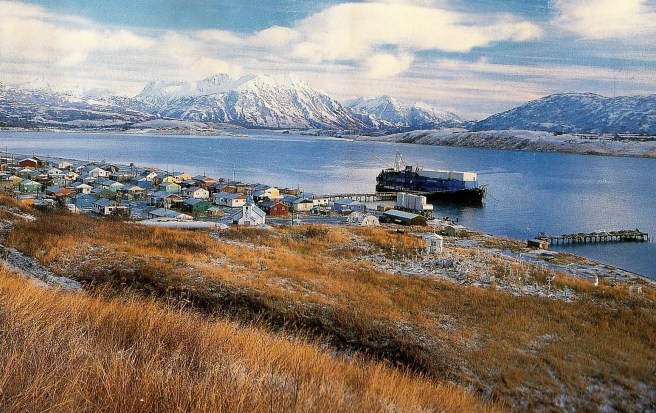
Buckled in next to the pilot in a two-seater helicopter, we flew to a gravel strip alongside the scant row of houses on a wide bay across from the Kenai Peninsula. Port Graham – an Aleut village of 200 people, was hosting a first-ever youth ‘Spirit Camp’ organized by the Alaska Native Health Board, with 30 teenagers from seven communities participating.

211a
Flying into Native communities in Southeastern Alaska

It brought back wonderful memories of my YMCA youth work over the years in the USA and abroad. Led by Don, a gifted and charismatic Native youth leader, they addressed the various pressing social issues and youth concerns with creative and engaging activities and discussion, including a powerful drama performance on the problems of alcohol abuse.

Flying north to the village of Kotzebue above the Arctic Circle in ‘the land of the midnight sun’ we watched the sun drop to the horizon to the west over the Bering Sea and then rise again – never setting. Then, by car we followed the gravel road through a wide and lonely expanse of low-lying hills to Nome where I was hosted by a local family and their 16 sled dogs.

234
The road to Nome, Alaska

Driving on to the village of Teller, we picked salmon berries, learned about ‘honey buckets’ from the community health workers and then drove to the end of one of the few remaining roads in this part of Western Alaska, through spectacular rolling hills, past sparkling clear streams draining distant snow peaks and emptying out into the Bering Sea to the west.

221

Then following a hectic week back in Anchorage typing up field notes on the computer, we flew to the sizable community of Bethel, located on the Kuskokwim River in Western Alaska to visit their hospital aptly named the “Yellow Submarine” due to its tubular shape and color.

225
Approaching the Yupic Eskimo village of Kipnuk

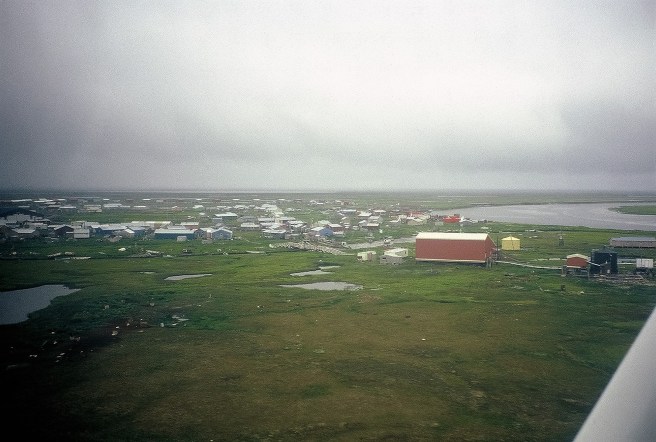
Continuing by light aircraft from Bethel, we flew over vast stretches of barren, misty tundra to Kipnuk village on the Lower Delta Region of the Kuskokwim River where we were searched for drugs upon arrival, except for one passenger who refused to be subjected to the search and left immediately on the return flight.

226a
Search House at Kipnuk village airport

One by one, the rest of us were taken into a small shed next to the airstrip where we were instructed to remove our outer garments and footwear while the official went through our bags – including my notebook page by page – apparently looking for ‘micro-dot’ doses of illicit drugs.

Each of the 229 federally recognized tribes in Alaska is essentially a separate ‘sovereign’ entity or ‘nation’ with the right to make their own laws and be governed by them. As such, local tribal ordinances in some communities have mandated thorough searches of passengers on all in-coming flights. These procedures are viewed as an essential part of the on-going battle to keep drugs out of their communities.

227a

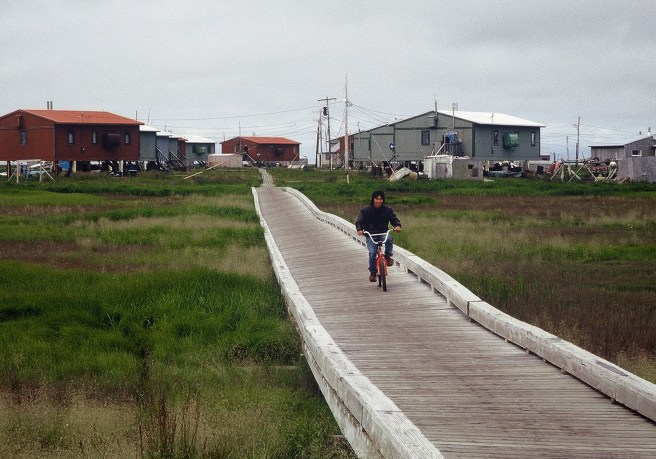
The tiny shamble of roughly built, weather-beaten wooden houses sporting TV satellite dishes punctuated an otherwise barren landscape. A solitary child rode his bike along the small patchwork of village boardwalks that straddled a sea of rubbish immediately below. The flat, mushy summer tundra stretched as far as the eye could see under the cold, misty grey sky.

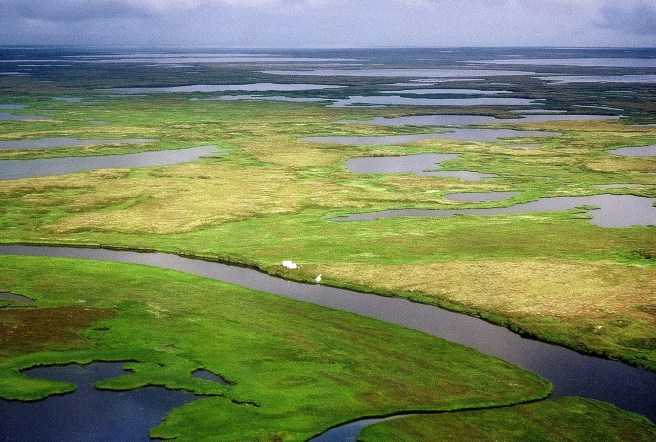
219Flying on to Alakanuk village on the Lower Yukon Delta we enjoyed spectacular scenery by light aircraft – flying over thousands of mirror-like ponds and squiggly waterways flowing through the multiple shades of greenest tundra feeding the Yukon-Kuskoquim Rivers and flowing out to the Bering Sea and on to Siberia.

220a
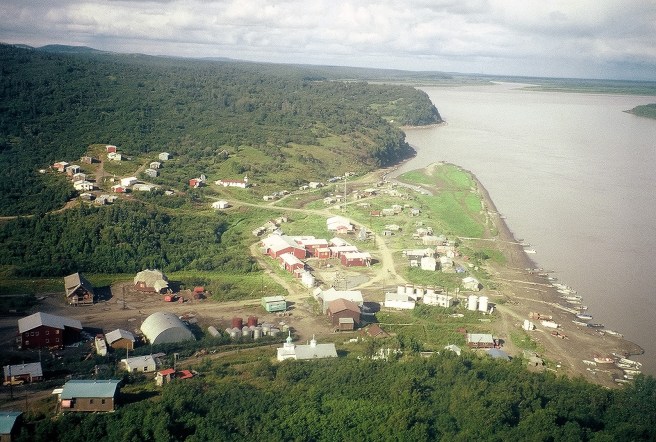
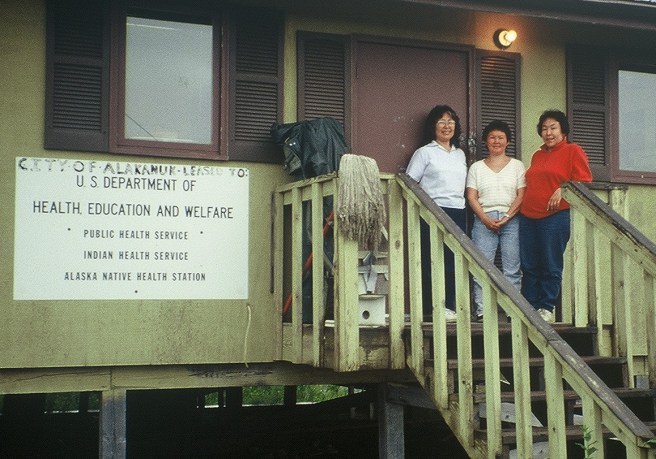
Alakanuk City Health Center ‘leased’ to the US Department of Health, Education and Welfare

An occasional white tent marked a riverside fishing camp. Moose and herds of Caribou moved across the vast expanses stretching to the horizon.

229a

Anchorage

By mid-August, the first snow had dusted the earth. In just one more week, I would be enjoying Hawai’i’s balmy breezes and inviting seas. But it was time to decompress. 223a

Travelling around the state and meeting everybody for interviews was extremely exhausting and stressful, and the whirlwind trip had taken its toll on my health. I had come to the conclusion that short-term intensive consultancies were probably not for me.

Just short, quick investigative visits in and out of a given community, but still expected to somehow absorb a sufficient understanding of the often complex situations. I also missed the sense of a longer term commitment to the place and the people as I had experienced on longer-term projects, like in Samoa and Thailand.

But overall, it had been an extraordinary experience – very special. And I hoped that my input would result in a useful contribution towards addressing the formidable and on-going challenges affecting Alaska Native health.

216Indeed, the people I met were exceedingly warm and gentle, and perhaps the most spiritual people I had ever known. When asked to describe themselves, it was always a ‘circle’ – balanced and in harmony with the universe.

But it was time to leave Alaska, and I enjoyed my last bike ride in Anchorage along the coastal trail between rain showers, breathing in the rich, moist, cool and invigorating air, alive with green growth.  I would miss it when the sun is out, but not the damp chilling rain, or the blustery north wind whipping across cold grassy marshes.

233 (2)
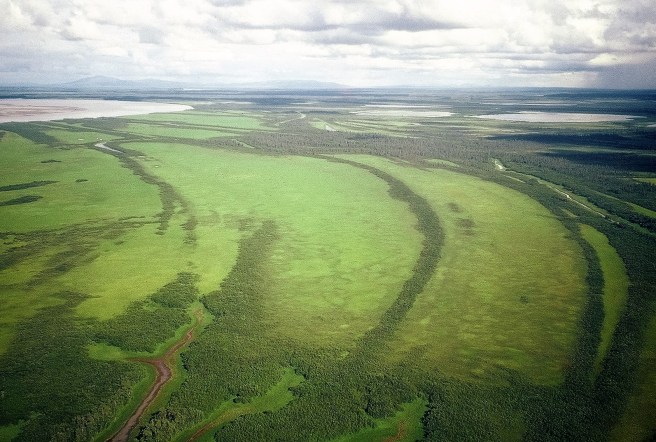
Spectacular scenery flying over Alaska’s interior

All so very beautiful – wildlife roaming freely. But I was ready to get back to warm sea breezes and refreshing morning swims in Hawai’i’s clear, sub-tropical waters. At last, handing over the document — with glowing evaluations from the Alaska Native Health Board and the Alaska Federation of Natives — I was content and ready for a good rest.

The Crash

I felt it coming after returning from Alaska in August, and it all stopped abruptly after losing Nit in December – she had married a Thai. Then the parting of friends at graduation, coupled with having lost Jessie when she married the year before, which symbolized a severance from the perpetual high of the past decade or so. The high and wide wave I had been riding for the first 18 months back in the USA had finally crested and crashed.

Eventually, I began to come out of the long bout of depression, culture shock and life-phase re-evaluation. But the painful sting of lost relationships remained – the consequence of living a transient, temporary existence everywhere – and forever negotiating that fine line between stability and stagnation.

001

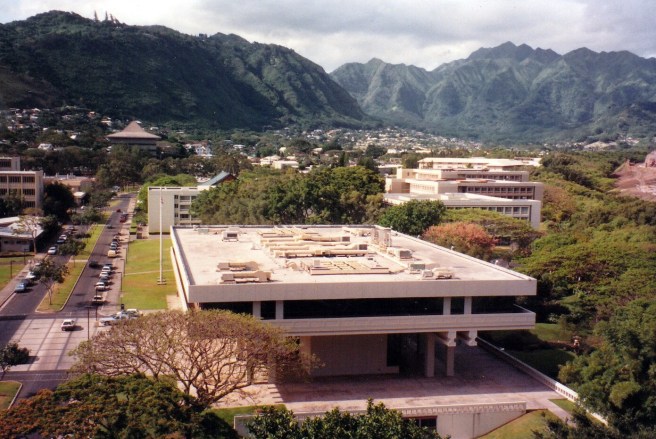
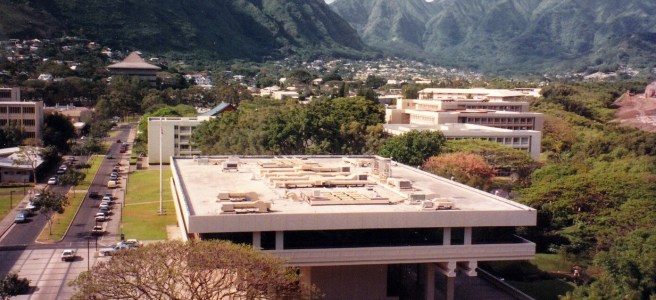
View of the University of Hawai’i at Manoa campus from my study room at the East West Center

So, at last it was back to the good life in Hawai’i – taking it all in. Three all-you-can-eat buffet meals each day, biking to the beach, swimming in the sea, stressed mainly from the busy social life, but most content to be in the library with my nose in the literature.

The view up into the mountains from my study room was spectacular. Misty, mid-morning showers brightening into rainbows, arching across the valley. Then suddenly, the semester was over, but more critically, the all-you-can-eat student meal plan was over as well! 

Stay tuned for more stories, coming soon!

You can read more about Jim’s backstory,  here and here.

Back to School: Alaska (Part One)

Author’s Note: In August 1990, I began my Master of Public Health (MPH) graduate studies at the School of Public Health, University of Hawai’i, USA. The following summer, I headed off to Alaska for my field research project, working with the Alaska Native Health Board,  an advocacy organization for the health needs and concerns of all Alaska Native people, to study and produce an analysis of issues, policies and programs affecting Alaska Native health.  The document served as the initial briefing paper for a joint Federal and State review of the geo-political, economic, environmental, cultural, psycho-social and other critical issues affecting Alaska Natives.

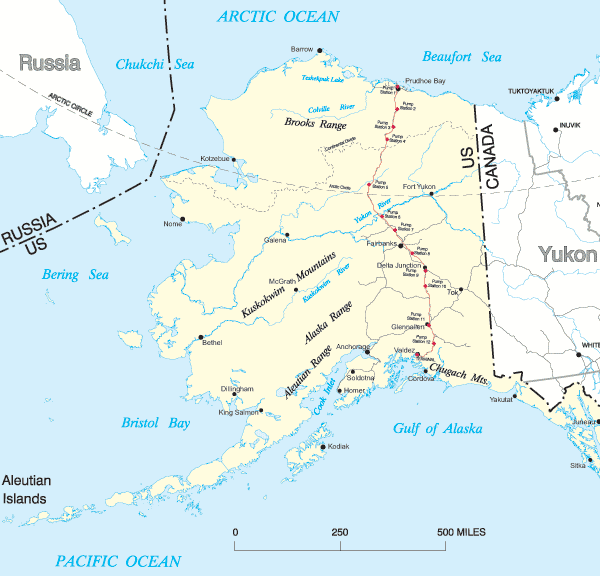
Alaska

State-of-Alaska-Map

It was time to tug on the muck-lucks, smear some whale blubber on my chin and head for the Klondike! Based in Anchorage for my Master of Public Health (MPH) summer field project with the Alaska Native Health Board, I traveled by road, sea, and air – including two-seater light aircraft with bush pilots to Native communities throughout the state. I met with tribal councils, visited village health clinics, and interviewed local health workers and their clients to gain a better understanding of the impact of public policies, programs and other critical issues affecting Alaska Native health.

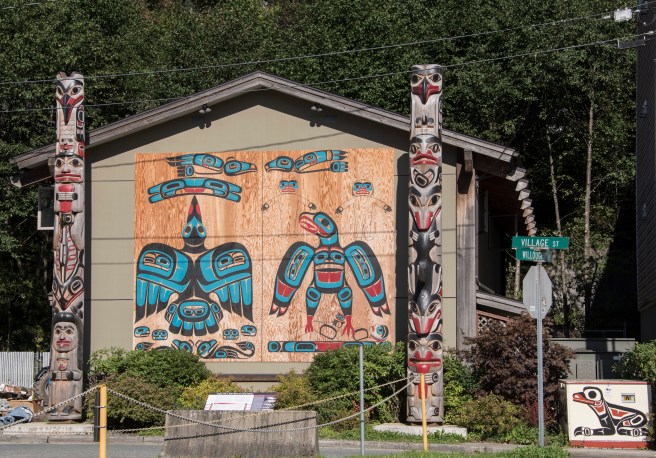
Tlingit & Haida Totem at Village Park, Willoughby Ave, Juneau, Alaska.
Tlinget and Haida Totem by Gillfoto CC BY-SA 4.0 Wikipedia Commons

Anchorage is like a modern city with big, broad streets, some busy highways, but with a distinctive, wide open western ‘cow-town’ feeling. The local bars are dark, windowless holes underground with billiard tables and sawdust floors — an efficient escape for anyone wishing to detach fully from the world. Alcohol abuse is a devastating problem in Alaska and it was depressing to see this in an otherwise healthy environment.

Neatly paved trails wind through the well-planned, eco-friendly city, and offer cyclists or skiers — depending on the season — a pleasant and practical alternative to the main motorways. Breathing in the rich, moist, cool and invigorating air, I enjoyed daily bike rides through dense forest along Cook Inlet, named for the famous explorer Captain James Cook. Sharing the bike trail with an occasional moose grazing in the late afternoon sun dazzling across the water, the world was alive and fresh with lush, green growth everywhere.

249c
Cook Inlet, Anchorage, Alaska

Beautiful when the sun is out, but cold and damp in the rain, with the blustery north wind whipping across the grassy sea marshes at low tide. Long summer days, sunglasses on at 10 PM. The sun still high and glinting off the water with spectacular sunsets over the snow-capped Chagrach Mountain Range – splendid in the clear, fresh evergreen-scented forest.

June was a bit nippy for this island boy — 45-55 degrees F. At 60 degrees, painfully-white sun-bathers stretched out on a muddy beach were hopeful in the midday sun. But by mid-August it was snowing and I was ready to get back to Hawai’i’s tropical sea breezes.

209a
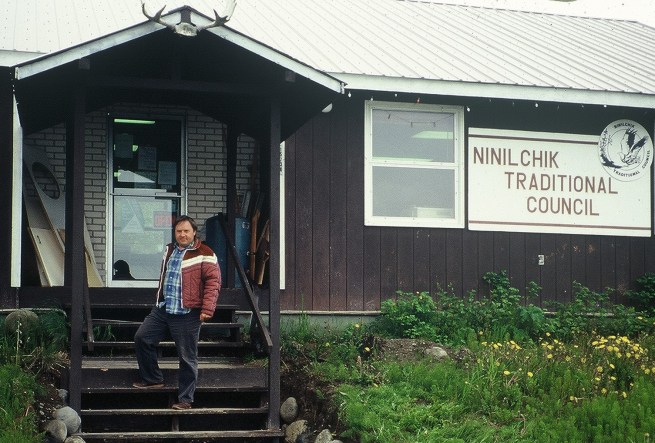
Bill at the Ninilchik Tribal Counsel Center, Kenai Peninsula

Weekends on the Kenai Peninsula with my friend Bill were refreshing getaways from work and the city. Half Athabaskan Indian and half Russian, Bill was typical of many Alaska Natives. Bill worked with the Indian Health Service in Alaska and was also doing his MPH at the University of Hawai’i School of Public Health. His cabin, which he had built himself, was one of the few buildings in his home village of Ninilchik.

The only other building in sight was a large, simple structure with a smoky all-night bar and country music dance hall on one side, and an 24/7 cafe/diner on the other. Separated by the bathroom, convenient transfers could be made from one venue to the other and back again, depending on the time of day or night.

So, it was exciting times in center-town Ninilchik Alaska, with mere hours between late night beer drinking with the sleepy country and western band and late morning coffee and breakfast in the attached diner. A one-stop, all-purpose gathering spot for local residents.

245
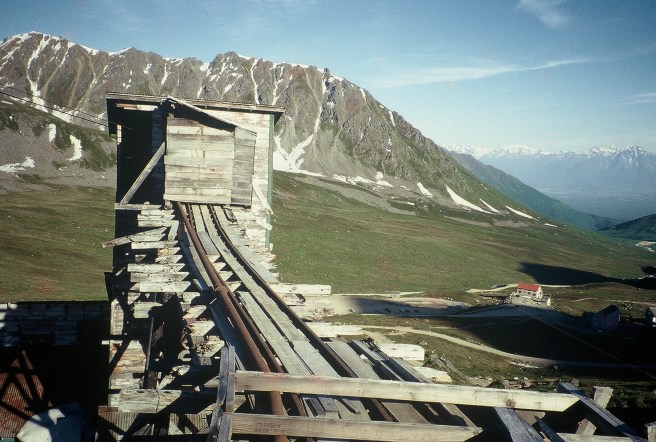
An abandoned silver mine south of Anchorage

Driving south from Anchorage past Portage Glacier, the town of Homer, also known as the “Halibut Fishing Capital of the World” was a total zoo with all the RVs, ‘shoestring’ budget campers and fishermen standing elbow-to-elbow along the Kenai River.

240 (2)
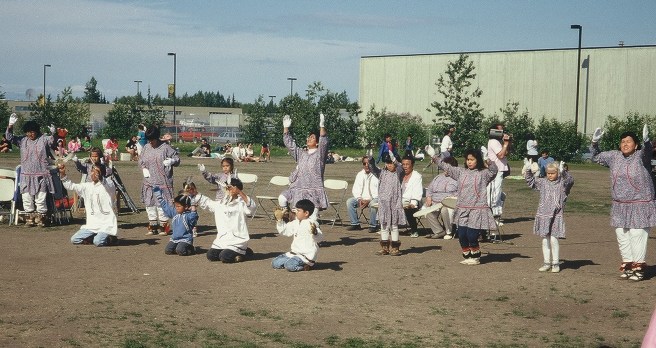
Traditional Alaska Native (Eskimo) Dancing

Bill took me to his family reunion and to several other Native potlatches – gift-giving feasts organized by indigenous peoples of the Pacific Northwest Coast of Canada and the USA. At these potlaches we enjoyed tons of tasty baked and smoked salmon, halibut, and seal meat, served up amid the splendid panorama of snow-peaked mountains with rivers rushing in spring run-off, and volcanoes rising across the inlet.

237a
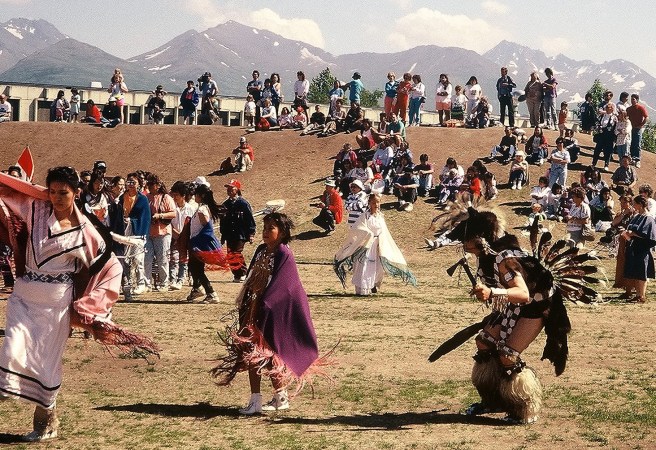
Native song and dance groups from the “Lower 48” States

Colorful Native dancers moved to the mystical beat of huge drums at the annual ‘Spirit Days’ festival in Anchorage, which brings together tribal groups in traditional costumes from throughout Alaska and from the ‘Lower 48’ States.

249a1
Russian Orthodox Church

With the rain coming down, oldies playing on the radio, I was happy as a clam in my cozy rooftop apartment overlooking Cook Inlet. Away from academia, I was thoroughly enjoying my research project on ‘real world’ contemporary health and development issues, in a cross-cultural setting and all on my own time schedule. My only worry was that I might become too engrossed in it all and miss out on enjoying this beautiful place.

248b
Russian Orthodox Church entrance reflecting the traditional church patriarchy of a bygone era

Fortunately, I am totally addicted to swimming. So my daily bike rides along the coastal trail to the University of Alaska pool were not to be missed. It was simply magical pedaling along the coast through the pine-scented forest with the late afternoon sun dazzling across the water — draining the new green of the mudflats at low tide.

But the real fun began went I started my field work in Native communities throughout the state – travelling across vast, empty stretches of land and sea to tiny, remote and often stunningly beautiful locations to meet and interview local health staff and community members for my research project.

img182 (4)b
Old Harbor, an Aleut village on Kodiak Island, Alaska

Stay tuned for ‘Back to School: Alaska (Part Two)’, coming soon!

You can read more about Jim’s backstory,  here and here.

Back to School: Hawai’i

August 1990 “A big, red sun was setting over smoggy Bangkok as the plane took off — setting as my heart is sinking – wrenching pain to again leave and say good-bye to good friends, and to once again leave a beautiful girl behind. Parting with Nit for an uncertain future – am I making another mistake? At the same time still smarting with the awful hurt of losing Jessie the year before – shattering those dreams. When will I be able to settle on someone, to finally be content, satisfied? Wishing I had taken her with me when she so wanted to go… now just fond, bittersweet memories. Really wiped out, heart-broken, so tired of it all. On to Hawai’i – back to my own country; back to school. A timely change for this fried expat. Look forward now, and enjoy the memories.”

Thailand

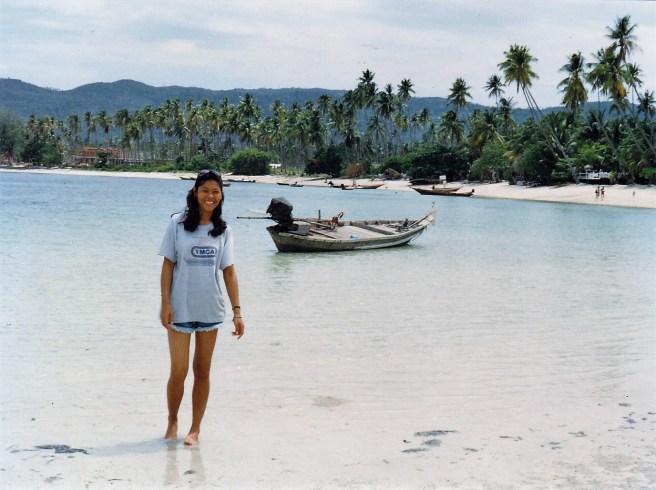
The beach was windswept, empty and stretched as far as the eye could see. A ferry was tied to the pier, but the passengers had long since disembarked. No one was in sight. Had she gone off somewhere? If so, how would she find my bungalow – she didn’t know where I was staying.

Suddenly Nit appeared from behind a sand dune, looking somewhat lost and alone. A small travel bag, black satin trousers hanging high and loose around her ankles, the wind blowing in her hair.  I felt terrible. I was late getting to the pier, and had not been there when she arrived.

026a (2)
Nit on Chawaeng Beach, Koh Samui, Thailand

Our reunion was tender, but somewhat dampened, as I was to leave for school in America the following week. Nit and I had been living together in Bangkok for nearly a year, and we had been preparing for this for some time. There were plans for her to follow me to Hawai’i, but as is so often the case, plans fall through.

We didn’t know it then, but this beach holiday was to be our last one together. One week later I would leave, and that would be the last I would ever see her. It still rips my heart apart to think about it. Distance and too much time apart spelled the end, and she eventually married someone else in Thailand late the following year.

Hawai’i

In August, I began my Master of Public Health (MPH) studies at the University of Hawai’i, School of Public Health and moved in to an apartment with three other students – one was a friend from my Samoa days. He had been a Peace Corps Volunteer when I was there with the YMCA, and invited me to join their Hawai’i household.  What a privilege it was to have the time, resources and purpose to tie together some of my ‘real world’ experiences in a comfortable academic setting, which helped make sense of it all, as articulated and validated in research and stimulating discussions.

002a
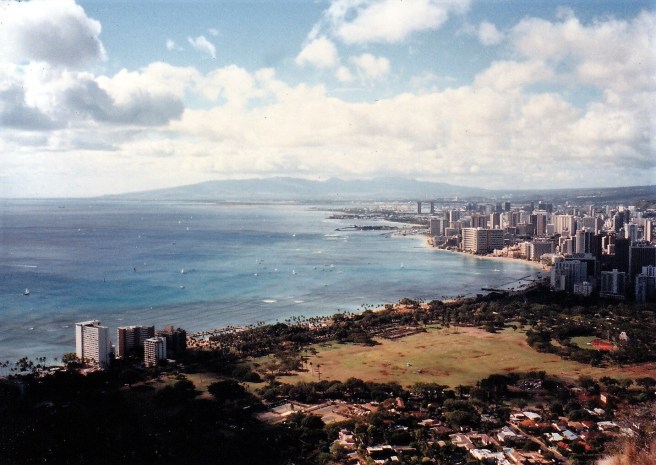
View from Diamond Head Crater State Monument, Honolulu, Hawai’i, USA

It was to be another jam-packed year of incredible highs and some intense lows – the heart-wrenching parting of friends, some wonderful reunions, and riding an incredible wave since arriving in Honolulu – turn right for the University, turn left for the beach.

Indeed, it was a significant year of transition returning to ‘civilization’ after nearly a decade living in the comfort of the outside world. But Honolulu was a beautiful, clean, modern city with a friendly, relaxed atmosphere, a perfect climate, and mostly Asian and Pacific people living in the beautiful Hawaiian Islands. I was stayin’!

IMG_20200309_172158199 (1)So it began – my tumultuous re-entry into the Western world as this ‘primitive man’ so to speak, prepared to ‘leave the trees’ – as illustrated in a typical Far Side cartoon panel showing a cave man clinging desperately to a tree at the edge of the forest as a truck stood by waiting – presumably to take him to the city.

Again, I was in for some of the highest highs and lowest lows as I entered my graduate program at University of Hawai’i School of Public Health. Not least of which was an insidious ‘reverse culture shock’ that eventually materialized, as I was faced with an American culture I could no longer relate to, nor easily return to.

I had chosen Hawaii partly because it was the only school of public health in the country that didn’t require the Graduate Records Examination (GRE) for admission, and feared I was not likely to score well after nearly 10 years away from school.

As it turned out, I received an academic scholarship from the State of Hawai’i to finish my MPH degree. And, at the bidding of several of my professors and former development colleagues, I applied to the East West Center, a federally funded research center on the university campus for a scholarship to pursue my doctorate. After all, four more years in Hawai’i sounded pretty nice, with fully funded research that would probably send me back to one of the Asian countries I had been so sorely missing.

530a
View from the Waipi’o Lookout, Big Island, Hawai’i

Actually, I had applied for an East West Center Graduate Degree Fellowship once before — for my Master’s program, but missed it by one place. Out of roughly 600 applicants each year, typically only two are chosen in Public Health – and I came third. But my professors encouraged me to re-apply for a grant to do my doctorate – which I did, and again received a rejection letter. Incredibly, my application had actually been lost and not even considered by the selection committee – and they would not meet again until the following year.

Amazingly, and at the urging of one of my professors, the committee broke protocol and reconvened to review my application – and soon after, I received my acceptance letter and continued on to complete a doctorate in Public Health – fully funded for four years, with research support in Thailand on the topic of abandoned children and HIV/AIDS.

004 (3)
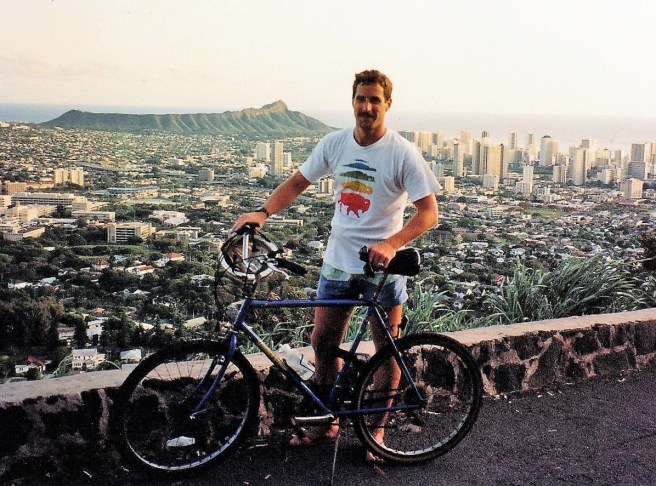
Cycling on Mount Tantalus overlooking Honolulu

On an unbelievable roll – that first year in Hawai’i was like riding a huge wave.  Absolutely loving all the fresh and stimulating activities with barely a spare moment to sit and reflect on it all. Biking to the beach for a swim each morning at 6 AM, to school for breakfast at 8:30, and then back home to collapse at 11 PM.

But all the while, missing my Thai girlfriend Nit more than ever, and still hoping she would be able to come to Hawai’i. But her commitments at home, coupled with time and distance were making that dream harder to hold on to. Nit spoke almost no English and had never traveled overseas, which made the long trip seem even more daunting.

006

Meanwhile, a steady stream of demanding academic responsibilities and social commitments at school filled my days and nights, especially after being elected School of Public Health Class Chair.

A full schedule of fun-filled but exhausting social gatherings included plenty of good food and drink, hiking, biking, swimming and barbecues on the beach — I could barely keep up with it all.

And all the while, feeling the intense impermanence of life – distant friendships, relationships, endless experiences.

But how to hang on to it all?

Stay tuned for ‘Back to School: Alaska (Part One)’, coming soon!

You can read more about Jim’s backstory,  here and here.


The ‘Expat’ Lifestyle

Author’s Note: In 1989, the Thoed Thai Highland Health Center Project implemented by Tom Dooley Heritage, an American non-governmental organization (NGO), in collaboration with the Royal Thai Government Ministry of Public Health was handed over to Government to assume full responsibility for its continued operations. The five-year Project was a successful international development partnership which provided capacity-building support (funding and training) for its gradual integration into the Thai Rural Health System. 

The experience also set the stage for my eventual entry into graduate school in Hawaii, USA — but not before accepting a one-year position with the Catholic Relief Services, another American NGO, which supported refugee relief work on the Khmer border and community health development in poor, rural communities in Thailand. 

Chiang Rai Province, Thailand

Though extremely difficult to leave, my time as Project Director at Thoed Thai Highland Health Center in northern Thailand had come to an end. The Thai Government was poised to assume full responsibility for operations of the Project, which had developed an appropriate health service delivery model for preventive and clinical health care by training and facilitating the entrance of local health workers into the Thai National Health System.

063
A hill tribe paramedic trained by the Project providing health services at the Highland Health Center

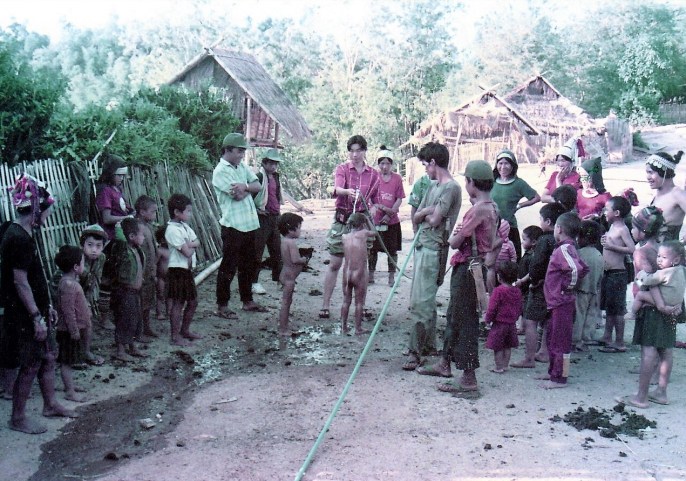
Innovative community-based health and development strategies had been successfully introduced, including gravity-fed village water systems, household gardening, community-based opium detoxification, and vector-borne disease control.

171b
Gravity-fed system bringing water to a remote mountain-top village for the first time.

A multi-ethnic cadre of village health workers trained by the Project had been established and were providing basic primary health care services in their local communities as part of the Thai Rural Health System.

061
Outpatient services at the Highland Health Center

Meanwhile, the District Immigration Officer was certain that I was CIA. After all, the area had been saturated with American CIA agents conducting opium eradication. And although I was not a medical doctor, somehow I happened to be the Director of an American health project in the area. Furthermore, I spoke and understood Thai language reasonably well and probably just looked a little too ‘military.’

In many ways, it was like running a summer camp. Nights lit by serene lamplight, a fun, youthful staff, lively parties, variety shows.  Nine languages were spoken at our health center, representing the various local ethic groups (and three Americans) that comprised our staff. But we used Thai language for general communication and staff meetings.

095 (5)
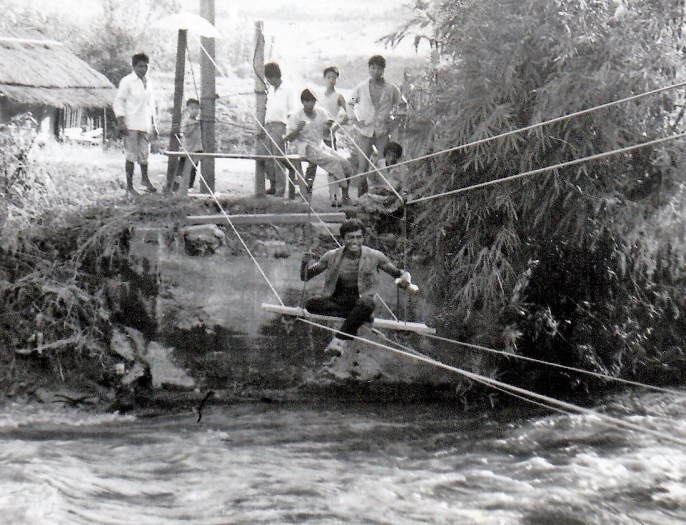
River crossing at a washed out bridge behind our hospital

Exhilarated and somewhat traumatized by the toughest and most intense work experience yet, I reflected on the many harrowing experiences, such as being pulled across a raging torrent on a swing-like board and cable where a bridge had once stood, before being washed away in the annual flooding due to widespread deforestation in the surrounding hills. Or the night a huge storm ripped through our area tearing the roofs off a dozen houses and knocking down ten others.

All was quiet following the violent storm. But there had been heavy shelling along the border all week long and insurgent fighters belonging to a rival drug warlord had reached the perimeter of our village. Wounded soldiers were arriving at a makeshift clinic across the road run by some of our health staff who were loyal to the local drug war lord, Khun Sa. 

Eighteen of us living at the health center boarded the hospital truck to evacuate down the mountain, but we decided the washed out road — at night and with numerous trees down — would be more dangerous than to chance lying low at the hospital.

015

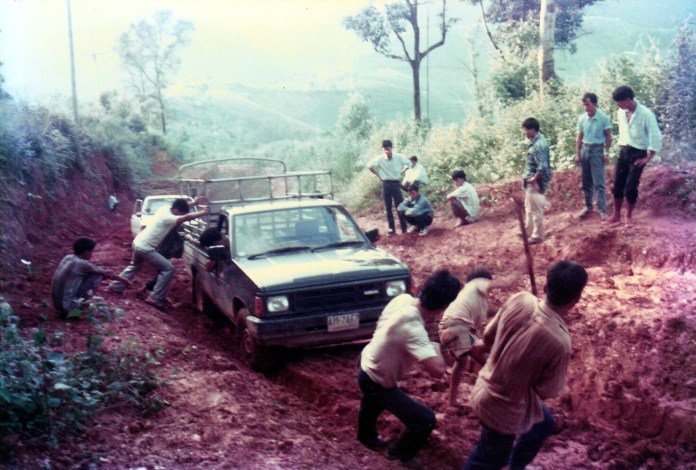
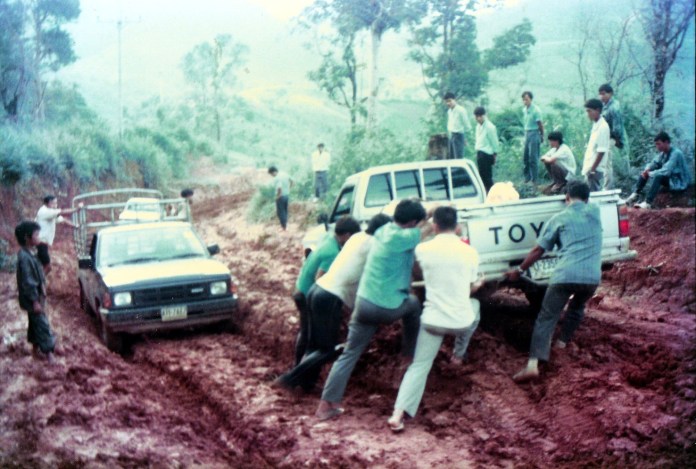
And of course, each 13 kilometer journey up our treacherously steep and slippery mountain track was an adventure in itself, hanging on for dear life with the rest of the passengers – some of them vomiting – in the back of the violently pitching pickup truck.

018

Riding with my favorite Chinese drug-running driver – we barreled wildly along the heavily rutted road past flooded rice paddies, climbing higher into the mountains that filled the horizon. Meeting other trucks head-on and lifting them out of the ruts to get past, then flying through villages as dusk settled over the hills — with a full moon on the rise — and arriving home in time for a warm beer and a plate of fried peanuts at our only restaurant.

Bangkok

In stark contrast to my 18 months in the mountains (with no electricity or running water), it didn’t take long to settle into the comfortable ‘expat lifestyle’ based in Bangkok with the Catholic Relief Services, an American NGO which supported health and development projects in Thailand and provided comprehensive primary health care services for over 30,000 Khmer refugees living in camps along the Thai-Cambodia border.

357a
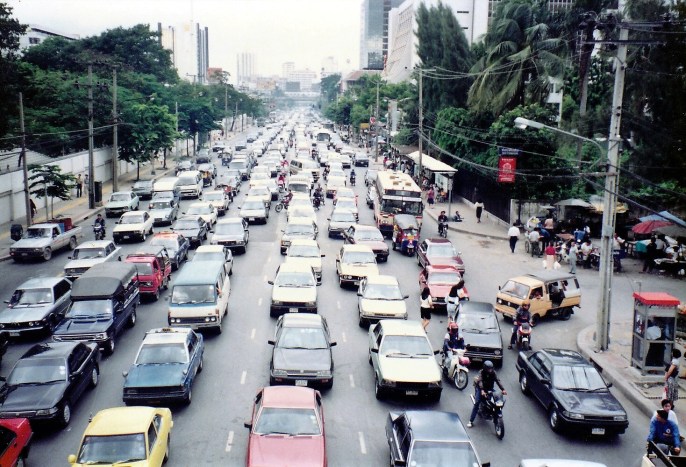
Bangkok Traffic

As Office Manager, and later as the Acting Country Representative, I controlled an annual budget of US$ five million, managed 120 employees in five offices nationwide, partnered with Government, NGOs and other international agencies, and ultimately negotiated major revisions to the CRS Country Program strategy to move from a welfare and emergency relief profile towards longer-term, sustainable social and economic development.

381 (3)
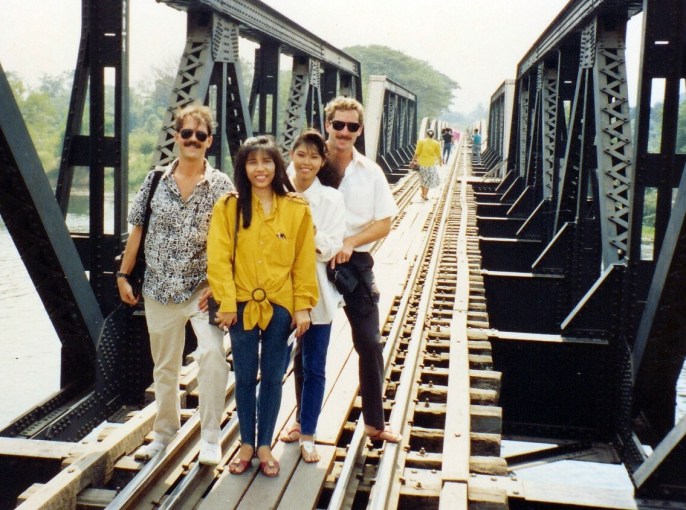
With friends on the bridge over the River Kwai

Joining friends from work, weekends in the nearby province Kanchanaburi provided a refreshing break from Bangkok’s notorious traffic snarls and choking air pollution. We stayed in floating bungalows on the River Kwai, and would cool off in the river before heading into town each night for some good food and drink.

386
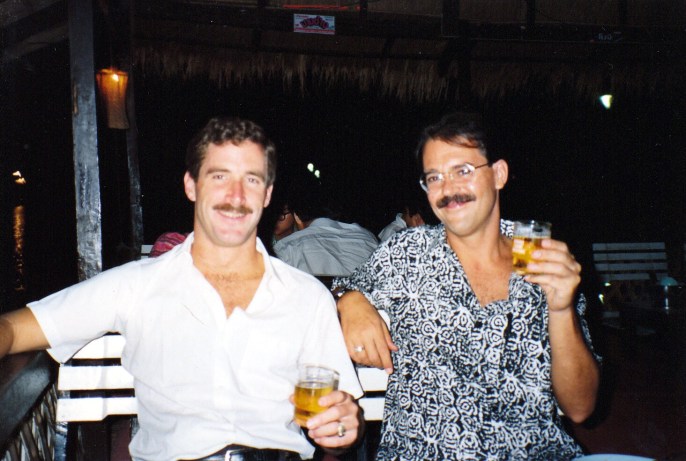
There’s nothing like a cold beer to take the edge off the heat on a warm, tropical evening 

At home in Bangkok, lazy weekends were spent lounging by the pool feasting on ripe, sweet mangoes with sticky rice and coconut cream.

508 (2)
A thousand bucks per month salary, plus flash accommodation – with a pool! I really thought I had made it!

Life was pretty easy living the high life in Thailand’s cosmopolitan capital city, with a luxury apartment and pool, an air-con office, a lovely girlfriend and a growing circle of friends all sharing the fat and happy expat lifestyle in our version of ‘The Modern Raj.’

024
Relaxing at home with my girlfriend Nittaya

A Chiang Rai Reunion

When I returned to northern Thailand the following year for a visit, the rains had begun. So I kicked off my shoes, donned my swim trunks and made my way barefoot, slipping, sliding and sweating the thirteen kilometers to Thoed Thai Highland Health Center.

049b

The mountain air was fresh and still. I felt absolutely high upon returning to Thailand’s northern frontier — unique and still mostly untouched, with the distant sound of cowbells, a few birds singing, and the full chorus of frogs and insects at night — and a cascade of emotions and memories from those exhilarating times living in the hills.

252 (2)
Reunion with some of the Highland Health Center staff

Breathing in the cool, fresh country air, I enjoyed a swim in our local spring-fed reservoir, hiked to a few nearby hill tribe villages and received a warm welcome from all.

But the wind was shifting and the time had come to set a new course. I would have to leave my friends and give up this extraordinary ‘expat lifestyle’ — after nearly a decade overseas — and return to America to begin my graduate studies in Hawaii, USA.

Stay tuned for more stories, coming soon!

You can read more about Jim’s backstory,  here and here.

Note: An expatriate (or ‘expat’) is a person temporarily or permanently residing in a country other than that of the person’s upbringing. The term is often used in the context of professionals or skilled workers sent abroad by their companies, rather than for most ‘immigrants’ or ‘migrant workers.’


Backpacker Yachties (Part Three) Sailing the High Seas on a Shoestring Budget

A lone sailing vessel anchored at Rotuma Island, Fiji Islands, South Pacific

Author’s Note: It had been a long haul since completing my doctoral studies in Public Health. Two years of fruitless job hunting — even resorting to wearing a suit and tie (and shoes) for interviews in Washington DC, New York and Boston. So when Eddie approached me to join him for a second season of sailing on the Nudge Nudge – amazingly, despite the numerous brushes with death on our maiden voyage, I agreed to join Captain Eddie and Ray – a seasoned sailor, to once again tempt fate aboard the infamous Nudge Nudge.

Season II aboard Nudge Nudge

“At last, a beautiful day of sailing, beam-reach to five knots – and another fish! Anchored in the middle of three small uninhabited islands — spectacular corals, sun-washed beaches. A northerly wind is rising, and the stars are brilliant. Ahh yes, the yachtie lifestyle!  Sometimes it works — and then there’s the rest of the time.” [Captain’s Logbook]

Nudge Nudge up on the hard in Neisau Marina, Lautoka, Viti Levu, Fiji Islands

Indeed, everyday aboard Nudge Nudge was grist for many a tale – with the endless stream of near calamities and breakdowns, patched together in true budget-yachtie fashion. Coke can slivers holding our winches in place, the leaky dinghy requiring repeated sessions with the air pump and the ridiculous hose fitted together haphazardly in bits and pieces.

A hole in the exhaust manifold that poured a stream of thick, black smoke into the cockpit, making it virtually impossible to remain there whenever the vessel was motoring. A chronically broken engine and faulty alternator – with no way to recharge our batteries.

But who needs electricity – or an engine for that matter — when your Captain is an ardent student of Polynesian Archaeology? It seemed we were destined to ply the seas as the ancients did, or at least as the early Europeans did, with our 1853 vintage British Royal Admiralty charts – attractive relics complete with coconut trees adorning the islands, but off on longitude, as we had noted on our maiden voyage the previous year.

The auto-steering setup was probably the most interesting feature. It consisted of a piece of surgical tubing tied to the tiller opposite the main sheet to balance our heading – and it worked like a charm!

Oh no!

Then there was the gaping hole that emerged in the hull when a sizable chunk of rust flaked away while scraping it. Fortunately, we were up ‘on the hard’ when that happened!

Amazing what a bit of bottom paint can do for a boat!

And we assumed that our efforts to take accurate sights with a sextant from the wildly pitching deck offered at most a challenging, if dubious backup to our GPS navigation system – until we learned that our ‘actual’ backup system wasn’t working either.

Taking a sighting with the sextant

But we were a rough and ready crew — the Backpacker Yachties.  Well-seasoned and undaunted by all the big, flash, high-tech yachts about — shouting defiantly from the bow “Hey, don’t you know who we are? We’re the smallest, slowest (and cheapest!) boat in the Pacific!“

Cruising Fiji!

It was our fifth day at sea. The winds and seas were building as the sun set over the distant island.  We were really punching it hoping to arrive in daylight, but darkness fell before we could get to a safe anchorage.

Too rough to stand off shore, with no moon, a faulty engine, and no real chart to speak of, we ventured carefully into port – poking along, hoping to avoid the few reefs outlined in our pitifully small guidebook map.

Arriving Rotuma at dusk, after five days at sea

I was at the helm. Eddie and Ray were looking out. We had a depth gauge, but these were all shelf reefs, so there would be little or no warning before any contact.  Fortunately, a brightly lit supply ship was docked there – a lone beacon guiding us in.

Looking out for reefs

Slipping silently along-side the rusty old freighter – as veritable pirates – it was past midnight, and the sleepy crew stared incredulously through the gloom as our tiny vessel appeared suddenly out of the darkness.

Sunrise in Rotuma

Waking up in the cool breeze we lounged on deck as the sunrise painted an ever-changing display of color and contour on our lovely bay. We were anchored in the most beautiful lagoon with the gorgeous island stretched out before us, just waiting to be explored.

Rotuma — tiny and isolated, lies halfway between the main islands of Fiji and the island nation of Tuvalu to the north. Rotuma was officially off limits to private yachts, but as guests of our Rotuman friends (whom we knew from Hawaii) and with the blessing of the local administrative authority, we were sliding a bit — ‘island style.’ Unknown to us however, a new, overly diligent, hot-shot government officer had just been posted there.

Busted! With instructions from the capital Suva, “Sergeant Cool” confiscated our passports. Nudge Nudge was to return to Customs and Immigration Headquarters, a five-day voyage.

Relaxing with several members of our host family

I was granted permission to fly back to the main island of Viti Levu to begin a consulting assignment there, but would be under ‘house arrest’ with our host family (which entailed plenty of eating, sleeping and swimming – and then doing it all over again) while waiting for the plane, which eventually arrived five days later.

Airborne at last, the tiny airport was filled with people waving goodbye, including our very own “Sergeant Cool” – a cordial farewell.

A hui hou! — until we meet again!

Eddie and I returned to Hawaii, and Ray sailed Nudge Nudge downwind to New Caledonia where he sold it for twice what Eddie had paid (borrowed) for it – not a bad investment. Riding one giant wave since my defense the previous year, it was getting better all the time! I printed the final version of my dissertation and submitted it to the UH Graduate Division.

Stay tuned for more stories, coming soon!

You can read more about Jim’s backstory,  here and here.

Backpacker Yachties (Part Two) Sailing the High Seas on a Shoestring Budget

Storm sailing rations: hardtack and water!

Author’s Note: Despite nearly losing our vessel ‘Nudge Nudge’ on the rocks, ‘Captain Crunch’ and his crew enjoyed a delightful five days in Niuatoputapu, the northernmost island group in the Tongan archipelago. Hiking, swimming, breakfasting in the lagoon – feasting with the islanders who prepared a delicious banquet for us.

We traded fishing gear for fresh fruits and vegetables and paid cash for finely woven pandanus leaf mats and locally grown kava – much to our hosts’ delight, as they normally must wait for up to two months to get paid. Goods are sent by ship each month to the mainland, and they receive payment only on the return trip the following month.

View from the main island of Niuatoputapu to Tafahi Island

The three main islands of Niuatoputapu are remote, beautifully unspoiled, and reached only by sea. Hoisting our orange quarantine flag, soon two young guys with long hair tied back in pony tails motored out to us in a Zodiac – the customs and immigration officials.

Pulling along-side, they greeted us and immediately suggested we bring along the booze (that they assumed we must surely have on board!) explaining that they would provide the coconut water for mixer.

Rookie government officials from the Tongan capital Nuku’alofa on their first assignment – hence, this remote posting, and they were quite keen to break the monotony over some drinks with the few yachties passing through.

Niuan woman dressed in a traditional woven leaf skirt

Traditionally a matriarchal society, the women appeared strong, smart, clearly in charge — and enterprising. Soon after we arrived, and to raise some cash, they offered to put on a traditional Tongan banquet for us for a reasonable fee. Some of the older women still wore the traditional wrap around skirts made of woven pandanus leaves, or ‘tapa’ cloth made from pounded bark, and decoratively painted.

Exploring the main island, we hiked to vantage points above the village for panoramic views across the sea to the volcano rising above the nearby island of Tafahi. Eddie was thrilled to discover several adze ‘quarries’ and other archaeological sites, indicating the early Polynesians’ migration to these islands.

Posing with our Niuan ‘girlfriends’ — a warm, fun-loving welcome from everyone

Rested and fully stocked with provisions and fresh water, we headed south for the central Tongan island group of Vava’u, a popular yachtie hangout.  But a low pressure system whipped up high winds and enormous 14-foot seas that hammered us for three days.

Hanging on and doing everything one-handed, the jib safely reefed and mainsail lowered to the tiniest patch of storm sail, we battened down the hatches and rode out the high winds and waves — punching steadily, hard into the wind for three exhausting days and nights.

Storm sailing!

It was far too rough to cook, and any kind of restful sleep was out of the question. Tossed by the winds and the sea, far from land — at least there was nothing to crash into.

But with each monstrous wave that crashed down on top of us with a resounding hollow bang, the entire boat shuddered as the hull strained to withstand the massive weight of the water dumping on us — and we wondered if the next big one would simply split us in half.

Tossed like a tiny cork in the massive, raging swells

Fortunately, the welds held, and our confidence in the integrity of our vessel actually grew as time went by. But we eventually gave up and turned downwind towards Fiji.

Located about halfway between Tonga and the main islands of Fiji, an island republic consisting of 330 islands, of which 110 are permanently inhabited, the Lau Islands have considerable Tongan (Polynesian) influence, despite being technically part of the Fijian (Melanesian) archipelago.

Navigating through the maze of Eastern Fiji’s Lau Island group, we weren’t out of danger yet – as high winds and white capped seas continued to drive us forward, surfing down the back sides of the swells.

We reached the archipelago at night, and were soon bearing down on Ngau Island. As we rounded the island, tiny lights of a coastal village twinkling through the pouring rain came into view. Tacking into the wind, following the coastline, we slowly made our way around the island.

Island-hopping through the Lau Islands, Eastern Fiji

In the darkness of the night, we could hear the sound of waves crashing on a reef nearby, but couldn’t see anything. Our charts indicated a large hook-like arm of land to get around, and this required turning further into the wind, and more tedious tacking maneuvers.

I was at the helm. Captain Eddie was below studying the charts. The surf sounded dangerously close. But Eddie insisted we continue on our present heading, and that further tacking would not be necessary to get around the protruding land mass.

Tacking into the wind and the rain

Through the rain and wind-slashed gloom, I began to make out a faint line of white foam pounding the shoreline. Suddenly, the surf break that we thought was well off our starboard bow was now dead in front of us!

We were headed directly into the center of the deadly wall of white spray – for certain disaster. At the last minute, I disobeyed the captain – and our faulty charts, turned hard to port and barely avoided the reef.

Hal had been seasick for the entire voyage, and was ready to get off the boat

Despite endless breakdowns, including two broken winches, broken toilet, broken alternator — thus, no way to generate power (no depth gauge, no lights, no radio, no batteries) we were finally approaching the main Fijian island of Viti Levu, when someone called out: “I hope we don’t need a lifeboat.” One entire side of the leaky dinghy had totally deflated!

Enjoying a tow — ours was the only dinghy around without a motor

A nasty weather system was bearing down on us, and we were being pushed perilously close to a leeward reef – and of course the engine had broken again. Club, gaff, cushions – all lost overboard. But once again we managed to survive, and were happily munching on sun-dried fish when we put the boat up ‘on the hard’ in Lautoka, Fiji for the storm season.

Stay tuned for Part Three, coming soon!

You can read more about Jim’s backstory,  here and here.

Backpacker Yachties (Part One) Sailing the High Seas on a Shoestring Budget

Author’s Note: Come join us – three rough and ready young sailors in a tiny 26-foot steel-hull yacht — for some high adventure, at times hilarious and often precarious voyaging through the South Pacific. Braving the high seas for up to ten days at a stretch between sun-drenched, castaway islands – some so remote they can only be reached by sea. Meeting the islanders and encountering exotic cultures in these unspoiled traditional societies – all on a shoestring budget. We were the Backpacker Yachties!

It was 1994. I had completed my field research on Abandoned Children and HIV/AIDS in Northern Thailand and returned to the School of Public Health, University of Hawaii in June to defend my doctoral dissertation.

At the same time, my roommate Eddie was completing his fieldwork on Pacific Island Archaeology in the Marquesas Islands, where he acquired the small, but stout sloop “Nudge Nudge” at a bargain price from a Swedish couple who had just sailed it around the world and were eager to return home.

A third friend Hal, joined us and by July we were off to the South Seas for six weeks of glorious sailing and high adventure aboard our 26-foot steel-hull vessel. Three men in a boat – and we lived to tell about it!

Captain Eddie and First Mate Jim

Ever the historian and archaeologist, Captain Eddie had photocopied a set of charts published in 1853 by the British Royal Admiralty — a beautiful historic and artistic treasure complete with decorative coconut palms drawn in at various points along the island coastlines. We were soon to find out however, that they were not accurate – and had it not been for quick thinking and a fair bit of luck, we might not have lived to tell this tale.

We were novice sailors — day sailors at best, and it was not until we were far out to sea, alone and well beyond the point of return that the precariousness of our situation became apparent. Fortunately for us, the boat was made of steel, as Eddie noted enthusiastically: “a steel hull is safer than fiberglass because we can hit a reef and not sink!”

Keeping an eye on the wind

Hal and I flew from Hawaii to Pago Pago, American Samoa, where we met Eddie who had sailed Nudge Nudge from French Polynesia to Samoa. From Pago, our first destination was Niuatoputapu, the northern-most island group of The Kingdom of Tonga, a Polynesian island state and archipelago comprised of 169 islands, of which 36 are inhabited.

The Niuas can only be reached by sea, and therefore have little contact with the outside world. Unspoiled and fascinating in many ways, not least is an enduring matriarchal tradition, and well-preserved archaeological sites with stone adzes and Polynesian Pita pottery in evidence.

Undaunted and eager to escape the damp, stifling heat of Pago Pago, we motored out to sea in the setting sun. Becalmed, we languished ‘in irons’ for the first 24 hours – retching, spewing over the side in the blazing heat and relentless bobbing of the doldrums. But happy to be at sea, even if we were travelling on “Captain Ralph’s Ocean Tours and Fish Feeding Adventures.

The Samoas disappeared over the horizon as light westerly airs finally brought us out of the doldrums and eventually gave way to the easterly trades, building to heavy seas and squalls. Thrilling sailing for novices — heading 180 degrees south, steady by the Southern Cross and Alfa-Beta Centauri. Heeled over and racing for Niua!

Catch of the day! Harnessed and clipped in whenever on deck to avoid falling overboard

It was an easy heading, keeping the mast between the twin stars of Alfa and Beta Centauri. Trailing fishing lines, fresh Mahi Mahi and Barracuda provided a steady supply of sashimi, fish soup and sun-dried jerky – as well as some exciting moments in our tiny cockpit. One spirited 50 pound Mahi managed to break the companionway door off!

On our fifth night at sea, the distant outline of Niua’s main volcano loomed suddenly through the mist. Darkness fell as we drew closer to the island. The moon had risen, turning the waves to silver. It was too dark to make out the island. But it was there – a mysterious presence as we followed the shadowy coastline. The winds died down to a gentle breeze, lightly filling the sails as we rounded into the lee of the island.

Land, ho!

I was at the helm. Eddie was below checking the Global Positioning System (GPS) and studying the charts, which indicated that we were sailing safely in deep waters. Hal was nowhere to be seen – he had been suffering badly with sea sickness and had disappeared into his berth, unable to move.

Bam! Suddenly with an awful scraping, we were over on our side in the shallows, surrounded by coral heads – crunching, pounding on the rocks with every swell. British Royal Admiralty Charts 1853 — seems our longitude was a bit off! We should have followed the whale. All the while he was singing to us through the hull and then turned towards the open sea — which would have led us safely away from the reef.

Scrambling over the wildly pitching decks, we shined our flashlights frantically into the gloom. Eddie began cranking our temperamental engine furiously and managed to fire it up. Incredibly, a snagged fishing line astern marked the narrow channel we had entered, enabling us to back out the way we came, through a maze of coral heads.

Hal at dawn — recovering from our harrowing scrape along the reef

As we drifted under the stars, badly shaken up, but patiently motoring back and forth along a safe line of sail until daylight, somewhere in the darkness a distant roar of breakers crashing on a reef kept us on our toes – now that we couldn’t trust our charts! But we were getting used to life aboard our ‘tin can’ and soon turned our attention to the mysterious land mass in front of us, and looked forward to exploring the island in the morning.

Stay tuned for Part Two, coming soon!
You can read more about Jim’s backstory,  here and here.

See the World with the YMCA

Author’s Note: Over the past 35 years, I have had the privilege of living and working in some of the poorest, most remote and underserved parts of the Asia-Pacific region and in the United States. My work involves assisting governments, international aid agencies and local communities to strengthen their systems for managing communicable diseases (including HIV/AIDS), women and child health, and youth leadership.

This presentation given at Snow Mountain Ranch YMCA of the Rockies in Colorado, USA covers roughly three decades of personal international development experience throughout the Asia-Pacific region, starting with the YMCA and continuing on with other development aid agencies. And this all began for me as an overseas volunteer with the YMCA! 

The YMCA (Young Men’s Christian Association) or “The Y” is one of the oldest and largest movements for youth in the world. Founded in 1844, the YMCA now reaches 58 million people in 120 countries, and works to bring social justice, empowerment and peace to young people and their communities regardless of religion, race, gender or culture.

Responding to priority needs and issues affecting young people and their communities, with a focus on key areas of health, employment, civic involvement and environment, YMCAs operate in a wide range of program areas including: agriculture, education and vocational training, sustainable development, gender equality, climate change, health and HIV/AIDS prevention, inter-faith dialogue, food security, leadership development, human rights education, migration, civic engagement, emergency response and peace building.

While each YMCA is autonomous, with its own Board of Directors responding to local needs, the common mission and focus of the YMCA movement worldwide is to develop the whole person — as depicted in the red triangle promoting a healthy spirit, mind and body.  Thus the individual is not merely a separate body and a mind and a spirit, but a wonderful result of their union, something entirely different than any single aspect of the self. Thus, one’s overall character is of greater value than simply the intellect or physical excellence.

I first learned about YMCA overseas volunteer opportunities when I was a college student working a summer job at Silver Bay YMCA on Lake George, New York. After graduating in 1982, I was soon off to Sri Lanka for a six-week summer internship – that turned into six months — leading outdoor recreation and life skills programs for disadvantaged youth.

After Sri Lanka, I was hooked on the thrill of international living. For the next eight years I worked with local and national YMCAs and other non-governmental organizations (including the Thai Red Cross Society, Tom Dooley Heritage Inc. and the Catholic Relief Services) in fifteen developing countries throughout the Asia-Pacific region.

Eventually, I returned to school for specialized training in public health, and joined organizations such as UNICEF and the International Rescue Committee, and have worked as an independent contractor on health and development projects funded by institutions such as UNAIDS, the Asian Development Bank (ADB), the Association of Southeast Asian Nations (ASEAN) and the Global Fund to Fight AIDS, Tuberculosis and Malaria (GFATM).

The lure of continued fun, adventure, personal growth and meaningful service as a humanitarian aid worker has taken me to over 20 developing countries throughout the Asia-Pacific region. Except for six years of graduate studies in Hawaii where I completed my Master’s and Doctoral degrees in Public Health, I have been overseas ever since.

This photo presentation is an overview of my international work experiences, starting with the YMCA and continuing on with other humanitarian aid agencies in countries including: Sri Lanka, Samoa, Fiji, Indonesia, Thailand, Cambodia, Philippines, Korea and Vietnam.

I also enjoy volunteering seasonally at YMCA family retreat and conference centers in the USA and traveling on a shoestring budget to exotic destinations throughout the world. I currently live in a quiet seaside island setting in southern Thailand.

Stay tuned for more stories – coming soon!

You can read more about Jim’s backstory,  here and here.

Complete Wellness: Ileostomate enjoys and shares the benefits of yoga for all abilities

Sivananda Advanced Yoga Teacher Training Course January 2018, Nassau, Bahamas

Author’s Note: Jim Mielke has been studying and practicing yoga and mindfulness meditation for the past 25 years. He received his Teacher of Yoga certification in 2003 from the International Sivananda Yoga and Vedanta Forest Academy in Netala, Himalayas, India. Jim recently completed his Advanced Yoga Teacher Training Course (500-hour Yoga Alliance Certification) at the Sivananda Bahamas Ashram.

Jim has also completed intensive meditation training courses in Thailand and India and is well grounded in Buddhist Meditation and Raja Yoga traditions. His instructional style encourages individual expression, spiritual or secular, and is tailored to all levels of ability and experience. Over the past 15 years, Jim has taught yoga and meditation in health clubs and schools in Thailand, Vietnam and in YMCA Conference and Family Retreat Centers in the United States. Jim currently resides in a quiet seaside setting in the south of Thailand, and has been living a full and active life with an ileostomy for over 40 years.

Originally published in The Phoenix ostomy magazine – www.phoenixuoaa.org

By Jim Mielke

Over the past 35 years, I have had the distinct privilege of living and working as a public health professional in some of the poorest, most remote and underserved parts of the Asia-Pacific region and in the U.S. My work involves assisting governments, international aid agencies and local communities to strengthen their systems managing communicable diseases (including HIV/AIDS), women and child health and youth leadership.

Volunteering Overseas

Starting out as an overseas volunteer for the YMCA and other non-governmental organizations, I eventually returned to school for specialized training in public health. I then proceeded to join organizations such as UNICEF and the International Rescue Committee, and have also worked as an independent contractor on public and private sector health projects funded by institutions such as the Asian Development Bank (ADB), the Association of Southeast Asian Nations (ASEAN) and the Global Fund to Fight AIDS, Tuberculosis and Malaria (GFATM). In addition to having worked in over 20 developing countries, I also enjoy traveling to exotic destinations and currently live in a quiet seaside setting in Thailand.

I also happen to have an ileostomy, which has served me well for over 40 years. After suffering years of pain and misery with Crohn’s disease as a teenager, I received my first ileostomy in 1977. Before long, my life took off like a rocket with my newly recovered health. I can still recall feeling like a new man almost immediately upon waking up with my ileostomy – suddenly free from nearly a decade of suffering with inflammatory bowel disease.

However, for the next three years I was in and out of several hospitals for 11 major ostomy-related surgeries, including total removal of the large intestine and rectum. Withdrawing from the addictive medications prescribed to me over the years that seemed only to treat the symptoms was also a struggle.

In 1980, I re-entered university in Colorado, having been forced to withdraw earlier for health reasons. I heard about overseas volunteer opportunities with the YMCA while working summers at Silver Bay YMCA of the Adirondacks in New York. Soon after graduating in 1982, I was off to Sri Lanka for a 6-month internship as a YMCA volunteer leading outdoor recreation and life skills programs for disadvantaged youth.

For the next 8 years I worked with volunteer aid organizations in developing countries throughout Asia and the Pacific before returning to school to complete my doctorate in public health, and then began consulting on high-level (and typically high stress) United Nations and government health projects.

Jim with a colleague during a health team visit to an Akha Hill Tribe village in Northern Thailand
Jim administering immunizations in rural Thailand
Jim at a wedding party in an Akha Hill Tribe village

Rest and Recovery

One of the benefits of working as a private consultant is the freedom to take long stretches of time off between jobs. So in 2001, after several particularly high-pressure assignments in Cambodia and Vietnam, I moved to a beautiful, unspoiled island off the southwest coast of Vietnam where I rented a beach bungalow for $100/month. Two years of personal development and self-study – including daily yoga and meditation – followed. I also enjoyed plenty of inspirational reading on Eastern philosophy, spirituality and mysticism, as well as swimming, biking, eating well, and generally looking after my health and well-being. It was a wonderfully refreshing and revitalizing experience.

Each morning, shapely, leotard-clad women filed out of my bungalow. With such a curious sight, my neighbors could only guess about my nocturnal activities. In fact, the women were joining my early morning yoga practice before they went to work. Although I had taken some yoga classes over the years and enjoyed sharing what I knew with my friends, I needed some formal training in order to teach yoga properly and safely.

Yoga Training in India

In 2003, I took the leap and traveled to northern India for a four-week yoga teacher trainers’ course at a remote ashram on the banks of the Ganges where it rushes through the dramatic Himalayan countryside. The training honed my teaching skills while profoundly impacting my personal yoga practice, and my very way of life. Recently, at Sivananda Bahamas Ashram, I completed the advanced teacher trainers’ course, over four weeks of intensive yoga practice and the study of Vedanta philosophy.

When I applied for both training courses, I explained about my ostomy and specific physical and dietary requirements. For example, I really love vegetarian food and it makes me feel great — clean, light and with excellent digestion as well. But I have difficulty assimilating sufficient protein over a long period of time. So in India, they gave me extra yogurt for more protein. In the Bahamas, I brought my own protein supplement, which worked well. I also purchased travelers’ insurance and brought plenty of pouch changes and medications that I might need while away from home.

From the start, I was open about my ostomy. And although I was probably the first ostomate they had trained to be a yoga teacher, my teachers and fellow trainees were totally accepting and supportive of my physical situation and limitations. I was given alternative postures whenever the class was practicing advanced poses that I could not do. One trainee was an older woman who needed to use a chair for certain postures — and this was also perfectly acceptable.

At one point, when the class was enjoying a few laughs while learning yogic ‘bandas’ or ‘locks’ — some of which require contracting the anal sphincter muscle while holding the breath to maximize the prana (life force) generated by advanced breathing exercises, I shared (for more laughter), that due to my surgeries, I was missing a few parts and may not be able to experience this in the same way.

Complete Personal Development

Originating in India many thousands of years ago, yoga is oldest system of personal development in the world, encompassing a balance of physical, mental, and emotional health. It combines all the movements needed for physical health. with breathing exercises that calm, revitalize and refresh the body. Meditation techniques ensure mental power and peace of mind. Anyone can practice yoga regardless of age, condition or religion. Yoga is not a competitive sport, so you can practice at your own pace with no pressure and no comparison.

                  “Anyone can practice yoga regardless of age, condition or                                         religion. Yoga is not a competitive sport, so you can practice                         at your own pace with no pressure and no comparison.”

The underlying purpose of yoga is to realize your ‘unity’ with all of existence. The word yoga literally means ‘union’ or ‘joining’. In time, if you continue with regular practice, you will become aware of a subtle change in your approach to life. Through persistently toning and relaxing the body, and stilling the mind, you begin to feel a state of inner peace which is your true nature.

Yoga is not a theory, but a practical way of life. It is not just about headstands or twisting oneself into extreme physical contortions, nor is it just for ‘spiritual’ people. In fact, if you are practicing to show off or otherwise boost your ego – you are missing the point. Through asana practice, you can tone and relax the body, with pranayama (yogic breathing) you can control your emotions, and through meditation, you can come to a deeper understanding of who you really are.

Yoga for Ostomates

There are literally thousands of yogic postures and variations to choose from and modify as needed to suit any physical condition or limitation.  For example, I can no longer do headstands due to multiple surgeries that have weakened my abdominal muscles. I can still safely do shoulder-stands and the standing ‘hands-to-feet’ pose for similar benefits.

The same goes for teaching. When I cannot demonstrate a particular asana (pose), I simply ask one of my students to demonstrate, and otherwise I give verbal instructions and assist where needed. Anyone who has undergone surgery should consult his or her surgeon for advice regarding physical activities including yoga.

I really love turning people of all ages on to classical yoga and meditation. But to understand the essence of yoga – as a practical, meditative path towards self-realization — you need to experience it for yourself. So put yoga into practice, and you will see the benefits. And when you are ready for some real fulfillment, become a yoga teacher and share the magic!

Stay tuned for more stories – coming soon!

You can read more about Jim’s backstory,  here and here.