Book Three – Finished!

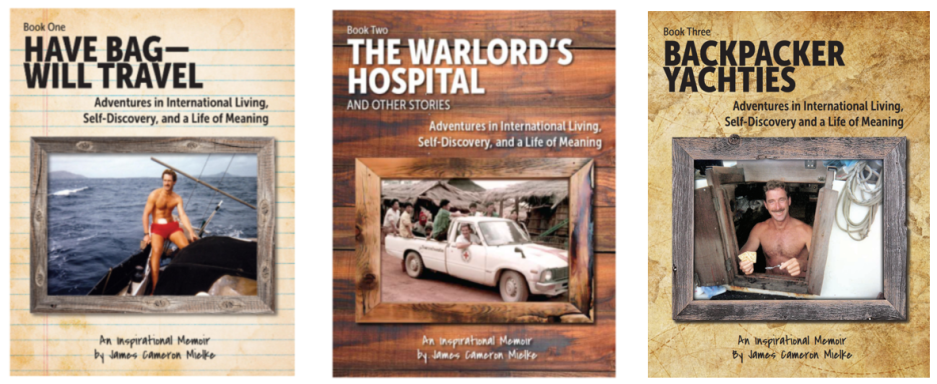
From the shores of academia to the vast expanse of the Pacific, Backpacker Yachties and Other Stories is the latest compelling installment in the series Adventures in International Living, Self-Discovery, and a Life of Meaning. This third book invites readers on an unforgettable journey that blends thrilling maritime adventure with deeply human introspection.

Many young people are eager for an overseas experience, and are searching for direction, but for various reasons, never get there. In a world of increasing global interdependence, the lasting benefits of international travel and cross-cultural service experiences are truly priceless.  

In book one, Jim learned about YMCA overseas volunteer opportunities when he was a college student working a summer job at Silver Bay YMCA on Lake George, New York. After graduating in 1982, he was soon off to Sri Lanka for a six-week internship with the Colombo YMCA, where he led outdoor recreation and life skills programs for disadvantaged youth. He ended up staying for six months.  

After Sri Lanka, and his subsequent postings with the YMCAs in Western Samoa and Fiji Islands, Jim was hooked on the thrill of international living. For the next eight years, he worked with voluntary organizations in developing countries throughout the Asia-Pacific region.  
In Book Two, the stories continue in the remote, lawless mountains along the Thai/Burma border where Jim is running a small, isolated hospital without electricity or running water. The hospital had been built by an opium warlord for his breakaway revolutionary army, and was staffed with undocumented workers from nine ethnic groups, each speaking a different language.  

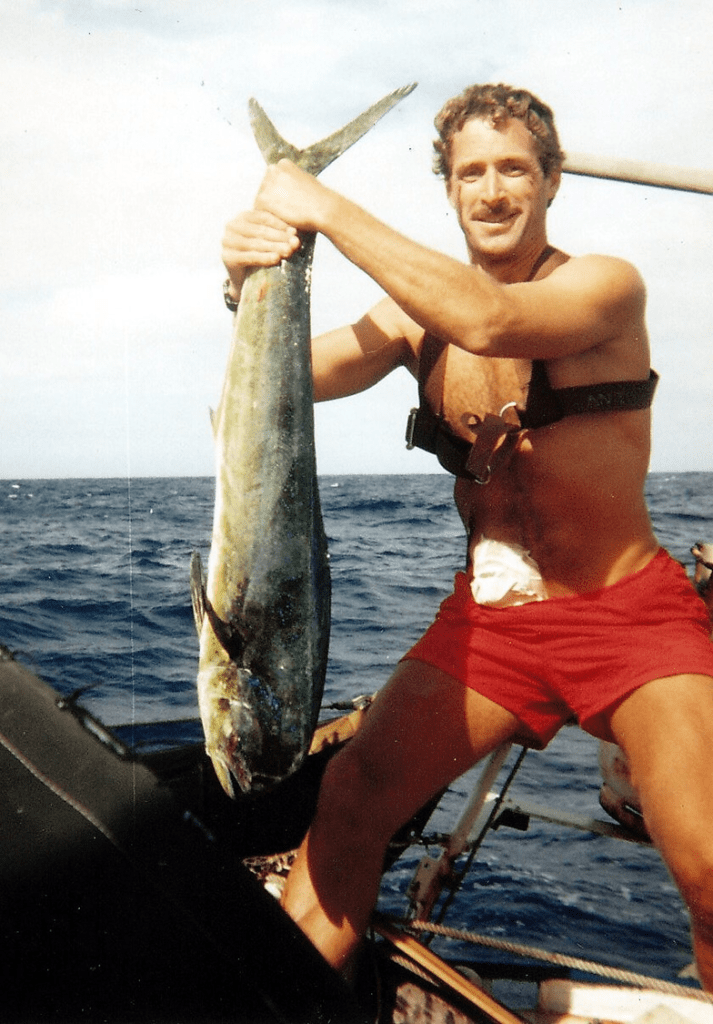
Sailing the high seas of the Pacific on a shoestring budget Moving forward and written with lyrical prose and unflinching honesty, Backpacker Yachties and  Other Stories follows Jim, at the time a young man on the cusp of finishing his PhD, weary from years of transience and heartbreak. Longing for a stable life, he’s unexpectedly pulled back into the allure of adventure when his friend Eddie returns from a harrowing voyage and proposes a bold expedition across the South Pacific.

Joined by Hal—a kind-hearted but inexperienced sailor just released from prison—the trio embarks on a journey that tests their resilience, friendships, and inner strength. As Jim navigates open waters, both literal and emotional, he finds himself confronting old wounds, new love, and the enduring search for purpose.
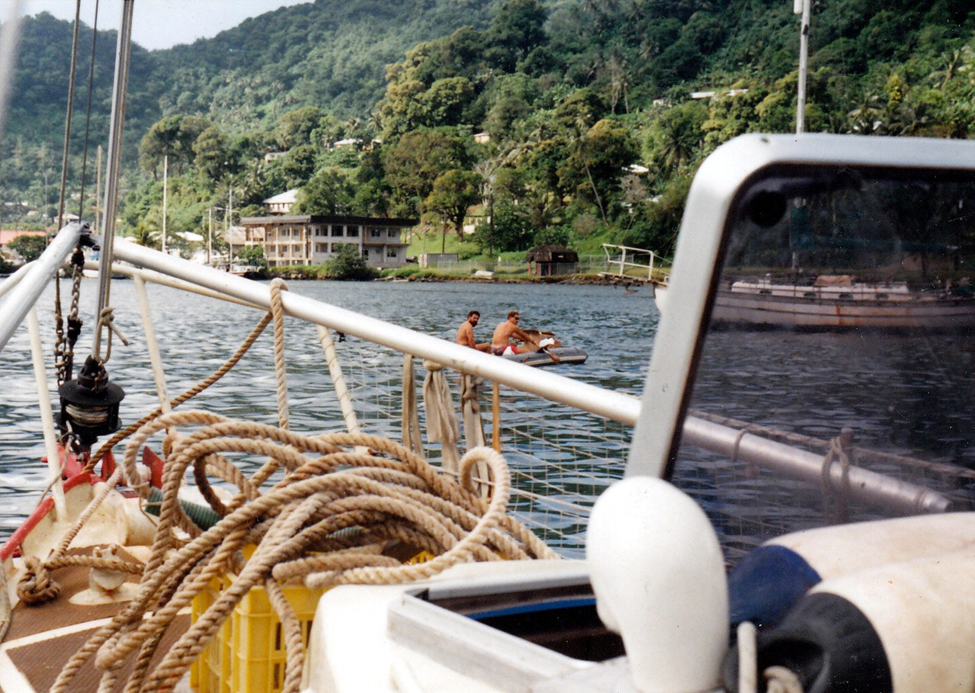
Spanning over a decade of international travel, humanitarian work, friendships, breakaway trips, and the quiet revelations that come with solitude, Jim’s story is as much about the world as it is about the soul. It is a testament to the power of embracing uncertainty and to the richness of life’s fleeting, often unplanned moments.

Why This Book Matters

Backpacker Yachties and Other Stories ignites the adventurous spirit—especially among young people—encouraging them to step beyond national borders, mainstream tourist traps, material comforts, and conventional career paths. For those in search of deeper meaning, it offers the possibility of finding it much earlier in life, before decades are lost to routine.

It will resonate with anyone who has ever longed to travel or live abroad. Jim’s journey proves that fulfillment and discovery are accessible to anyone, regardless of background or budget, through curiosity, courage, and a willingness to engage with the world authentically.

This is also a story of giving back. Jim’s international humanitarian work is a powerful reminder that expanding one’s world through service often leads to the most profound personal growth.

Perhaps most inspiring is Jim’s resilience. As we learned in book one, Jim receiving an ileostomy was a turning point that restored his health and freedom. His story is a reminder that what feels like the end may just be the beginning. With humor, heart, and humility, Jim shows how embracing change and adapting with positivity can open new doors—and new adventures.
Backpacker Yachties and Other Stories is available now internationally at Amazon.

James Cameron Mielke (Jim) is originally from Buffalo, New York, and grew up as a pastor’s son. At age 19 he was fitted with an external pouch, following years of pain, depression and suffering with Crohn’s disease. The pain and misery were gone. Almost immediately after receiving the ‘bag,’ he felt strong and exhilarated and was catapulted into a whole new energized life. For the first time in years, he was free to enjoy all that life offers and that freedom continues now, 45 years later. 

Over the years, Jim has spoken to college students, members of voluntary organizations and other interested groups about world service work and other options for international experiences – just as someone spoke to him 45 years ago, when he was a summer employee at the YMCA.  

Jim has lived and worked in over 20 countries of the Asia-Pacific region. In that time, he completed his Master’s and Doctoral degrees in Public Health at the University of Hawaii. This was funded by a State of Hawaii academic award and a US Government grant administered by the East-West Center research institute in Honolulu, whose mission is to “promote better relations and understanding among the people and nations of the United States, Asia, and the Pacific through cooperative study, research, and dialogue.

The Warlord’s Hospital and Other Stories

Adventures in International Living, Self-Discovery, and a Life of Meaning 

An Inspirational Memoir by James Cameron Mielke 

Author’s Note: In June 1988, I joined an American non-governmental organization (NGO) and the Royal Thai Government Ministry of Public Health to manage a cooperative health and development project. The purpose was to provide comprehensive health services to highland residents of a remote, underserved region in the extreme north of Thailand along the Burmese border. Innovative community-based health and development strategies such as gravity-fed village water systems, household gardening, vector-borne disease control and opium detoxification were also introduced.

The experience set the stage for my eventual entry into graduate school in Hawaii, USA — but not before accepting a one-year position with the Catholic Relief Services, another American NGO, which supported refugee relief work on the Khmer border and community health development in poor, rural communities in Thailand. 

Can you imagine running a small, isolated field hospital without electricity or running water in the remote, lawless mountains along the Thai-Burma border?

What if it was built by an opium warlord for his breakaway revolutionary army, and staffed with undocumented workers from nine ethnic groups, each speaking a different language?

And what if you had to transport medicine and patients by horseback to and from the nearest town and referral hospital when the one and only road gets washed away each rainy season? What if you had to lie low at the hospital while the local drug warlords fling mortars at each other in their fight over the narcotics trafficking route that ran through our village?

“While carrying out the body of one of our patients who died of Malaria — it came as a stark realization that providing rural health care with no electricity or running water was going to be a bit different from my earlier YMCA experiences!”

Book Two takes us from Thailand’s rugged and lawless northern frontier, before transporting us to the modern, glitzy capital city of Bangkok and the contrasting cushy and enjoyable urban ‘expat’ lifestyle. I was responsible for overseeing improvement of rural healthcare in Thailand, and for Khmer refugees living in camps along the Thai-Cambodian border who were fleeing the horrors of genocide.

"A lady died tonight in the IPD – cerebral malaria (as I scratch yet another mosquito welt)… Three hunters were brought in – gored badly by a wild boar. Miraculously they survived – later presenting us with a thick slab of the meat. A couple stabbed each other. The man was stable, but with just lantern light to work by, our MD could not stop the wife’s bleeding – her life literally draining out before our eyes. We had to convince a local truck driver she would not die on the way down the mountain (if so, he believes his truck will be cursed). Our medics held the artery through the night down the rough mountain track to the lowland hospital – and she survived… A family walked for days from somewhere inside Burma to reach us – two kids died on the way, the third one died soon after arriving… Two men were shot – one died in the ER because no one would drive them to the district hospital in the lowland – afraid of ambush… Heavy shelling here all last week – but all quiet now."
"A great week helping villagers build a water system – hacking through the bush to lay the pipeline, pouring two cement tanks for water storage. Fantastic to see this giant change in their lives – bathing right in the village – the kids are loving it!… The one bridge that doesn’t get washed away each rainy season was built by local drug barons – to ensure a steady flow of heroin down the mountain. The struggle continues – people here make the most of the situation, but the bottom line is that they are not free – without citizenship, they could be forced from their homes at any moment – while seeking to combat their poverty, legal and otherwise – so it goes on…"

Eventually, we return to Hawaii, where I pursue my graduate studies in Public Health, which included field research on the impact of State and National policies on Alaska Native health.  With Federal Government funding awarded through the East West Center in Honolulu, I continue on to earn my doctorate in Community Health Development from the University of Hawaii.

Returning to Thailand, my initial research on HIV/AIDS in Bangkok’s largest slum helped refine the focus of my doctoral research. At that time, Thailand was experiencing one of the most devastating and rapidly spreading HIV/AIDS epidemics in the world. During this time a mysterious and dramatic rise in child abandonment was threatening to overwhelm the social welfare services in northern Thailand. My independent investigation assessed the magnitude and nature of problems within a context of rapid social change and proposed options for prevention and community-based management of abandoned children. The findings were published in a major collaborative study to assist national and regional planning and policy development.

Join me for another epic journey spanning nearly a decade of personal growth and professional contributions to international health and development. Tag along for low-cost leisure travel and more exotic adventures in Thailand, Vietnam, Sri Lanka and the Maldives before returning to Hawaii. Meet the rare mix of people along the way, and learn about the steps taken to achieve these goals and aspirations. Discover the deeper meaning and potential derived from overseas cross-cultural experiences and perspectives – as a humanitarian aid worker!

“The Warlord’s Hospital and Other Stories” is my second book in the “Adventures in International Living” series. Drawing on 45 years of personal journal entries, the series chronicles some of my experiences living and working in developing countries throughout the Asia-Pacific region.

Available for download at Amazon’s e-book marketplace, here! Please feel free to contact me on Facebook, comment on Amazon, or to email me at jim_mielke@hotmail.com.  

Make sure to check out the book! I can’t wait to hear what you think!

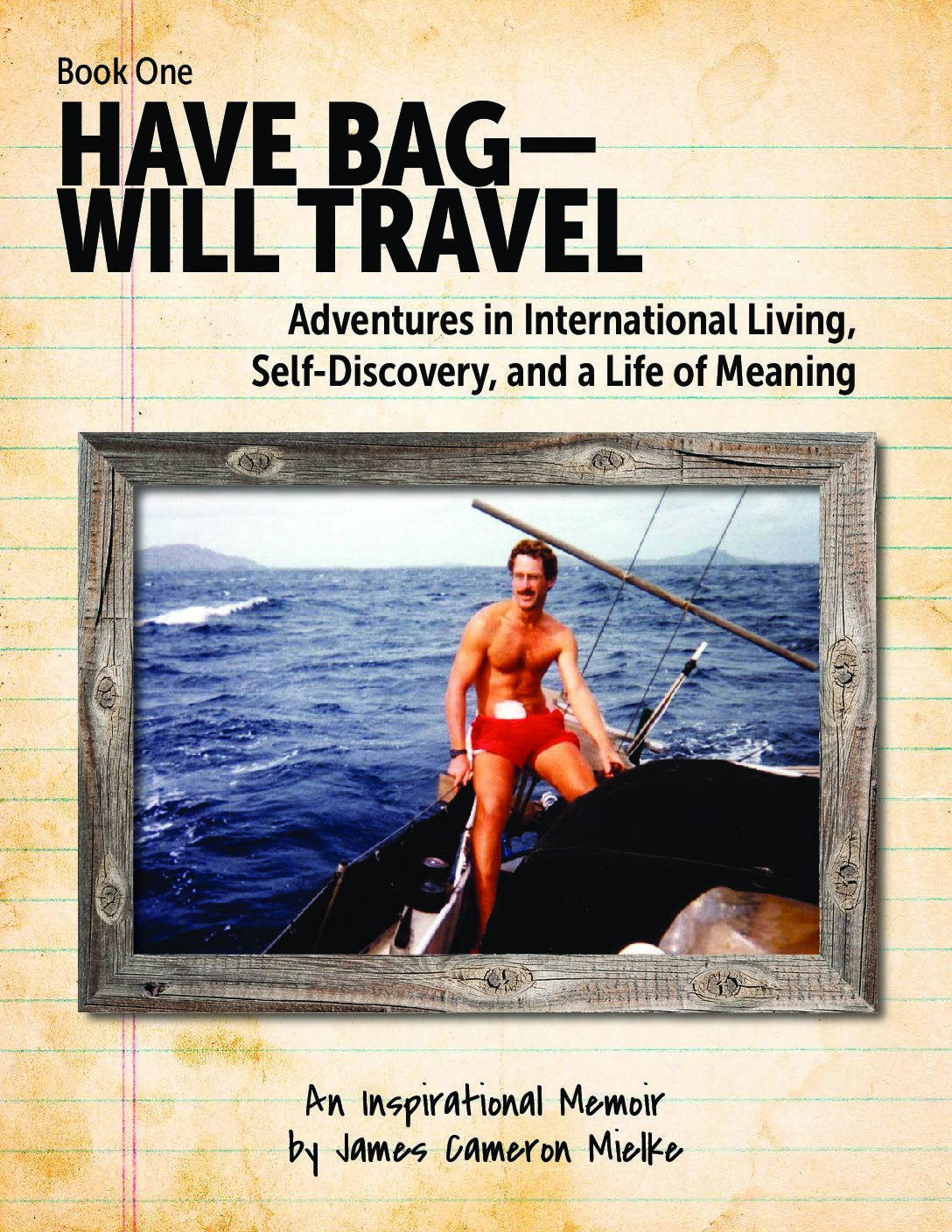
Book Release: Have Bag – Will Travel

FOR IMMEDIATE RELEASE 
SUMMER 2021 

Contact: 
James Cameron Mielke 
jim_mielke@hotmail.com 

NEW BOOK SHARES INSPIRATIONAL STORY OF OVERCOMING HEALTH OBSTACLES AND FINDING NEW LIFE THROUGH ADVENTURE, WORLD SERVICE, AND INTERNATIONAL LIVING. 

Have Bag – Will Travel” is a compelling memoir detailing international living, self-discovery, and adventure, and is available for immediate release on Amazon’s e-book marketplace. A coming-of-age story, young James spends his days ill at ease with American life and is at the mercy of an at-times grueling digestive disorder. At the age of 19, James received an ileostomy, and life after recovery felt as thrilling as being shot from a cannon.

This exhilarating tale presents vivid descriptions of exotic far-off lands, unique and meaningful international work experiences, the growth of goals and aspirations, and a rare mix of people along the way. Packed with pithy narratives of overseas adventures, the thrills, humor, and heartaches, some romance, and stunningly beautiful natural scenes – these stories give some glimpses into an evolving insight of a young man moving through the seasons of his life.

Many young people are eager for an overseas experience, and are searching for direction, but for various reasons, never get there. In a world of increasing global interdependence, the lasting benefits of international travel and cross-cultural service experiences are truly priceless.   

James first learned about YMCA overseas volunteer opportunities when he was a college student working a summer job at Silver Bay YMCA on Lake George, New York. After graduating in 1982, he was soon off to Sri Lanka for a six-week internship with the Colombo YMCA, where he led outdoor recreation and life skills programs for disadvantaged youth. He ended up staying for six months. 

After Sri Lanka, James was hooked on the thrill of international living. For the next eight years, he worked with voluntary organizations in developing countries throughout the Asia-Pacific region. In general, nothing was planned — there was no grand strategy, no burning ambition, no life-long dream or goal to achieve, only a keen desire to continue living this incredibly fulfilling lifestyle out in the world.

That was about 40 years ago, and the lure of continued fun, adventure, personal growth, and meaningful work as a humanitarian aid worker has taken James to over 20 developing countries throughout the Asia-Pacific region. Except for six years of graduate studies in Hawaii, where he completed Master’s and Doctoral degrees in Public Health, he has been overseas ever since. 

Have Bag – Will Travel” is the first book in the “Adventures in International Living” series. Drawing on over 45 years of personal journal entries, the series chronicles some of his experiences living and working in developing countries throughout the Asia-Pacific region, as well as low-cost adventure travel to exotic destinations on every continent except Antarctica.  

10% of proceeds from book purchases will be donated to charitable organizations in the developing world.   

THIS BOOK IS IMPORTANT BECAUSE: 

It will stoke the fires of adventure, especially among young people – It will inspire and encourage those seeking something beyond their national borders, beyond the mainstream tourist destinations, superficial material lifestyles and empty career paths. The discovery early in life of the deeper meaning and potential derived from international and cross-cultural perspectives might even save 30 years of meaningless work later.   

It will resonate with anyone who has desired to travel and live overseas – the stories demonstrate how anyone can experience genuine fulfillment and self-discovery through different, freer ways of living, no matter what your budget.  

It reveals that you grow when you give back – Giving back to the world in return for all that has been given, and expanding one’s horizons through travel, leads to immense personal growth.  

It demonstrates perseverance with a positive mindset – After years of suffering with Inflammatory Bowel Disease, receiving an ileostomy was the best thing that happened to James. It gave him back his health, his freedom – and 45 years on, life keeps getting better all the time.  This story encourages readers to be accepting, flexible and to learn to roll with the flow. Bumped off the track? The next adventure is about to begin! Find the silver lining that transforms negatives into positives, and new doors open. 

About the Author

https://cms-internationsgmbh.netdna-ssl.com/cdn/image/article/public/pioneering-story-finalists_Jim.jpg

James Cameron Mielke is originally from Buffalo, New York, and grew up as a pastor’s son. At age 19 he was fitted with an external pouch, following years of pain, depression and suffering with Crohn’s disease. The pain and misery were gone. Almost immediately after receiving the ‘bag,’ he felt strong and exhilarated and was catapulted into a whole new energized life. For the first time in years, he was free to enjoy all that life offers and that freedom continues now, 45 years later.  

Over the years, James has spoken to college students, members of voluntary organizations and other interested groups about world service work and other options for international experiences – just as someone spoke to him 45 years ago, when he was a summer employee at the YMCA.   

James has lived and worked in over 20 countries of the Asia-Pacific region. In that time, he completed his master’s and doctoral degrees in public health at the University of Hawaii. This was funded by a State of Hawaii academic award and a US Government grant administered by the East-West Center research institute in Honolulu, whose mission is to “promote better relations and understanding among the people and nations of the United States, Asia, and the Pacific through cooperative study, research, and dialogue.”  

James Mielke is an experienced expat, and also enjoys adventure travel. He has been to more than 60 countries in Asia, Africa, Europe, North and South America and the Pacific. James currently works as an international health and development consultant for various humanitarian aid agencies. He is also an internationally certified classical yoga and meditation teacher and teaches both as a seasonal volunteer at YMCAs in the USA and abroad. Having  survived  these adventures,  James still travels, and lives in a peaceful seaside setting on Phuket island in southern Thailand. 

Have Bag ‒ Will Travel” Review 

“Jim’s memoir clearly illustrates the power of the human spirit. The book is a rich mixture of travel, adventure, personal growth and cultural exchange. In a tumultuous era this is a guidebook to the soul. The author compels us not only to “know ourselves” in a spiritual way but to make friends and have some fun in the process. Jim is both a practical guy who rolls with life’s punches while remaining an inveterate optimist. It’s a must read for anyone with an interest in Southeast Asia and the Pacific.

Rob Kay, Lonely Planet author, creator of FijiGuide.com and recipient of Lowell Thomas Travel Journalism Award

Have Bag, Will Travel

Cover design by FourColorDesign.net

Adventures in International Living, Self-Discovery, and a Life of Meaning 

An Inspirational Memoir by James Cameron Mielke 

Author’s Note: In this “Adventures in International Living” series, my aim is to demonstrate how anyone can experience genuine fulfillment and self-discovery through different, freer ways of living – ones that are not narrowly focused on blind ambition, resume building, or saving the world, but more so on following your heart, discovering your life’s purpose, moving with the natural flow of your energy as it connects with the universal energy. By keeping it simple, easy and not forced, this may involve “living outside of the box”, experimenting with lifestyles learned from other cultures and different ways of living – being open to other priorities in life.

Following years of pain, depression and suffering with a debilitating chronic disease, newfound health catapulted a young man into a new reality – energized and free to enjoy all that life has to offer. 

Have you ever dreamed of discovering other countries, learning multiple languages, relishing foreign cultures and living abroad like a local? For me Jim Mielke, it’s a dream come true, and continues to unfold with amazing, at times hilarious (and often precarious!) travel adventures, along with meaningful professional contributions to the health and well-being of people living in some of the poorest, most remote and under-served places in the Asia-Pacific region.  

“Have Bag – Will Travel” is the first book in the “Adventures in International Living” series. Drawing on over 45 years of personal journal entries, the series chronicles some of my experiences living and working in developing countries throughout the Asia-Pacific region, as well as low-cost adventure travel to exotic destinations on every continent except Antarctica.  

Like being shot from a cannon, I am still flying high with my new-found health thanks to ileostomy surgery – at age 19 I was fitted with an external pouch, following years of pain, depression and suffering with inflammatory bowel disease. The pain and misery were gone. Almost immediately after receiving the ‘bag’, I felt strong and exhilarated and this newfound health catapulted me into a whole new energized life. For the first time in years, I was free to enjoy all that life offers and that freedom continues now, 45 years later. 

Book One covers my early years growing up in the USA, giving some of my childhood background and continuing throughout my teen years. It goes on to describe my first decade or so living overseas. Join me for an epic journey spanning nearly a decade exploring 18 countries throughout the Asia-Pacific region and the USA, including vivid tales of unique and meaningful international work experiences. Meet the rare mix of people along the way, and learn about the steps taken to achieve these goals and aspirations. Discover the deeper meaning and potential derived from overseas cross-cultural  experiences and perspectives  all on a shoestring budget!  

Packed with pithy narratives of overseas adventures, the thrills, humor, and heartaches, some romance, a bit of sex, and stunningly beautiful natural scenes – these stories give some glimpses into an evolving insight of a young man moving through the seasons of his life.  

“Another lovely evening in the tropics – watching the moon light up the clear tropical sky – highlighting the edges of thin clouds and shimmering off tall, elegant palms. The air is warm, a slight breeze wafts through the leaves. Daily swimming and diving on the reef in the clear lagoon waters, hiking and camping in the cool, dense jungles of the island’s interior – eating bat stew on the rim of an ancient volcano, swimming in a cold, bottomless crater lake – and becoming lost in a blanketing mist, outrigger canoe trips to uninhabited islands, numerous adventures by trail bike, romance in the setting sun, and night-dipping under the shooting stars. Too many social commitments, too much fun, too damn many women and not enough sleep.” [Journal excerpt, Western Samoa, December 1985]

I first learned about overseas volunteer opportunities as a college student working summers at a YMCA  Conference and Family Retreat Center in the USA. A six-week internship with the YMCAs in Sri Lanka turned into six months, and 40 years later I am still out in the world, having lived and worked in over 20 countries of the Asia-Pacific region. I also enjoy adventure travel to exotic destinations throughout the world.  

Over the years, I have spoken to college students, members of voluntary organizations and other interested groups about world service work and other options for international experiences – just as someone spoke to me 45 years ago, when I was a summer employee at the YMCA.  Many young people are keen for an overseas experience, and are searching for direction, but for various reasons, never get there. In a world of increasing global interdependence, the lasting benefits of international travel and cross-cultural service experiences are truly priceless.  

This book is important to stoke the fires of adventure – especially among young people. The stories in this book will resonate with anyone who has desired to travel and live overseas. They will inspire and encourage those seeking something beyond their national borders, beyond the mainstream tourist destinations, superficial material lifestyles and empty career paths. The discovery early in life of the deeper meaning and potential derived from international and cross-cultural perspectives might even save 30 years of meaningless work later.  

I  earned a Master’s degree and a Doctorate in Public Health and work as an international health and development consultant for various humanitarian aid agencies. I am also an internationally certified yoga and meditation teacher, and teach classical yoga and meditation as a seasonal volunteer at  YMCAs in the USA and abroad. Having  survived  these adventures, I still travel, and live in a peaceful seaside setting on  Phuket  island in southern Thailand. 

This book has been quite a work of heart, and for a limited time, it will be available for free download June 4th, 5th and 6th. I welcome comments and reviews on all platforms. Feel free to contact me on Facebook, comment on Amazon, or to email me at jim_mielke@hotmail.com.  

Make sure to check out the book! I can’t wait to hear what you think! 

Springboard to Asia

Indonesian Sunset

Author’s Note: I returned to Hawaii in June 1998 after two and a half years with UNICEF – six months in Fiji and two years in Cambodia. The East-West Center, located on the UH campus in Honolulu, had graciously provided me with an office to edit 20 years of personal journal entries while contemplating my next adventure. My landlords also welcomed me back to a quiet, refurbished apartment – with spectacular views up to steep mountains and deep valleys, misty with passing showers and rainbows, and down to the sea, sunsets and the lights of Waikiki – indulging in the artist’s lifestyle in the beautiful Hawaiian Islands.

Hawaii was the perfect refuge. But, even ‘paradise’ can become a bit ordinary, and the time had come for a change of scenery. So, once again, the ‘Land of Aloha’ was the springboard to Asia as I ventured off into the exotic hideaways and popular tourist havens of the Far East with none other than Gary – my old buddy from our Western Samoa days.

He’s a former semi-pro footballer, body-builder – not totally gone to fat, but complete with gold chain and perpetual grin, chuckle and lust for good times, especially with ‘the babes and a few beers.’ What a trip! It was quite exhausting trying to keep up the pace with Gary – too damn much beer, a steady stream of women, and no sleep!

Map of Southeast Asia, Wikipedia Commons

Gary had left a successful career as an educator to travel overseas and experience different cultures. He decided he would “rather have a passport full of stamps than a house full of stuff and a big bank account.” Having traveled widely and lived and worked in several developing countries, Gary understands the profound impact total immersion in another culture can have on one’s world view and outlook on life.

As the Senior Field Officer with the Western Samoa Red Cross Society, Gary poured his heart into his work, which included organizing events and raising funds tirelessly for a range of international youth health and development programs. He credits his overseas experiences for having helped him develop greater empathy towards other nationalities, particularly developing countries, which made his personal problems seem tiny by comparison. Gary has also clearly had a thirst for adventure, and claims that “if I didn’t have some crazy travel stories to tell, then I did something wrong.” So, here are a few of those ‘wild and crazy’ stories.  

Our night flight over the Gulf of Siam was lit up with the lights of fishing boats positioned in patterns – as if we were flying ‘over’ the stars. It was an eerie but beautiful sight as these constellation-like patterns dotting the sea below merged with the horizon and the night sky filled with the ‘real’ stars and constellations. In Bangkok, we joined a couple of my Thai friends on several occasions for some nice dinners out with plenty of good local food and drink. Before heading home each night, we would drop Gary off at Patpong Road – Bangkok’s infamous ‘Entertainment District’ – where he continued the festivities well into the night.

Street vendor selling dried squid, Thailand

From Bangkok, we headed to Bali, Indonesia – and to Kuta Beach, a popular tourist area, where we enjoyed tons of delicious and incredibly cheap local food and drink. We soaked up the fresh air, sun and surf, and joined the lively parade of nocturnal revelers that filled the streets, restaurants, bars and cafes at night. The delicious grilled tuna steaks, avocado shakes and cute local waitresses were not to be forgotten.

I crashed early each evening and let Gary carry on into the night, taking full advantage of the bar scene and vibrant night life, beside himself with pure pleasure. Unfortunately, he claimed to be unable to remember a few nights – too drunk. However, he did recall waking up at least once with a broken condom – man! Anyway, I did my best reminding him to be careful.

Jim with a group of Balinese Dancers, Bali Island, Indonesia

The weather was blazing hot in Bali, and also at the Gili Islands – a group of three tiny islands located  off the coast of the nearby island of Lombok. It was the height of the rainy season and the humidity was stifling. But the boat trip to Lombok Island and then by bus through the dense jungle, past traditional villages and finally aboard a small, local boat to the Gilis was thrilling. Automobiles and motorized traffic are prohibited on the Gili Islands, so the preferred method of transportation is by foot and bicycle or the horse-drawn carriage called a cidomo.

Each of the three idyllic islands has its own unique character. The two smaller islands offer peaceful tropical island retreats. But of course, and at Gary’s bidding, we opted for the larger and more heavily touristed “Party Island” – and that it was!  Beer flowing, music thumping, mushrooms – people tripping, partying all night. This would have been my last choice – so it was a different experience for me. But we had fun, and Gary was stoked!

Gary and Jim staying with Marie (center front) and some friends at her villa in Saigon

From Bali, we flew via Bangkok to Ho Chi Minh City (which is still referred to by the locals as Saigon) and were hosted by Marie, my Viet Kieu (French Vietnamese) friend at her beautiful French villa. Gary and Marie hit it off immediately talking import-export business, and Marie proved to be an excellent host and tour guide. She took us into the countryside and through the Mekong Delta region, along hidden canals through Cholon District (Saigon’s Chinatown) for nighttime shopping – including visits to her businesses, and to local markets, war museums and to the immense network of underground tunnels at Cu Chi. We had a great time!

‘Comrade’ Gary (and ‘Uncle Ho’ pictured above) at the Cu Chi Tunnels, Saigon, Vietnam

On to Hanoi, we headed for the congested madhouse of the city’s “Old Quarter” alive with beeping horns along the narrow, winding streets choked with a chaotic tangle of motorbikes and bicycles, and the ever-present pestering touts. Gary was nearly robbed and became totally lost that first night. I was enjoying a second bowl of noodles (Pho) when we became separated. But Gary managed to survive, especially with a Big Mac or pizza fix, whenever possible.

Best of all, it was really neat to experience it all through Gary’s eyes – like seeing everything for the first time. Otherwise, I would have been bored with just the familiar tourist stuff to do. Finally, we concluded our whirlwind three-week Asian tour with a trip to beautiful Ha Long Bay, a UNESCO World Heritage Site, which features thousands of steep, limestone karsts and isles in various sizes and shapes rising dramatically from the dark, green water.

Jim at Ha Long Bay, Vietnam

Travelling by bus from Hanoi through the countryside to the coast, we enjoyed good fresh air, amazing scenery and later, a boat ride through magnificent Ha Long Bay. So, after a dozen or so years of talking about it, we had finally managed our adventure through Southeast Asia! These good times stoked the adventure fires for more, which would lead to our South Asian travels in India, several years later. (Stay tuned for those stories, coming soon!).

Soon after Gary left Hanoi for the States, I met Thanh Huyen, a local newspaper reporter who wanted to practice her English. We shared the next several days and delightful evenings together in Hanoi’s historic city center, sipping chilled avocado smoothies and eating Pho by the shores of Hoan Kiem Lake – brilliantly lit up with lamp lights that shone across the water.

Jim and Thanh Huyen in Hanoi, Vietnam

Despite my nearly complete exhaustion following the full blast travels with Gary, I tracked down some of my aid worker friends in Hanoi who soon talked me into undertaking a more serious job hunt there. Indeed, upon walking into the UNAIDS Vietnam office, I was offered a short contract to do a rapid assessment of HIV/AIDS counseling and social support needs, which took me throughout the country from Hanoi in the north to Saigon in the south.

As I was finishing the intensive UNAIDS assignment, I interviewed one last key informant before leaving Saigon for Hanoi. She and her three Australian colleagues had just been sacked from an Australian Agency for International Development (AusAID) women and child health project based in Saigon, and the Australian government was under pressure to put a new team of international consultants in place. So, despite not being Australian (they must have been desperate!), I was offered a position on the Project – and it just felt so right!

Ngoc Son Temple, Hoan Kiem Lake, Hanoi, Vietnam

Back in Hawaii, I was also considering a position with the Hawaii State Health Department, but eventually opted to make the break for Vietnam. A familiar pattern of transition was once again playing itself out – each time, setting me free to take a new direction. This time, a whirlwind trip around Southeast Asia had set the scene for the next exciting chapter to open!

Stay tuned for more stories, coming soon!

Biting the Dust in Cambodia (Part Three)

Author’s note: In 1997, Cambodia was embroiled in a brutal civil war, while still reeling in the aftermath of the Khmer Rouge’s reign of terror that led to the deaths of nearly a quarter of the population through execution, torture, starvation and disease.

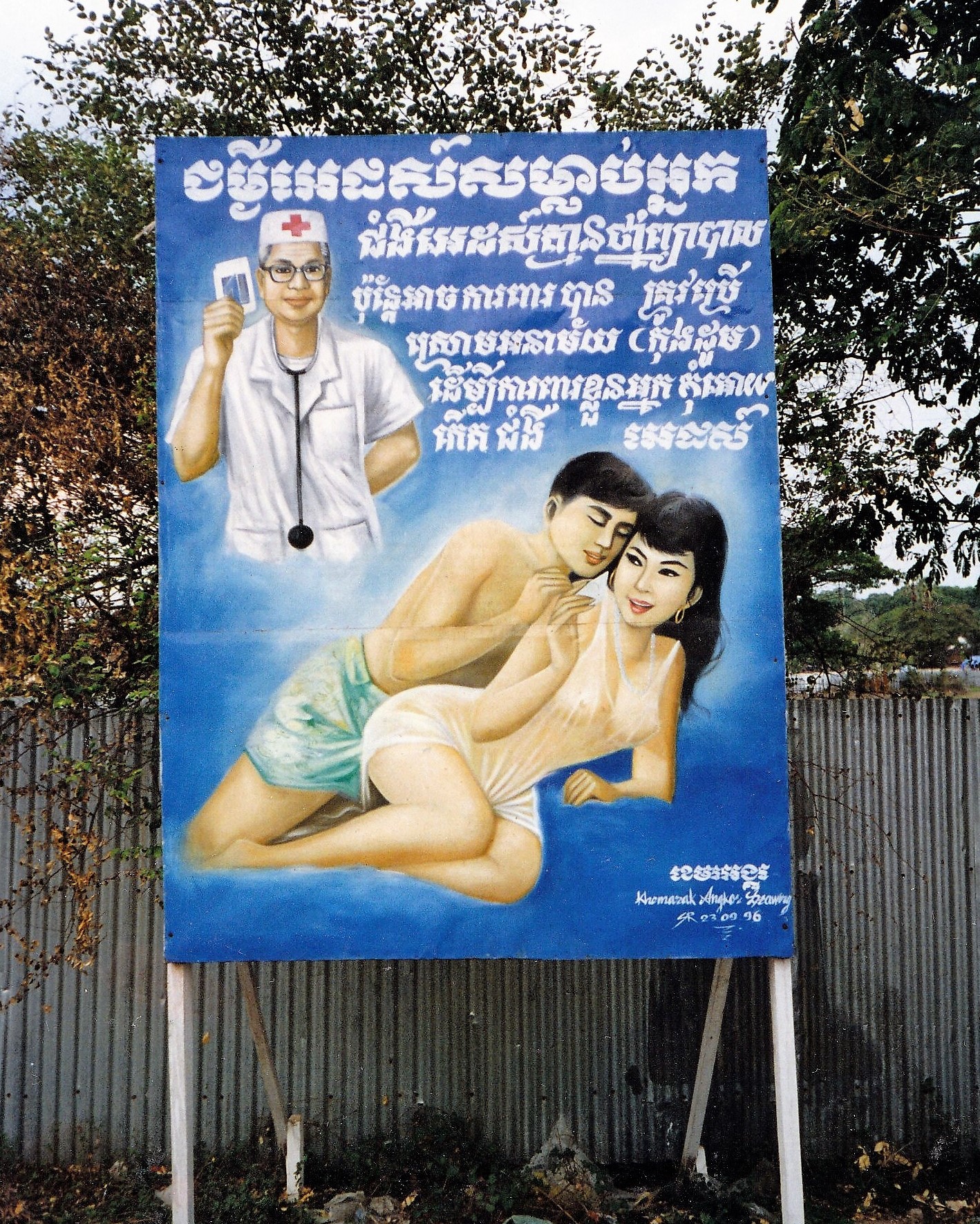
At the same time, Cambodia was experiencing the most serious and rapidly progressing HIV/AIDS epidemic in Asia, and was on the brink of becoming one of the worst affected countries in the world. As Project Officer for STD/HIV/AIDS, I was responsible for setting up and managing UNICEF’s country program of assistance to government and international aid agencies in Cambodia, which included development of innovative multi-sector capacities for the prevention and control of HIV/AIDS in the country.

Bed Nets and Condoms

The trip with the Royal Cambodian Navy and the WHO Malaria Team was up-lifting in a number of ways.  A five hour voyage to a distant island on a comfortable Naval battleship, hosted by the fine crew and their impeccable leadership. In a flawless white uniform, the Cambodian Admiral embodied honor, responsibility, and respect.

599z3b
The Royal Cambodian Navy Admiral presenting mosquito bed nets to soldiers based on malaria-infested islands

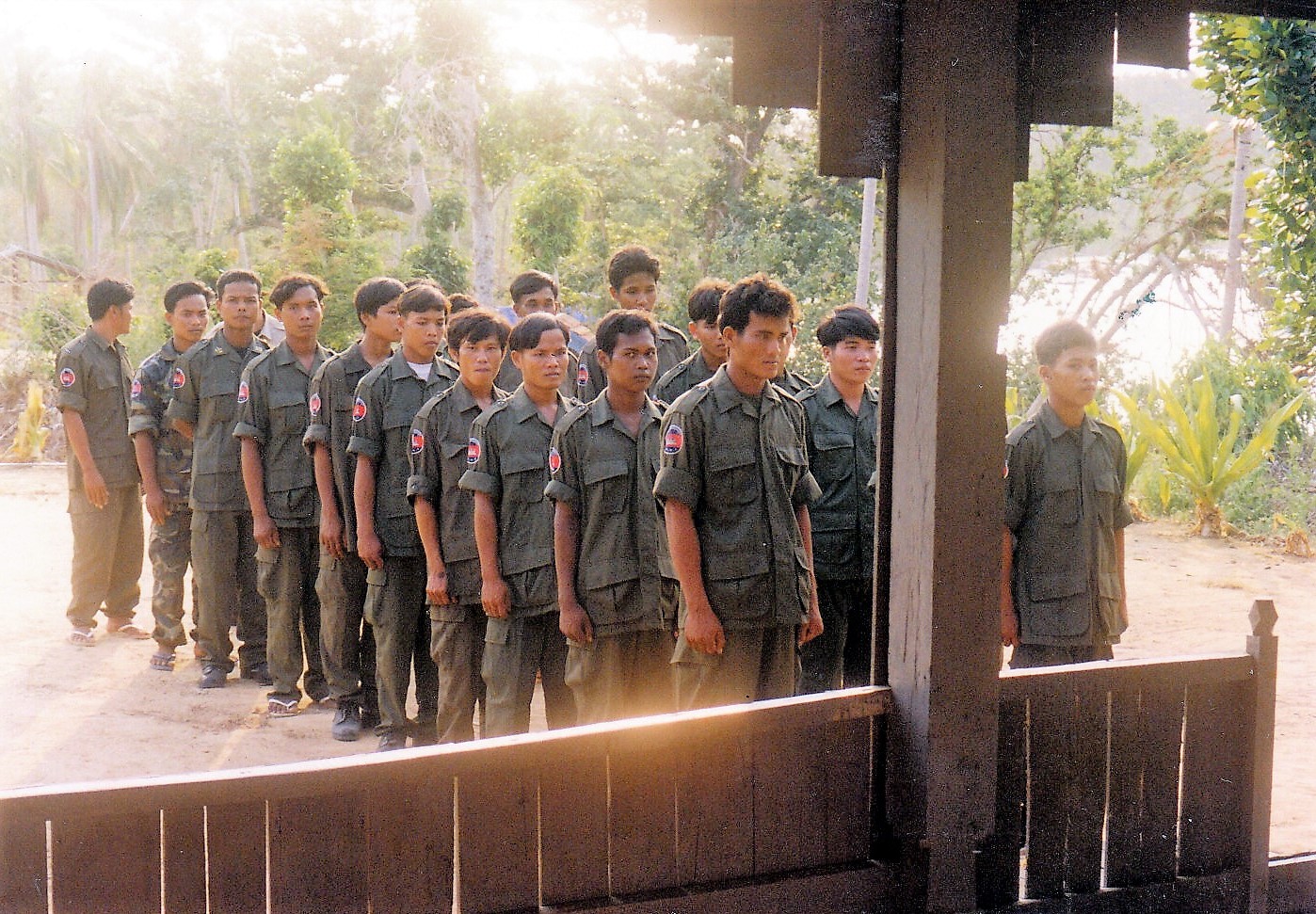
We delivered mosquito bed nets, condoms and prevention education to soldiers based on three outer islands and treated the soldiers who were suffering from Malaria. It was refreshing to witness some humanity in the midst of so much turmoil in the society. The young military men were clearly appreciative, and the leadership worthy and honorable.

It was encouraging to see effective medical treatment solve a health problem like Malaria – at least in the short term. But bed nets, condoms and prevention education were necessary for long-term control of Malaria and HIV.

745ab
Feverish Cambodian soldiers waiting to receive malaria treatment provided by the WHO Malaria Team

Although the life saving combination drug therapy known as the “AIDS cocktail” could help manage HIV as a chronic disease, it was not a cure. And the widespread poverty and years of armed conflict which had created conditions favorable for HIV transmission in Cambodia required longer-term, multi-sector interventions to promote safer behaviors.

For example, a string of brothels on the mainland were host to many of the young men on shore leave. But would they remember and be willing to use the condoms we gave them – and sleep under the bed nets?

An Unexpected Visitor

Then there was the time I walked into my apartment and found a strange girl asleep in my bed.  It was the height of the dry season. Whatever had been dumped, spilled, drained, coughed, sneezed, shat or spat into the streets was now a swirling cloud of fine dust – just waiting to deposit germs in your lungs – resulting in a nasty bronchitis that had the whole town coughing and gagging, and I was feeling pretty sick as well.

735 (3)
Many of Phnom Penh’s streets were unpaved

I was on my lunch break – UNICEF operated on the European two-hour lunch break – and I had just finished eating at a restaurant around the corner from my apartment and was headed home for a nap. As I was leaving, I noticed an attractive Cambodian woman of about 30 eyeing me from a table next to the door. So while passing, I politely said hello, and in my limited Khmer briefly explained that I was not feeling well and needed to go home to rest before returning to work.

We parted, and I continued home. But no sooner had I put my feet up, there was a knock at the door. She had followed me home, and somehow talked my guard into letting her in the gate!

624 (2)
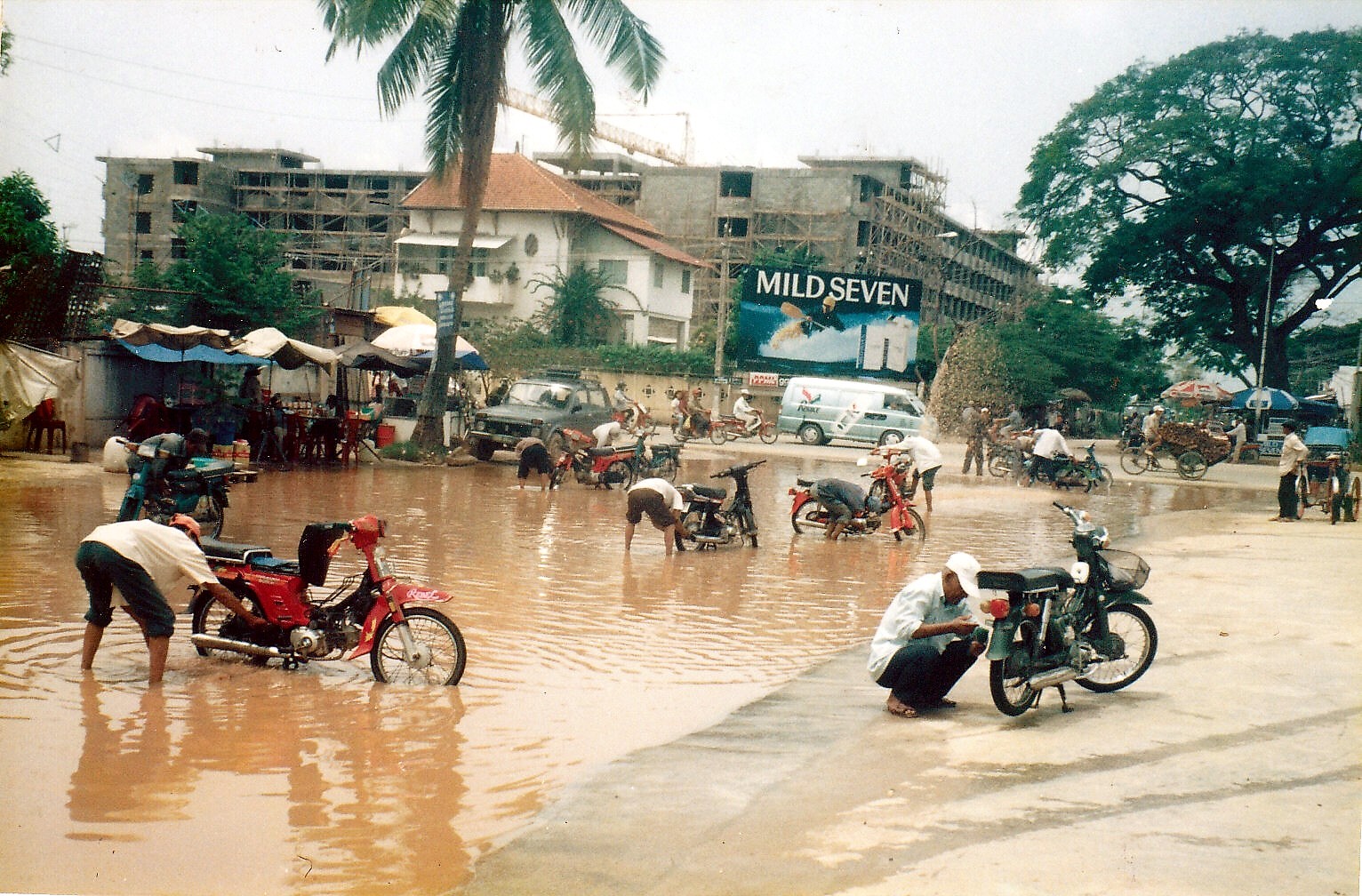
Local ‘car wash’ in Phnom Penh’s chronically flooded streets

So, I offered her a glass of water, and again tried my limited Khmer for some small talk before ushering her to the door and bidding her farewell – and again, thought nothing more of this. After all, I was feeling really miserable and just wanted a nap before returning to the office. So it came as a complete surprise when arriving home that night to find her fast asleep in my bed – wearing my tee shirt and gym shorts – her long black hair spilling over the pillow she clutched.

So began my friendly relationship with Vany – who had lived through the all-too-common stark suffering and death as a result of the brutal Pol Pot years. Her parents were presumed dead, and so were her husband and child. She had been working in the casino ship moored in the center of town and had been laid off – and for some reason could no longer stay with her sister, who was also working in town.

599m1
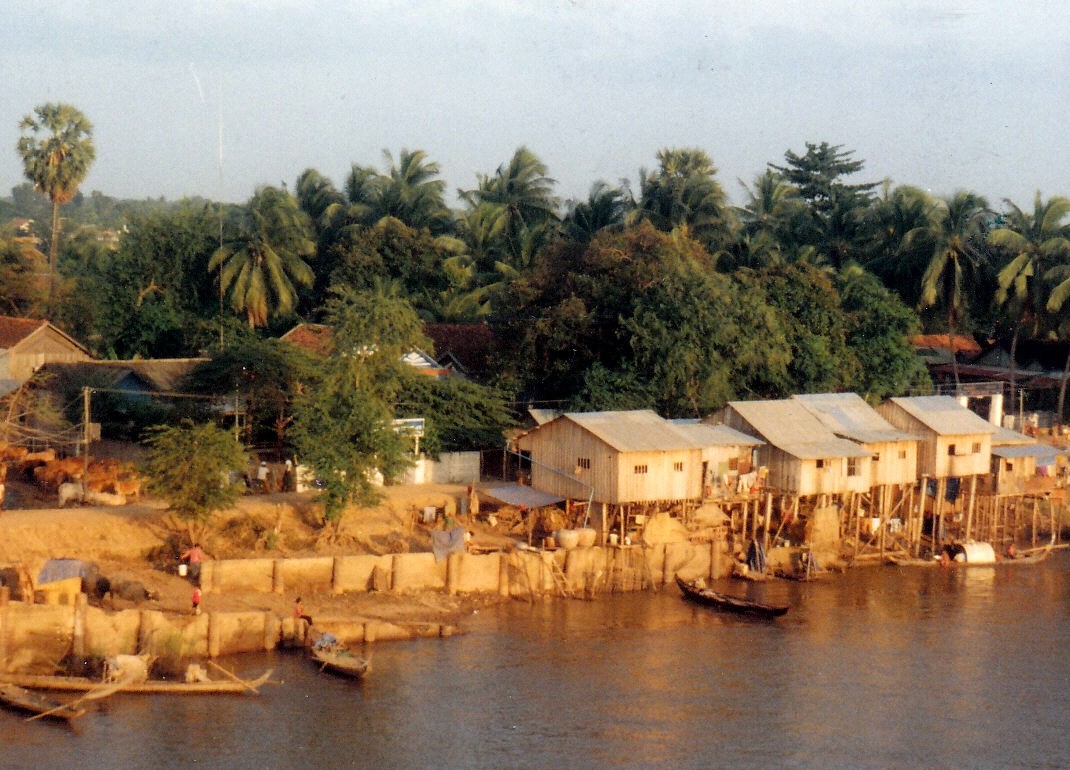
Riverside houses along the Mekong, Phnom Penh

She spoke no English, but did know some French, and I suspected she may have been the girlfriend of a resident Frenchman who had since left Cambodia, and was looking for a new boyfriend/ benefactor.

So we made a deal – she could be my housekeeper and do the marketing in return for room and board, as long as she was looking for a new job. She also became my Khmer language tutor, and stayed with me for the remainder of my time in Cambodia. My contract with UNICEF was coming to a close in a few months, but before I left Phnom Penh, she found a job and moved back in with her sister.

The Mekong Region STD/HIV/AIDS Project in Cambodia

The Project was up and running, and since that time, Cambodia has made substantial progress in preventing and mitigating the impact of HIV and AIDS, and is one of the few countries in the world which has been successful in reversing its HIV epidemic and achieved near universal access to HIV/AIDS treatment. This was achieved through targeted prevention programs that increase awareness of transmission and promote condom use, and the expansion of comprehensive care and treatment services throughout the country.

A 1999 external review of the UNICEF Mekong Region STD/HIV/AIDS Project concluded that:

“The Project has been successfully implemented and made valuable contributions at both country and inter-country levels to strengthen the capacity of a range of partners to respond more effectively to STD/HIV/AIDS prevention and care needs. Project implementation has been well managed and technical guidance has been good at all levels of project implementation. Activities undertaken have been appropriate, well designed and delivered, consistent with national priorities and responsive to emerging trends in the epidemic, and can be demonstrated to have considerable impact and have the potential to be sustainable. UNICEF’s commitment to collaborate with a wide range of national and international partners means that the effort is not isolated and has had an impact on, and benefited from the programming approaches of other agencies.”  

677 (3)
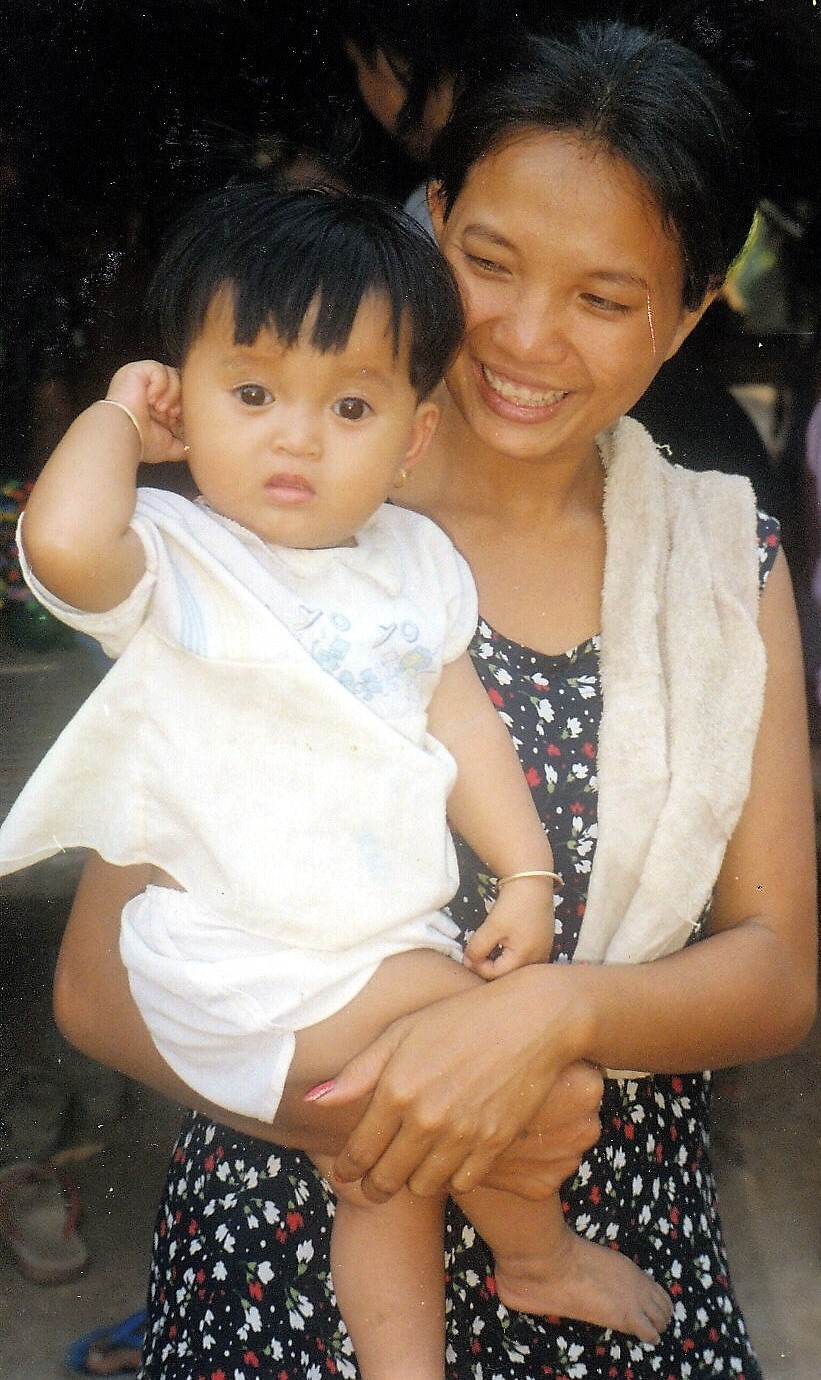
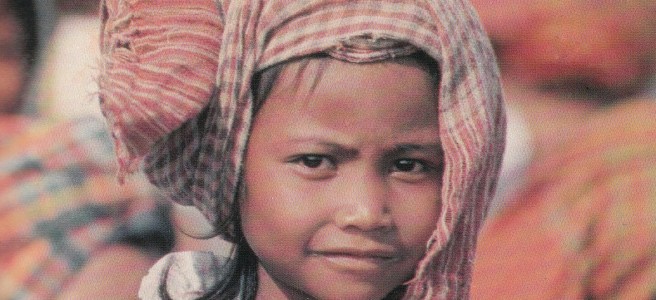
A happy, healthy Cambodian mother and child

Since that time, Cambodia has made substantial progress in preventing and mitigating the impact of HIV and AIDS, and is one of the few countries in the world which has been successful in reversing its HIV epidemic and achieved near universal access to HIV/AIDS treatment.

This was achieved through targeted prevention programs that increase awareness of transmission and promote condom use, and the expansion of comprehensive care and treatment services throughout the country.

Despite Cambodia’s success in controlling the HIV epidemic, more must be done to maintain the momentum in combating the spread of the virus, especially among the nation’s most vulnerable and marginalized populations, which include women, children and young people.


Hawai’i – The Perfect Refuge

 I returned to Hawai’i in June 1998 after two and a half years with UNICEF – six months in Fiji and two years in Cambodia. The East-West Center in Honolulu graciously provided me with an office to edit 20 years of personal journal entries while contemplating my next adventure.

My former landlords also welcomed me back to a quiet, refurbished top floor apartment – with spectacular views up to steep mountains and deep valleys, misty with passing showers and rainbows, and down to the sea, sunsets and the lights of Waikiki.

Biking to the beach each morning in the cool of the dawn just before the sun appears over the hills, a brisk swim out to the reef and beyond refreshes body and spirit. Moving through crystal clear water with the fish, sea turtles, and an occasional eel or ray. Then, seated with a cup of coffee under the coconuts in the morning sunlight – steady breezes under clear, blue skies, watching the surf roll in – indulging the artist’s lifestyle.

Sunset_next_to_Waikiki_Beach,_Oahu,_Hawai,_USA1
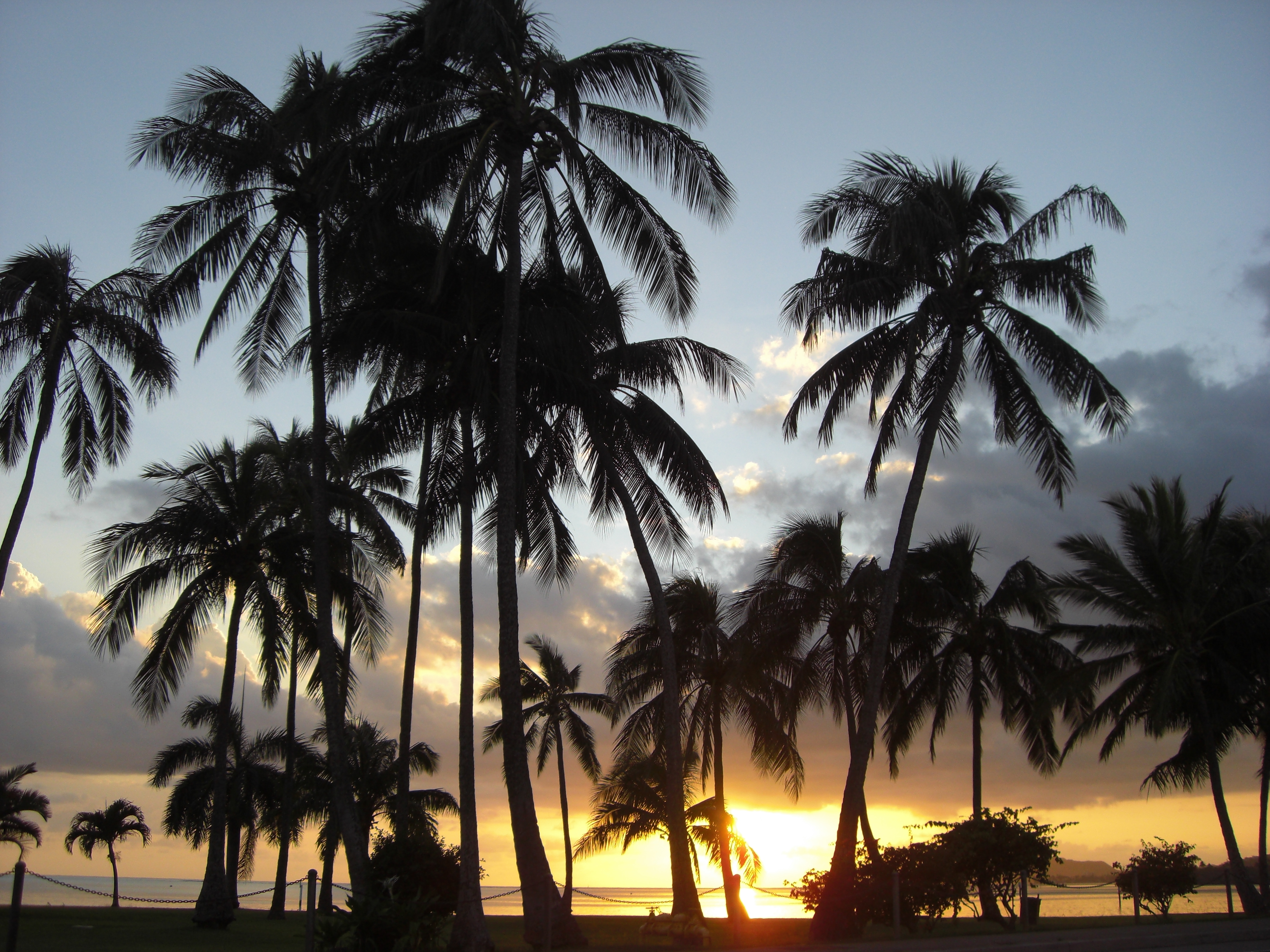
Sunset at Kaimana Beach near Waikiki, Oahu, Hawai’i, Wikimedia Commons

As 1999 dawned, I joined a friend for six weeks of travelling in Thailand, Indonesia – and Vietnam, where I would soon enter the next chapter of fun, adventure and serendipity.

Stay tuned for more stories, coming soon!

You can read more about Jim’s backstory,  here and here.


Biting the Dust in Cambodia (Part Two)

December 1997: “Stretched out along the banks of the mighty Mekong, the weather in Phnom Penh is fantastic this time of year. Sunny and breezy, all is green following the rains. The mud-slide streets have dried up and the choking dust and oppressive heat won’t come into full force for another month or so. Most importantly, the city is quiet – for the time being at least. Some fighting resumed in the northwest of the country, but we are back to the calm after (or before?) the storm. One never knows what to expect in Cambodia!”

1f cb-map

Civil War

During the months leading up to the fighting in July you could feel the increasing tension in the air. As usual, either utter doldrums of boredom in the blazing heat, with the usual annoyances, or life would suddenly get quite thrilling – as we listened intently for the steady bursting of shells. The situation was the worst it had been in some time.

The stalls in the local vegetable market were empty. My neighbor and I made a last dash to the nearby 7/7 shop and managed to score the few remaining basic food items and bottles of drinking water off the bare shelves before the owners closed the doors, locked the gate, loaded up their motorbike and headed out of town.

All but one of the banks had closed – and it was mobbed with people standing outside with bankbooks in hand watching the lucky ones in front receive hundreds, fifties, twenties, tens, fives, ones, and then, out of cash the bank simply closed its doors, leaving us all standing there with our worthless bankbooks.

Most of the foreign nationals were evacuated from the country. However, many of the international NGOs and United Nations staff remained during and after the fighting. It just so happened that both of my passports – diplomatic and USA national – were in government offices getting visas renewed when all this happened, so even if I could have left the country, I couldn’t travel anywhere. So we waited at home – shelling all day. My landlord’s family stayed too, and was wonderful with food and mutual support throughout.

636 (2)
My Phnom Penh apartment owner, Madam Vong

One of the areas of heavy fighting was near the UNICEF office (and near my apartment!)  Fortunately, the automatic weapons fire and heavy artillery were aimed away from my place.  We were instructed to stay at home – I was literally under the bed and tuned to the two-way radio handset while the fighting swept by.

Others were not so fortunate.  People were killed, and many homes and businesses were either destroyed by the fighting, or cleaned out by widespread looting by roving gangs of drunken young men toting AK 47’s.

Many people fled to the countryside, and the deadly political purges followed. Sadly, just around the corner from the UNICEF office, two children were blown up by a hand grenade they found lying on the ground.

599l1

After the event, there was an overwhelming and pervasive feeling of depression. Jobs disappeared as investors and foreign aid agencies pulled out. All that had gone towards establishing some form of stability, law and order and a semblance of hope in Cambodia seemed lost.

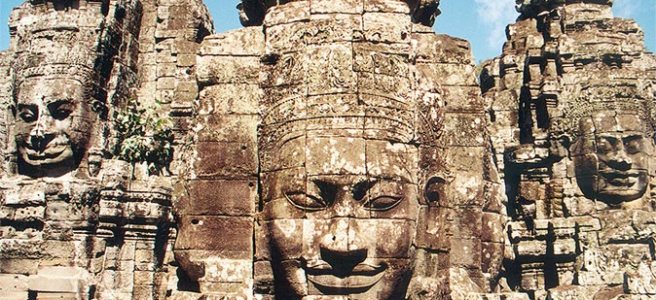
Eventually, shops re-opened, and investment slowly trickled back into the country, but the economy remained weak. Tourism largely ground to a halt. So if you were planning a visit to Cambodia,  you would have the beautiful temples of Angkor all to yourself!

The international airport had also been significantly damaged by the fighting, and was closed for several days. And until repairs could be completed, it was prudent to schedule morning flights to Phnom Penh when the weather was more likely to be clear, because pilots had to rely on visual navigation only, to land at the international airport. When I eventually got my passports back, I had new visas that allowed me to stay in Cambodia for another year – a comforting thought!

The Mekong Region STD/HIV/AIDS Project

On top of all this Cambodia had the most serious and rapidly progressing HIV/AIDS epidemic in Asia, and was on the brink of becoming one of the worst affected countries in the world.  HIV infection rates among sex workers, their clients and pregnant women were the highest in Asia. Nearly half of all brothel workers were infected, and the HIV infection rate among pregnant women had doubled since the previous year.

599p2

Commercial sex was cheap and widespread – an estimated 50,000 commercial sex contacts occurred each day in Phnom Penh, and with inconsistent condom use.

670 (3)
Cambodian girl receiving job training after being rescued from a brothel by a local non-profit organization

Under its humanitarian mandate, UNICEF continued working for the benefit of women and children in Cambodia, including the training of over 10,000 primary and secondary school teachers and curriculum writers on Life Skills approaches for HIV/AIDS prevention, along with a learning package for foreign language schools.

599t
Students in a UNICEF-supported ‘floating school’ on the seasonally inundated Tonle Sap freshwater lake

UNICEF supported multi-sector prevention activities at provincial level as well as community-based care and counseling for people living with HIV/AIDS. One such activity was later designated as a UNAIDS “Best Practice” model, which successfully brought together a dozen NGOs, and the Buddhist temples in Phnom Penh – all working in support of the municipal health services.

UNICEF also played a leading role in the first ever National Strategic Planning effort to identify priorities and key strategies to guide the response to the spread of HIV/AIDS in Cambodia.

Don’t Bring AIDS Back Home

UNICEF’s mass media social marketing campaign “Don’t Bring AIDS Back Home” had become the most popular HIV/AIDS prevention theme in Cambodia.

Cambodian women are especially vulnerable to HIV, in part due to cultural norms that tolerate men who seek sex outside of marriage and return home to have unprotected sex with their wives. Although the country’s epidemic was largely male-driven, it was increasingly infecting more women, with more than half of the new infections among women, and implications for increased mother-to-child transmission of the virus.

717a
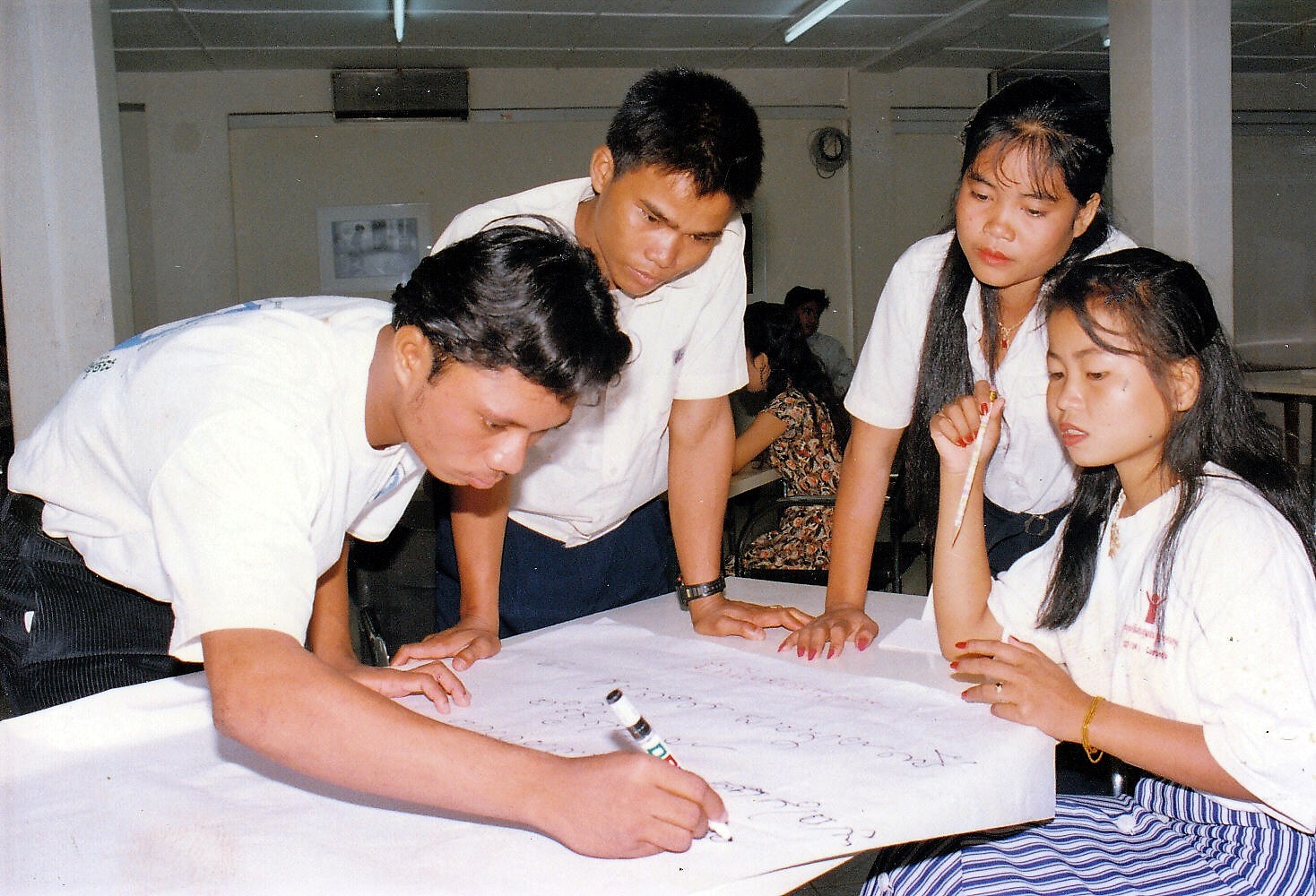
Young people were closely involved in development of appropriate HIV/AIDS prevention messages and IEC media

Based on recent studies of sexuality among young people in Cambodia as well as our own participatory research with key target audiences, UNICEF worked closely with young people to produce appropriate IEC (Information, Education and Communication) media, including a series of interactive teaching video packages which presented real-life scenarios and modeled practical strategies for dealing successfully with a variety of risk situations.

Some of the videos were so popular, they were pirated and distributed even before being completed. These video packages were also adapted for use in Thailand, Laos and Vietnam.

714a
Empowering young people through Life Skills education

Behavior modelling and Life Skills educational programs aimed to empower young people to deal effectively with their problems, make choices, act on their decisions and protect their health when pressured to take illegal drugs, engage in unprotected sex or participate in dangerous activities.

For example, working with adolescent boys hanging out at snooker clubs, and who also visit brothels, UNICEF staff helped them identify a typical risk scenario, draft some basic scripting, and even act in the video – often featuring the peer group leader clearly modelling safer behavior at the brothel – in this case, insisting that they all use condoms.

Another scenario targets adolescent girls with example dialogue and behavior to effectively and amicably delay the onset of sex, when pressured by their boyfriends.

599q
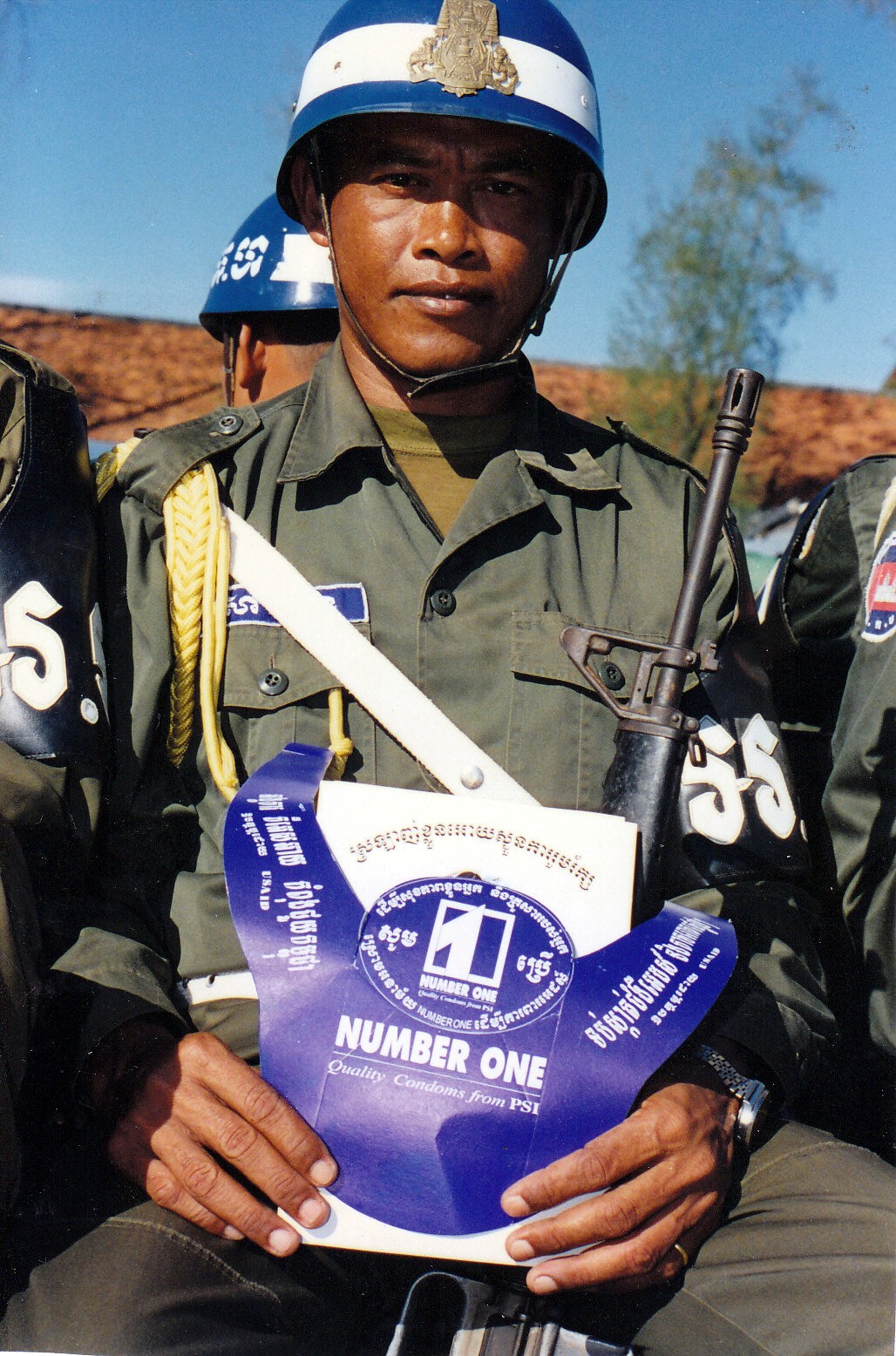
Police were an important target audience for “Number One” condom promotion in commercial sex settings

Popular TV spots featuring famous Khmer actors also demonstrated safer behaviors. For example, married men who go out with their friends to drinking establishments where the waitresses or ‘beer girls’ also sell sex, are reminded to remain faithful to their wives or otherwise use a condom every time.

On one occasion, our popular film star disappeared with the ‘beer girl’ actress after the TV spot filming was over. We could only hope they were using condoms!

Stay tuned for more stories, coming soon!

You can read more about Jim’s backstory,  here and here.


Biting the Dust in Cambodia (Part One)

December 1996: “A weekend retreat — traveling three hours by convoy for safety, radios in each of the three cars and along a good, tar-sealed road (which passes through Pol Pot territory – and a popular kidnapping area lined on either side with mine fields) brings us to some very pleasant beaches along Cambodia’s southern coast. Then, during a morning jog along the beach, someone discovered a freshly killed, bloody corpse (probably a smuggler) the day we left the resort town Kompong Som. A stark reminder that we are still in Cambodia – where at times life can seem cheap, and security must be taken seriously.”

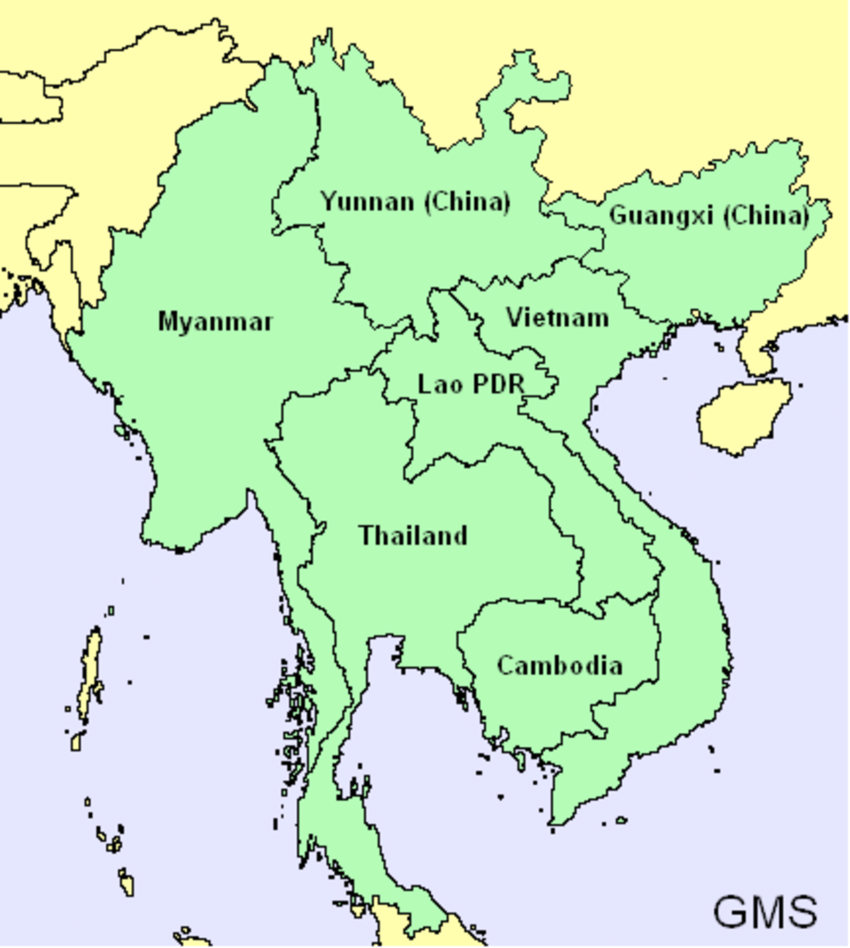
In May 1996, I moved to Phnom Penh, Cambodia to set up and manage UNICEF’s country program assistance to government, NGOs and international organizations as part of the Mekong Region STD/HIV/AIDS Project, a new regional project implemented in six countries bordering the Mekong River: Cambodia, China, Laos, Myanmar, Thailand and Vietnam.

The-Greater-Mekong-Subregion-GMS Researchgate
Greater Mekong Sub-region, by Research Gate

Still reeling in the aftermath of the Khmer Rouge’s reign of terror that led to the deaths of nearly a quarter of the population through execution, torture, starvation, and disease, Cambodia was, in the mid-90’s experiencing the most serious and rapidly progressing HIV/AIDS epidemic in Asia, and was on the brink of becoming one of the worst affected countries in the world.

1f cb-map
CIA World Fact Book

For the majority of Cambodians, HIV/AIDS was not considered a priority concern. Disruption and weakening of the family and community, as well as continued armed conflict and extensive poverty following years of turmoil had resulted in large numbers of young people, women and children living in especially difficult circumstances.

599o1
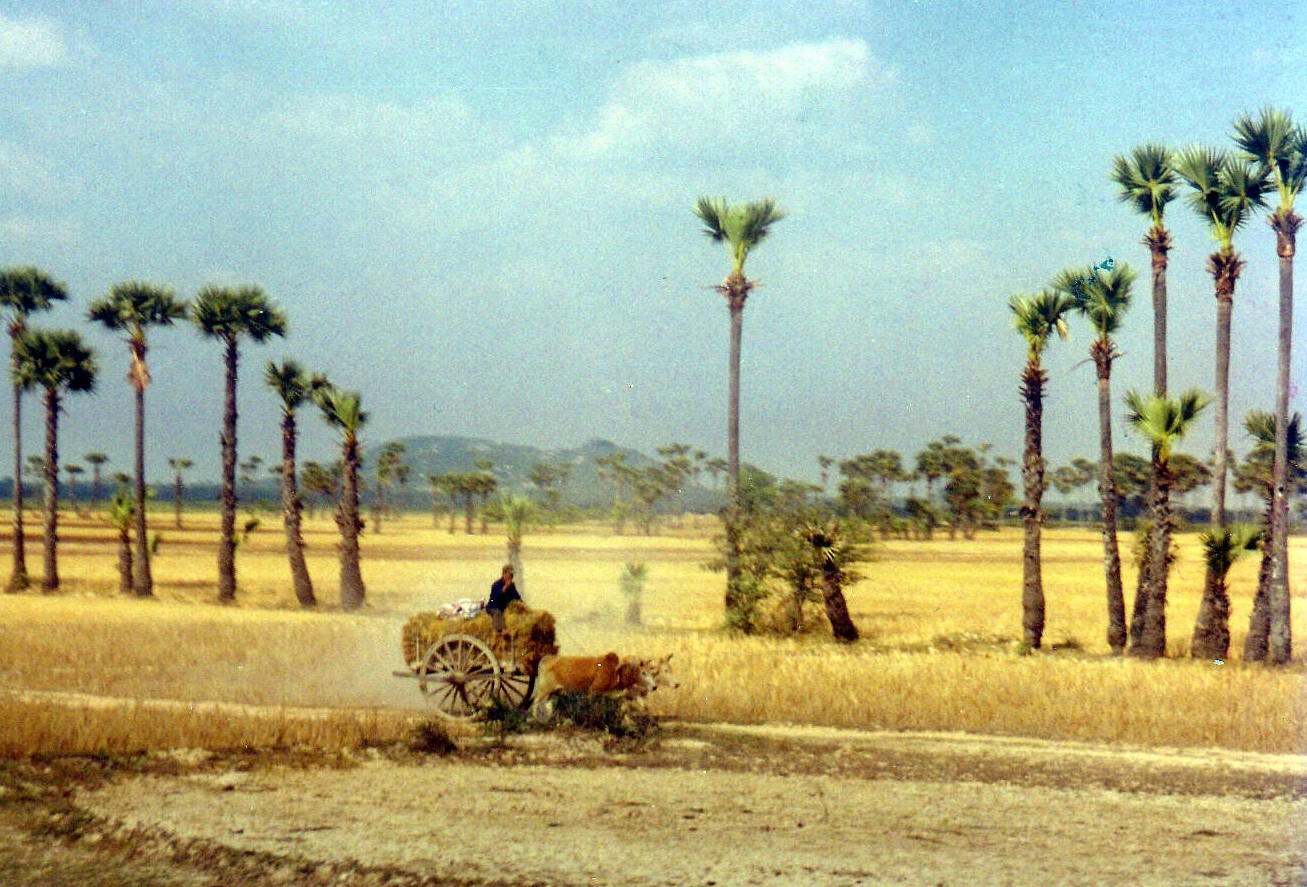
Cambodian countryside

The rapid transition to a free market economy, increased population mobility, the opening of borders, and other liberalizing measures implemented with little apparent guidance or regulation were also contributing to the explosive spread of HIV in Cambodia.

616 (2)a
Phnom Penh street traffic, mid-90’s

The primary mode of HIV transmission was unprotected heterosexual intercourse. Women especially faced an enormous challenge from HIV. National HIV Sentinel Surveillance had found that over 40% of the commercial sex-workers tested and nearly 2% of pregnant women attending ante-natal clinics were HIV-infected.

599h4
National HIV/AIDS Program  targeted prevention messaging and condom promotion 

Even among those who were not occupationally exposed in Cambodia’s growing commercial sex industry, women were increasingly at risk for infection from their husbands and boyfriends.

UNICEF’s chief strategy was to raise the capacity of counterpart organizations at local levels, working in collaboration with target populations assessed to be most vulnerable to sexually transmitted diseases (STDs) including HIV.

These included students in primary, secondary and vocational schools, non-formal education participants, out-of-school youth, women of reproductive age, women and children directly affected by HIV/AIDS especially rural people and ethnic minorities who faced a higher risk for HIV infection because of their marginal status.

599k2
The Khmer Rouge planted coconut trees throughout the capital Phnom Penh to impart a ‘rural utopia’ image.

Because so many of the educated Khmer had either died, were badly traumatized, or had fled the country to escape the horrors carried out by the Khmer Rouge under Pol Pot, the few remaining qualified government counterparts UNICEF could work with were stretched to the limit and often unavailable as they faced enormous challenges of competing priorities in health, education, social welfare, and other sectors that UNICEF supported.

Project Officer for STD/HIV/AIDS

As UNICEF’s Project Officer for STD/HIV/AIDS, I was responsible for overall planning, development and management of technical and financial assistance on all aspects of Project implementation to establish Cambodia’s component of UNICEF’s Mekong Region STD/HIV/AIDS Project.

599z2
Conducting situation analysis, needs assessment and awareness-raising on HIV/AIDS throughout the country

Through on-going situation analysis, awareness-raising, human resource needs assessment and training, the Project raised the capacity of government agencies, NGOs, local communities and the UNICEF country office to design, test, implement, monitor and evaluate activities to reduce HIV/AIDS transmission and increase community acceptance and care for women, children and families affected by the illness.

As the leading multilateral agency supporting Cambodia’s National HIV/AIDS Program and its multiple  implementing partners at national, provincial and community levels, a major challenge was trying to coordinate these efforts for maximum impact.

642_0001b
International Youth Club Pool, Phnom Penh

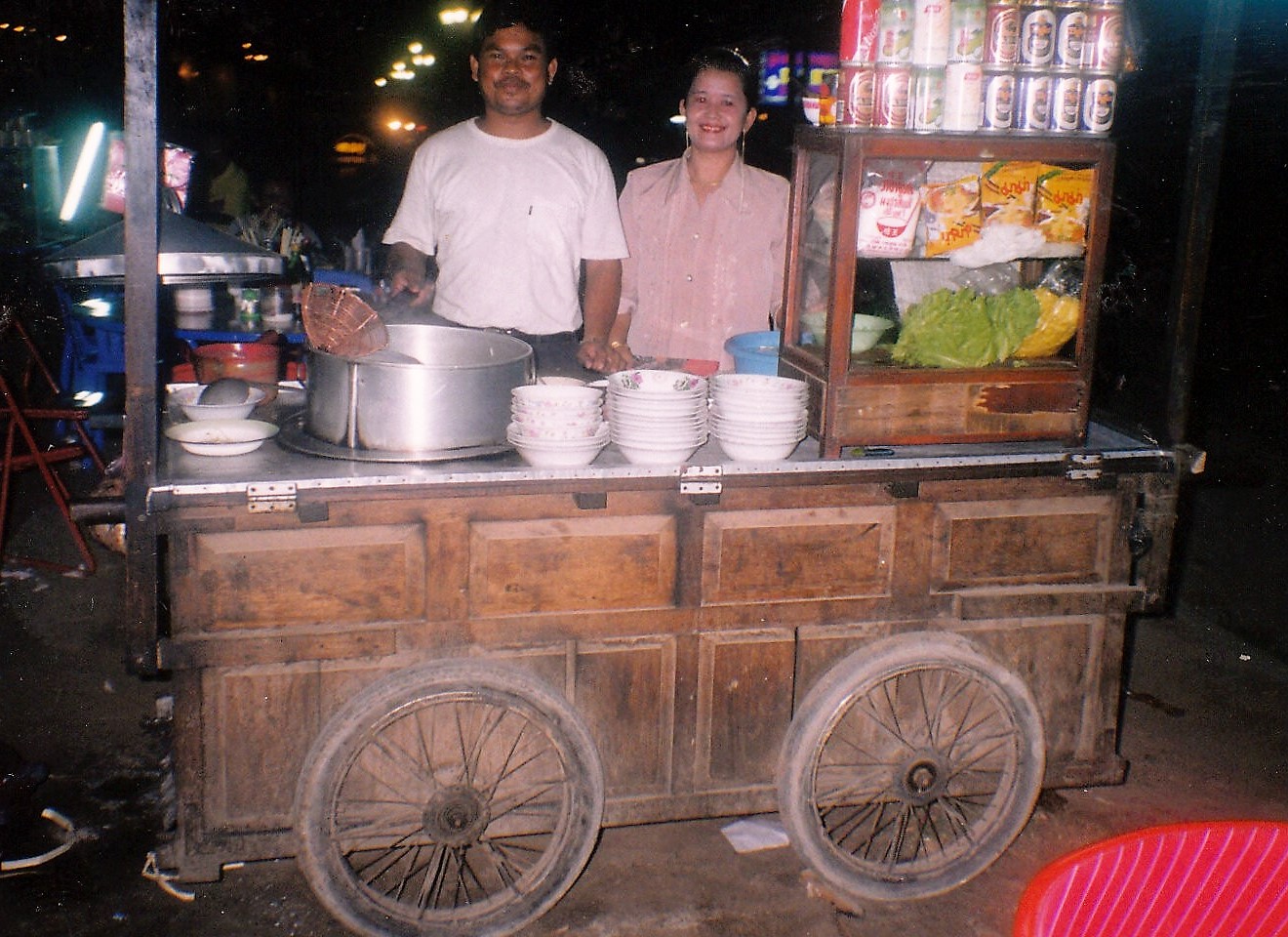
A swim each evening at the International Youth Club pool was refreshing and helped ease the strain, followed by a bowl of noodle soup from my favorite street vendor and a loaf of hot, crispy French bread from the ‘Nom Pang’ (bread) vendor whose ‘Pang Pang’ cries echoed through the streets as he peddled his bike through the night.

630 (2)
My favorite noodle soup vendors, Phnom Penh

Of course, it was prudent, especially after dark, to carry a readily accessible $20 bill to hand off in a hurry if confronted by armed robbers roaming the streets.

614 (2)
Some of the exquisite French-colonial era architecture

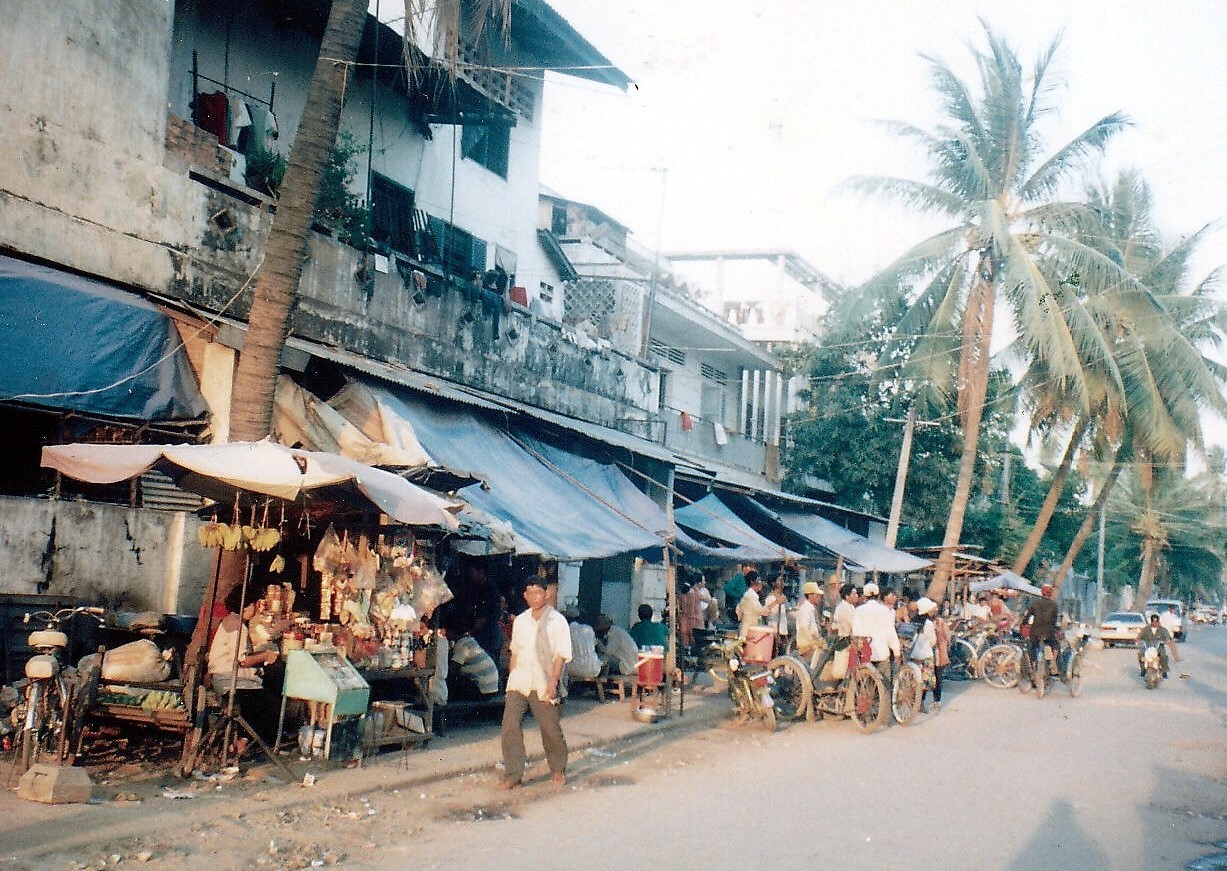
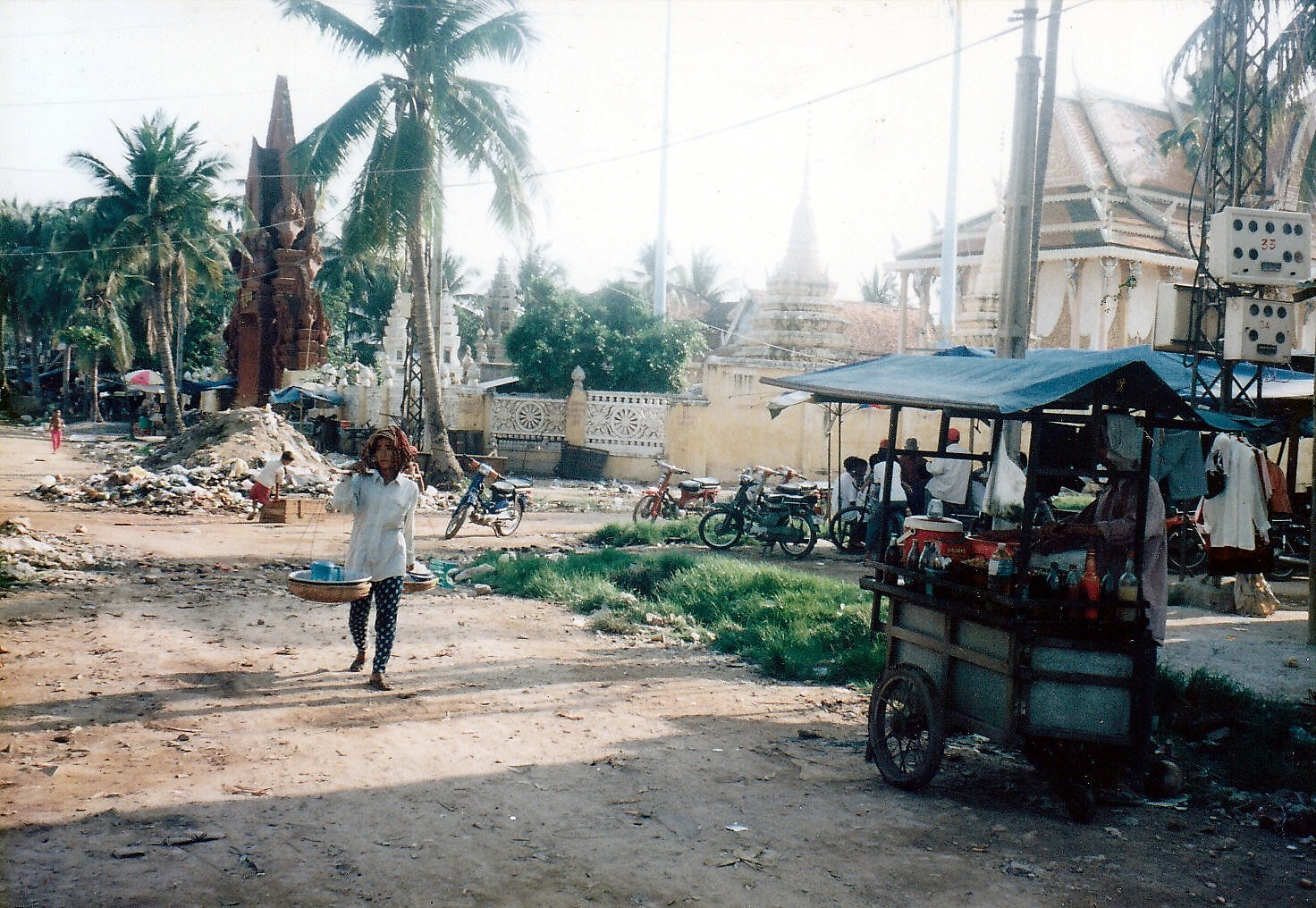
Once known as the “Pearl of Asia,” Phnom Penh was considered one of the loveliest French-built cities in Indochina in the 1920’s. Sadly, in the mid-90’s, the city was a stinking mudslide when it rained, and a heavily trashed dust bowl the rest of the time, especially because of the growing traffic on the largely unpaved roads.

735 (3)
Many of Phnom Penh’s streets were unpaved and badly trashed

Of course, a big challenge was simply managing the energy drain and overall depressing nature of the place. Rampant corruption, civil war and subsequent political purges, AIDS, poor illiterate peasants, beggars, amputees, child prostitution, orphans – it was going to take time to recover from such horrific trauma and suffering.

619 (2)
Not much to buy or eat

Strolling home from the pool each night under the stars, twinkling through the coconut palms – down the quiet, dusty back streets, a few fires burning in the darkness, migrant workers and their families huddled in ramshackle shelters.

A few guys shooting snooker, a scuttering rat or two in the rotting rubbish piles and stagnant pools of stinking water, past a small market area behind the crumbling hospital next to a temple.

002d
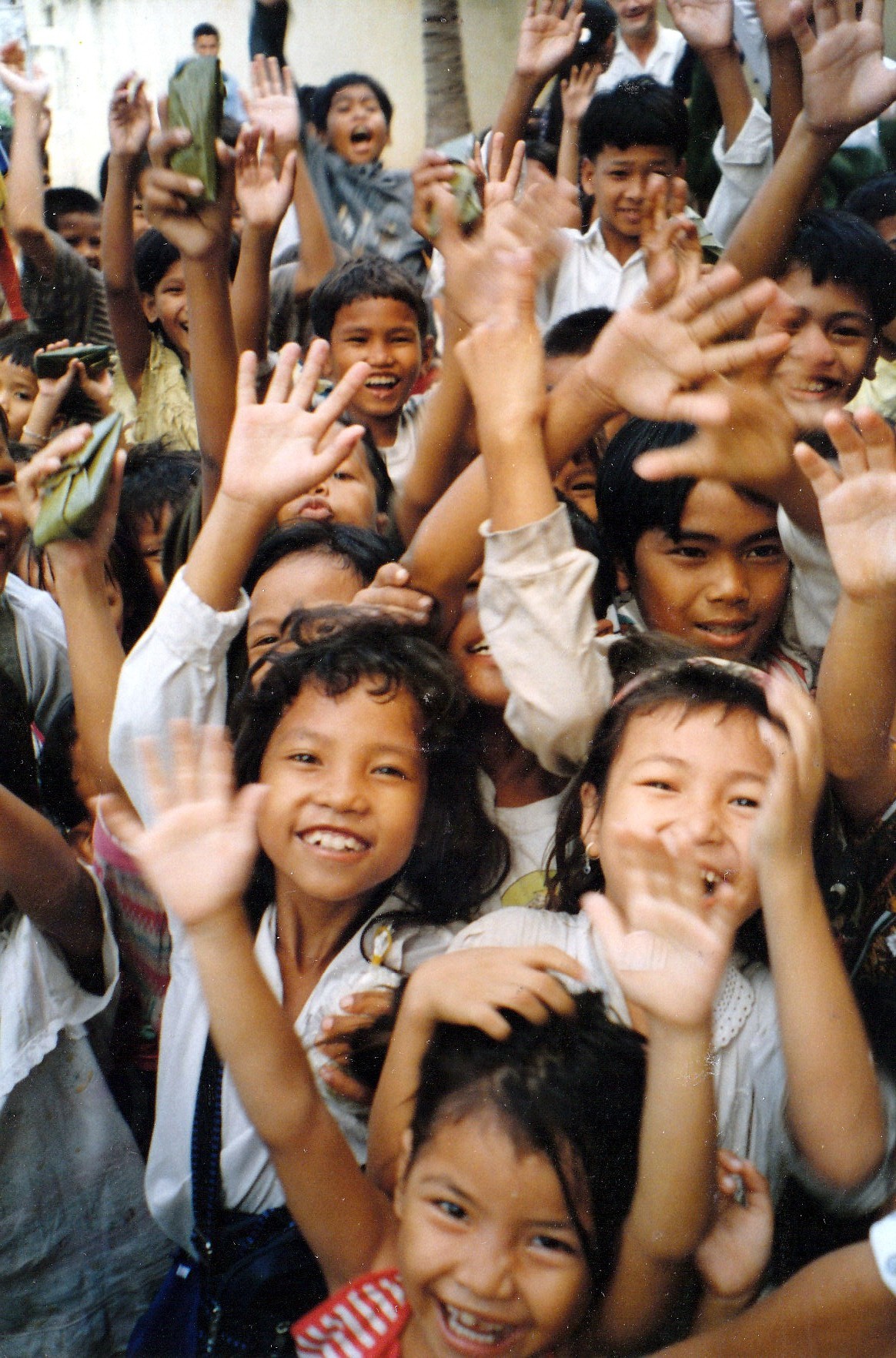
Exuberant Cambodian Children

But as usual, there was not much worth buying or eating – except a roast banana or perhaps a blackened rock-hard baguette from the mobile hot bread-seller.

Again, the positive and stimulating nature of my work at UNICEF is what saved me. And thank goodness for the pool, and for walk-able streets, and the stamina to respond to the swarms of kids desperately seeking attention and love, and somehow, still bursting with boundless youthful exuberance.

Stay tuned for Part Two, coming soon!

You can read more about Jim’s backstory,  here and here.

Kava Kava

Author’s Note: It was such a great year – finishing my doctoral fieldwork in Thailand, defending my dissertation, graduation, sailing the South Seas and getting off the boat to begin a six-month consultancy with the United Nations Children’s Fund (UNICEF) Pacific Regional Office based in the Fiji Islands. After a long fruitless job search, it was my first big break back into the working world after half a dozen years in graduate school.

UNICEF Pacific Islands works with the Cook Islands, Fiji, Kiribati, Marshall Islands, Federated States of Micronesia, Nauru, Niue, Palau, Samoa, Solomon Islands, Tokelau, Tonga, Tuvalu and Vanuatu. These 14 countries and territories are home to about one million children under the age of 18, living in more than 660 islands and atolls covering an area the size of the US and Canada.” United Nations Children’s Fund (UNICEF) Pacific Islands.

Map of the Pacific by UNICEF Pacific
Countries and Territories of the Pacific

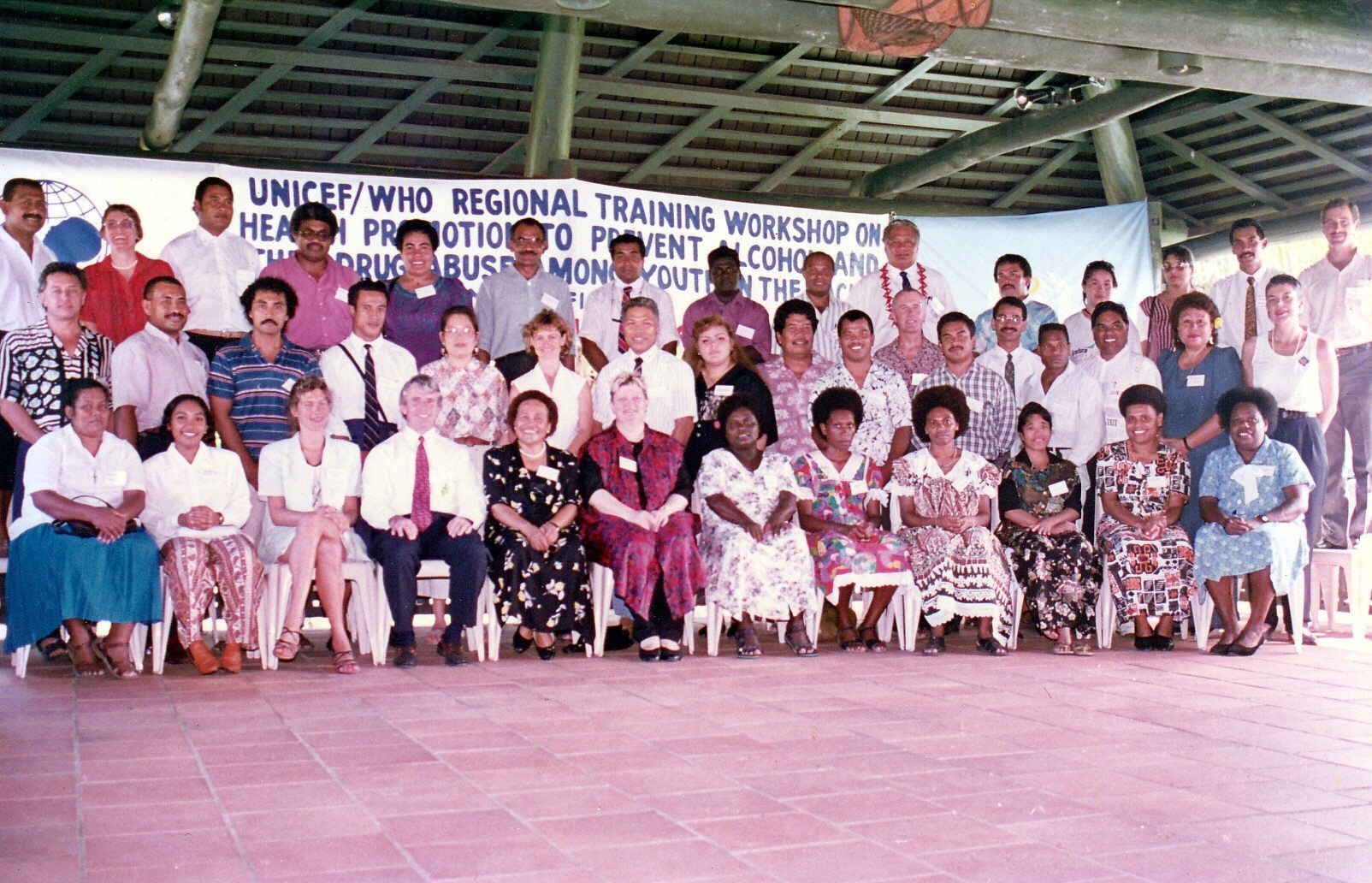
The New Year 1996 began in the Fiji Islands, at UNICEF’s Regional Office for the Pacific. I was on a consulting assignment to investigate the impact of rapid social change on Pacific Island youth, with particular reference to substance abuse (alcohol, tobacco and Kava), and the implications for related issues such as violence, crime, unemployment and sexual risk behavior.

In collaboration with the World Health Organization (WHO) and the Australian Agency for International Development (AusAID), UNICEF Pacific Islands organized and hosted a regional “train the trainer” workshop for government, non-governmental organizations (NGOs) and community leaders from 14 Pacific Island nations to share experiences and develop targeted health promotion and prevention initiatives.

676a
Participants in the Regional Workshop, Nadi, Fiji Islands

Far from uplifting, the drug and alcohol work was a welcome break from HIV/AIDS which had been the focus of most of my work in recent years. It was also a refreshing change to be tackling the complex issues related to misuse of alcohol, which are often overlooked, as responsible alcohol consumption is common and widely condoned, and yet at times, also abused, including by those tasked to address alcohol-related problems.

Participants from a range of NGOs and government ministries were in positions to lead on addressing these issues in their home countries. But the severity of the problem was brought starkly to the fore when an alcohol-related sexual assault occurred at the workshop, perpetrated by one of the delegates supposedly tasked to address these issues in his home country.

678a
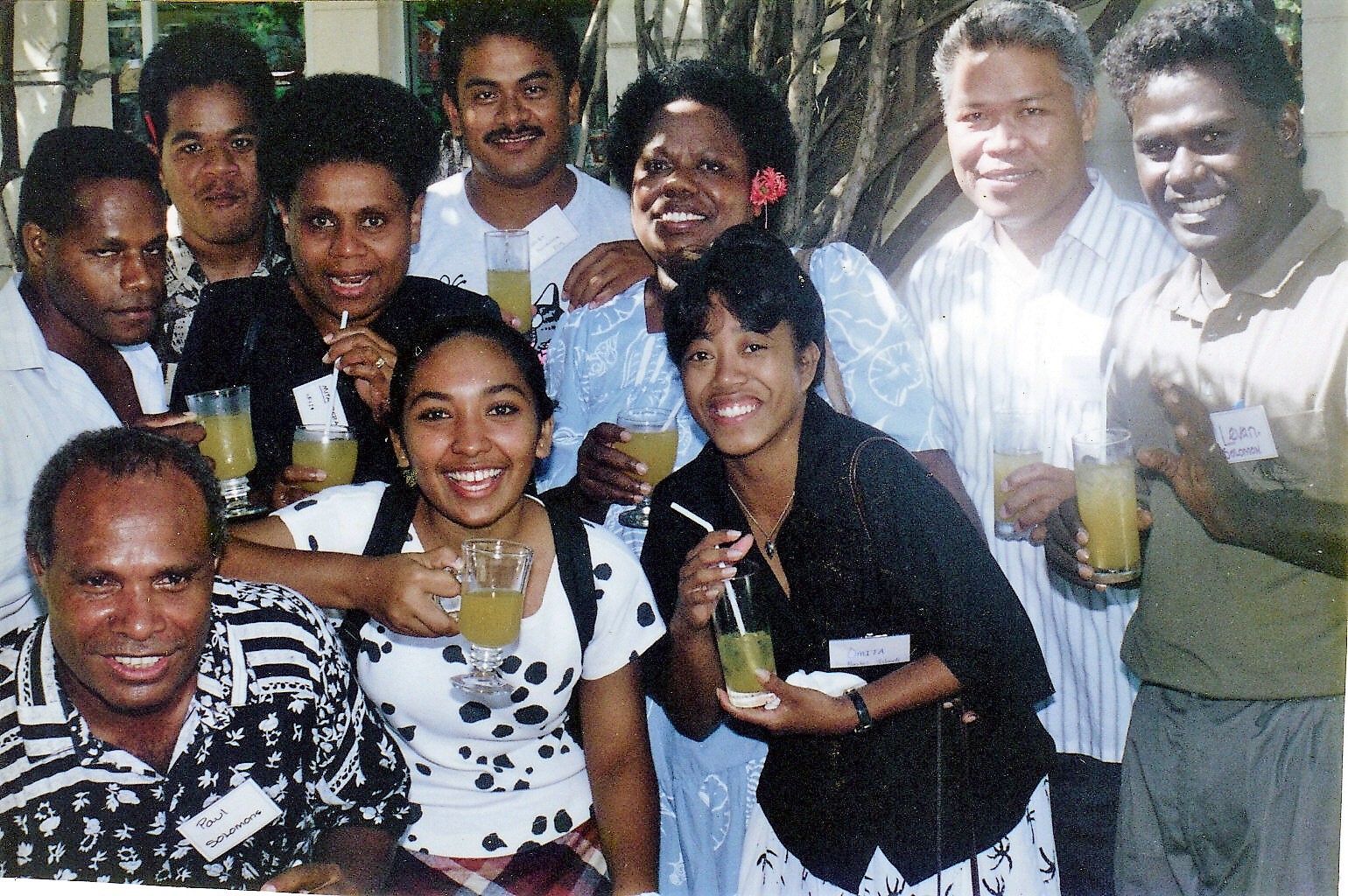
Workshop participants enjoying an ‘alcohol free’ break

On the positive side, important outcomes from the workshop included establishment of laws regulating two key areas of alcohol marketing to reduce its impact on Fijian youth. First, the logo of Fiji’s popular local beer “The Sportsman’s Beer” was changed to “Ahh Your Beer.”  Second, all advertising of alcoholic beverages was banned from sporting events in Fiji both of which associated alcohol with youth sports.

The downside was that beer banners flying at sports stadiums were replaced with non-alcoholic, sweet fizzy drinks – which entail their own health problems, particularly obesity. But at least they were promoting an alternative to alcohol.

677a
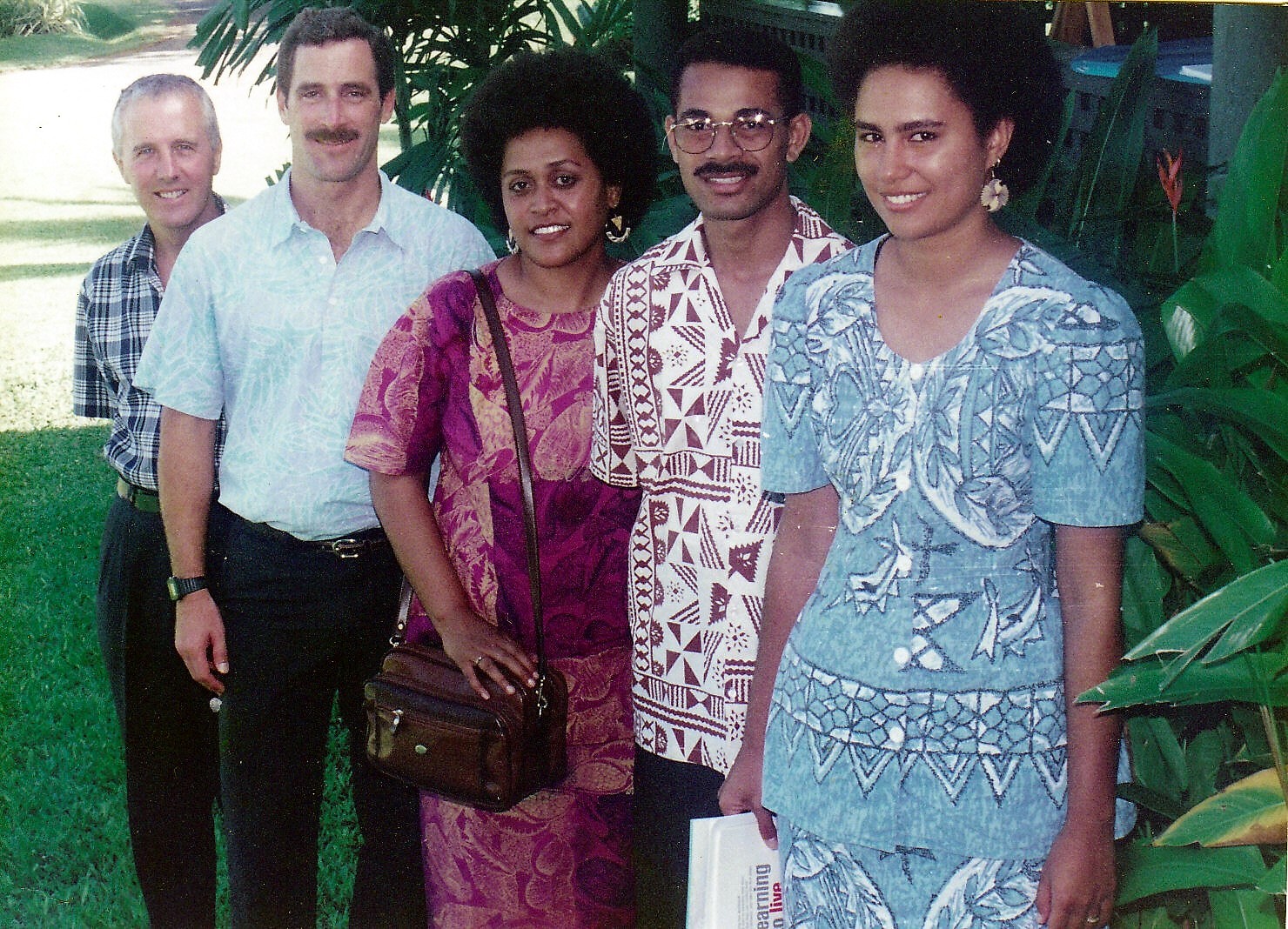
Jim with some of the workshop organizers

Kava is consumed widely in many Pacific Island communities both socially and ceremonially. The locally produced and culturally valued beverage ‘Kava’ is also promoted as a healthier alternative to alcohol. Some of the local churches even promote Kava use over alcohol.

Known as yaqona or simply grog in Fiji, Kava is a mildly narcotic drink made from mixing the powdered root of a species of pepper plant with water and results in a numb feeling around the mouth, lips and tongue and a sense of relaxation. It is also an important export crop within the Pacific from major producer countries (e.g. Fiji) to other countries in the Pacific, and as an ingredient for some health supplements and pharmaceutical products sold in Europe and the U.S.

051 (2)
Fijian visitors to Samoa are being served Kava as a part of a traditional welcome ceremony for special guests.

Kava is cheaper than alcohol, and thus less likely to be a drain on household finances. There is little scientific evidence of harm to physical health from drinking all but extremely large amounts of Kava. Both men and women typically drink it together in social gatherings.

Violence or assault, which can be associated with alcohol misuse, are much less common – especially sexual assault, due to Kava’s effect as a sedative and muscle relaxant (so it is not possible from the male standpoint!) And when the drinking stops, the usual result is simply to fall peacefully to sleep.

695a
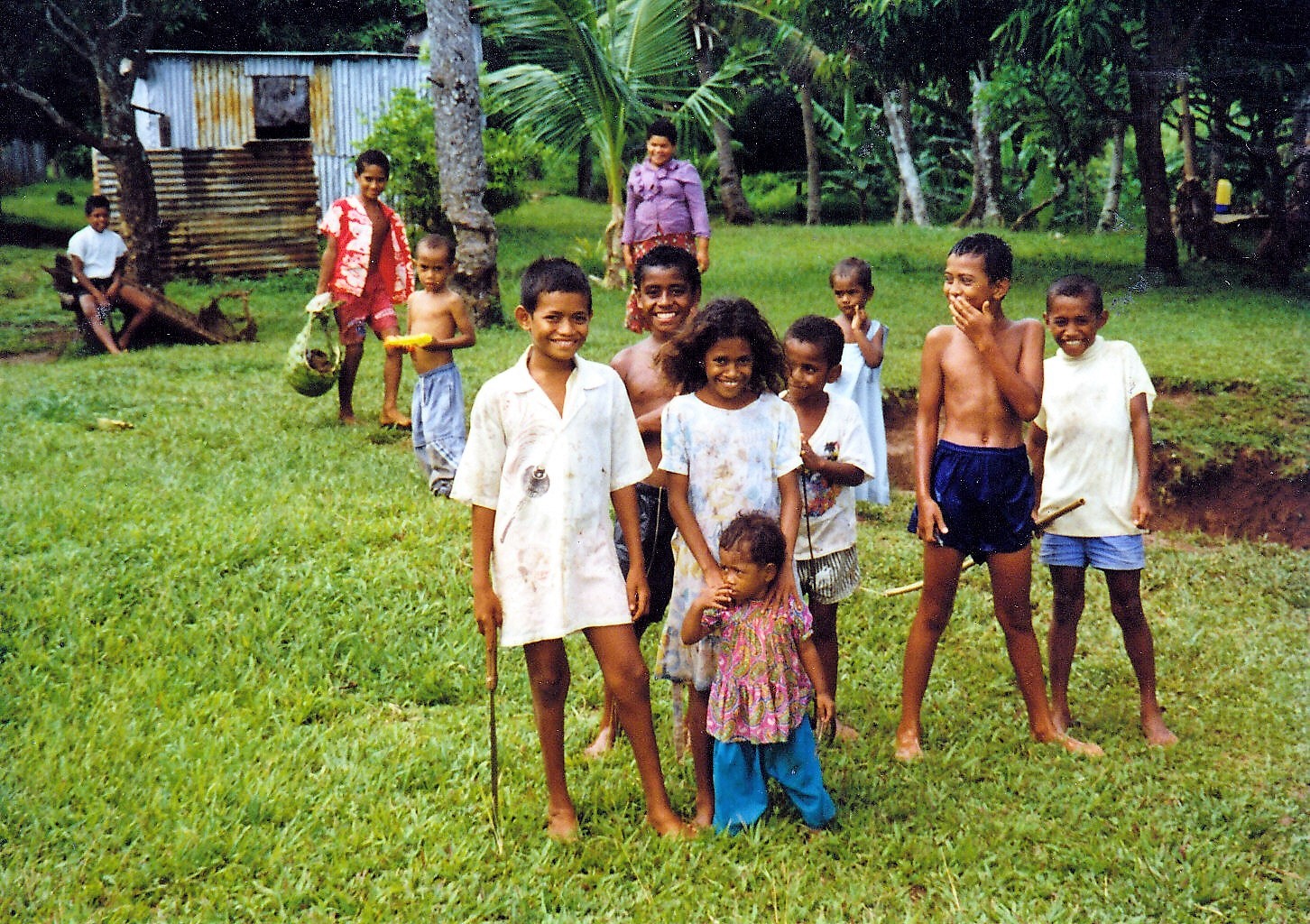
Village kids on Moala Island in the Lau Island Group, Fiji

During this time, I joined two WHO consultants to conduct a regional study on alcohol consumption in the Pacific, and published the findings in the journal Drug and Alcohol Review. Data were gathered in the Cook Islands, Fiji, Kiribati, Samoa, the Solomon Islands and Tonga, and were reported along with a discussion of the nature of alcohol-related problems in the island nations.

Per capita consumption was found to be highest in the Cook Islands, which compared with other countries had the highest ratio of liquor outlets and lowest alcohol taxation regime. As an alcohol prevention measure, it was concluded that the promotion of responsible consumption, together with the option for abstinence for those who wish it, is an acceptable strategy for the Pacific.

166
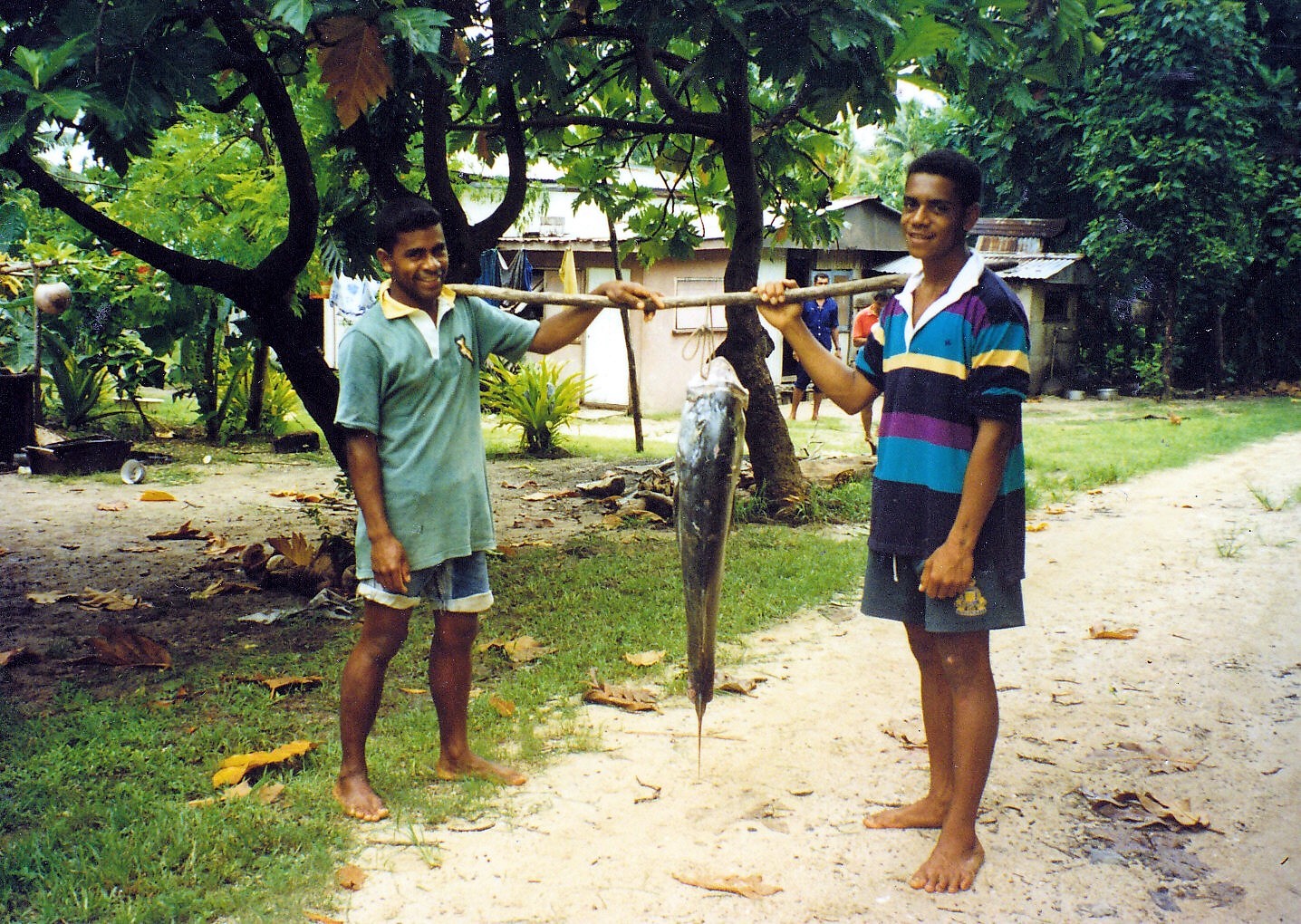
Catch of the day!

After completing my consulting assignment with UNICEF, I agreed to assist Rob Kay, author of several popular Pacific travel guidebooks  (including the online “Fiji Guide”), to update his latest edition of “Fiji: A Travel Survival Kit.” My research on Kava had taken me to some of Fiji’s more remote outer islands anyway, so I was able to visit tourist and traveler destinations in these places for the updated guide book.

In such a small country, everyone at these places would know Rob, but not me, so my reporting was more likely to generate an unbiased opinion about the quality of food, accommodation and service at these resorts.

693a
Village view, Moala Island, Lau Islands, Fiji

Flying Sunflower Airlines to the far-flung Lau Islands of Moala and Vanua Balavu to the east, then by ferry to Kandavu Island in the south, pampered at times in 5-star resorts, I took detailed notes by hand-held recorder on the quality of the food, general accommodation, room décor, bedding, and service, etc. Elsewhere, I sweltered in ‘prison-cell-like’ ‘budget’ backpacker accommodation.

190h
Touring the rugged interior of Viti Levu Island, Fiji

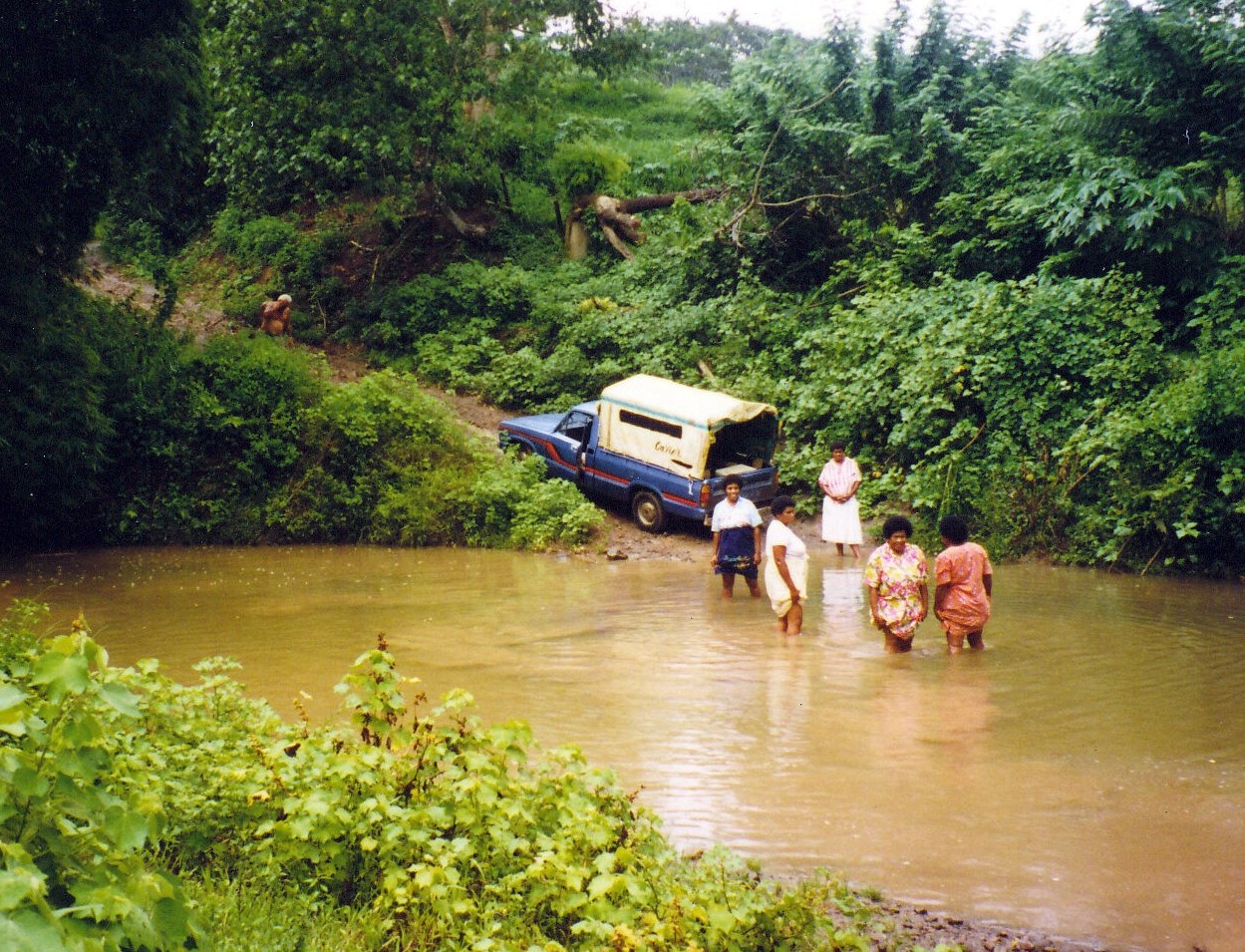
In the rugged interior of the main island of Viti Levu, I joined some of my former colleagues from the Fiji YMCA for some four-wheeling along ridge tops in the setting sun and through swollen rivers of Sigatoka Valley.

171 (2)

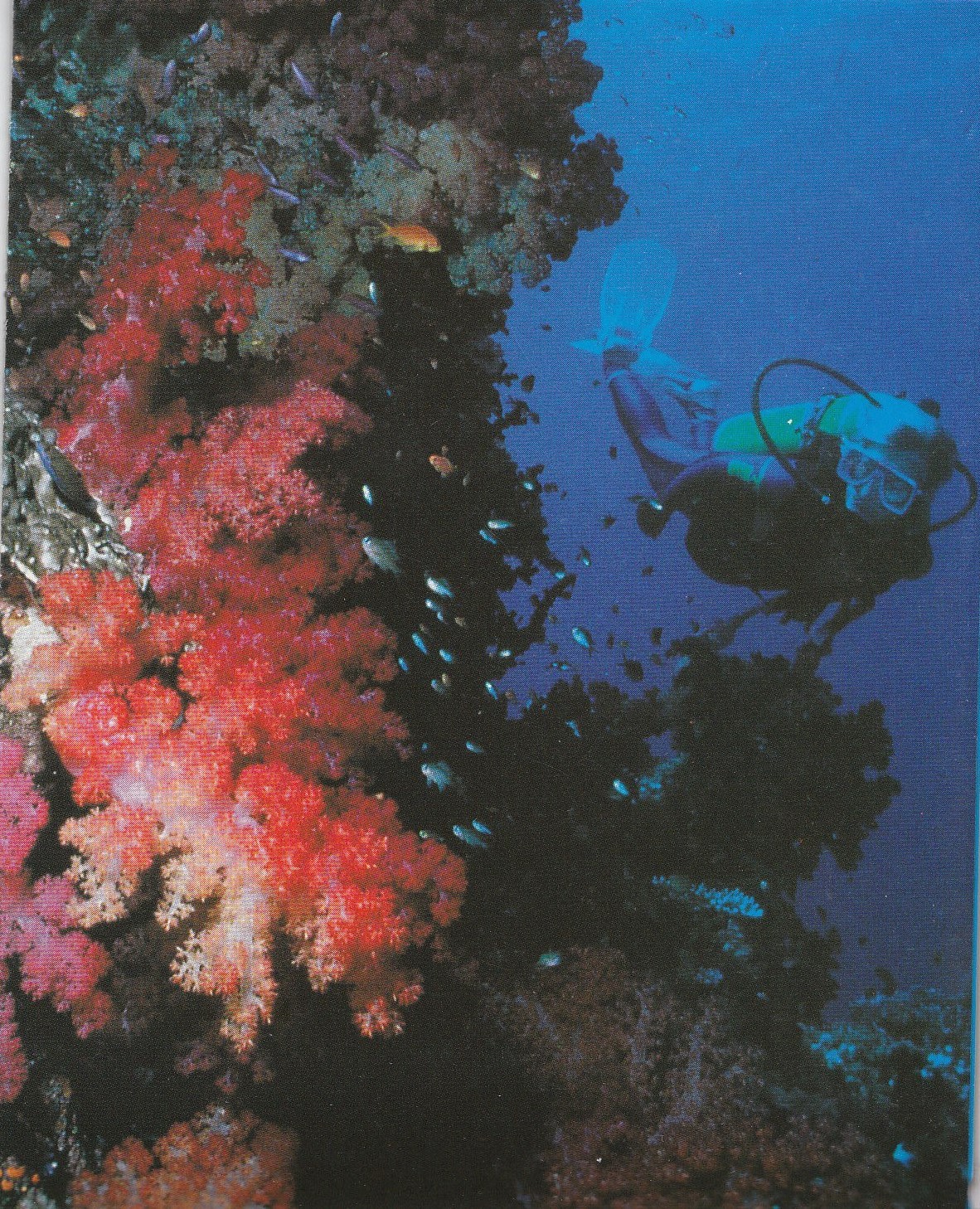
On to the Coral Coast, and then to Taveuni Island, I went scuba diving on the famous ‘white wall’ of live coral. Swept along with the strong current and entranced by the passing circus of colors, I lost track of my depth and suddenly realized that my dive partner was far above me – as I drifted deeper and dangerously into the early stages of nitrogen narcosis! Fortunately, I came to my senses in time to rejoin my dive partner at a safe depth.

720 (2)a
Farewell Fiji – until we meet again!

The job networking finally paid off when someone I had met at a regional HIV/AIDS conference in Thailand contacted UNICEF Fiji and offered me the STD/HIV/AIDS Project Officer position with UNICEF, Cambodia!  I would soon be a full-time ‘expat’ again!

Despite all the fun and exotic travel around Fiji, I was  pretty burned out, and ready for a change. The pervasive health and social problems of alcohol misuse, drugs and HIV/AIDS were wearing on me a bit. But it was all still rolling along, and now I was headed back to Asia, and to all that Cambodia had to offer, including: Pol Pot, poverty, civil war, corruption, beggars, amputees, HIV/AIDS…

Stay tuned for more stories, coming soon!

You can read more about Jim’s backstory,  here and here.


Abandoned Children and HIV/AIDS in Northern Thailand (Part Two)

Author’s Note: In 1993, during the peak years of the HIV/AIDS epidemic in Thailand, I planned and conducted an independent investigation on child abandonment and HIV/AIDS in northern Thailand, as part of my doctoral program at School of Public Health, University of Hawai’i at Manoa, with support from the East-West Center research institute in Honolulu, USA, UNICEF Thailand, and Mahidol University School of Public Health in Bangkok.

The fieldwork incorporated epidemiological and anthropological methods as well as participatory urban and rural appraisal techniques over a nine-month period. I applied computerized data analysis to assess the nature and magnitude of problems within a context of rapid social and economic change, and proposed options for prevention and community based management of abandoned children. The findings were published in a major collaborative study to assist national and regional planning and policy development.

Chiang Mai

Across from Central Shopping Complex, my apartment in Chiang Mai, Thailand’s second largest city, was new and comfortable, if a bit sterile. But the rent was cheap, the building was clean and a public pool was just a short walk away – through choking, dust-filled, traffic snarls.

It also happened to be home to a host of local ‘kept’ women – the ‘minor wives’ (mia noi) of wealthy Thais, their Mercedes and BMWs regularly arriving to pick up and drop off these beautiful women, in some instances with small children – comprising ‘second families.’

My other hangout was a public health station on the outskirts of the city where I was hosted by a community health nurse and her son in a peaceful, rural setting, but within a short pickup truck ride to the city. As many of the peri-urban districts near Chiang Mai, ours had been hit hard with HIV/AIDS and was therefore one of my primary data collection sites.

578 (2)
“Yao”, a community health nurse at her district health station near Chiang Mai, Thailand

Almost daily, and for months, local funeral processions made their way to the crematorium directly across the road from our health station. The men were dying from AIDS, and tragically, it would only a matter of time before their wives and girlfriends would follow.

In one neighboring sub-district, fully 30% of pregnant women had tested positive for HIV. These women, as so many others like them, had been infected with HIV by their only sex partner – their husband. Widespread unprotected sex in the many commercial sex venues frequented by single and married men was the principle driver of the epidemic.

In many cases, the husband was already dead – the child as well, and many of these young housewives would be left utterly alone – rejected by neighbors, friends and family, and unable or unwilling to safely confide in anyone except the local health worker or counselor due to the widespread fear and stigma towards people infected with HIV.

Others, particularly the poor who worked in the widespread commercial sex industry would eventually die as well. Having lifted their families out of poverty – a nice home, perhaps a new pickup truck parked out front – but the daughter (or son) was dead.

579ab
Conducting field visits in northern Thailand where HIV/AIDS was ravaging the countryside.

It was devastating, and I was forever humbled by the tireless dedication of the many fine individuals in the medical, social welfare and counseling professions – including Yao, the most junior of the eight community health nurses assigned to her health station. She was often the only one who would provide home care for people living with HIV and AIDS, and eventually was the only one who would close the eyes of the deceased.

She also quietly supplied the local ‘gay’ temples with condoms – and tried unsuccessfully to convince the local Abbot, a respected figure – and HIV positive – to ‘come out’ to promote better prevention. Buddhist temples have traditionally taken in young boys as novices, often from poor families wanting a better future for the child, including free education, shelter and financial support.  But without proper oversight, sexual abuse has become a reality, both among the older and younger novices as well as between monks and novices.

However, as the epidemic progressed,  many Buddhist temples also became important refuges for the HIV-positive homeless – who had been rejected by their families, and hospices for end-of-life care for people living with HIV and AIDS.

Land of Smiles

Back at the apartment in town, my neighbor Bill was seated in the downstairs lounge reading a paperback, his hulking mass squeezed into a lounge chair – waiting, as always for his phone to ring with the next job.

A former coal miner from somewhere in northern England, he now made a living running contraband between various Asian ports. His large, scarred head was covered with sparse patches of brown stubble. He looked up and flashed a cheerful grin through broken teeth.

“Off somewhere?” he asked.

“Headed to the beach for a few days – need a break from this madhouse, dust-ball of a town.” I replied.

“Good idea! I just got back from Japan – I’m set for money now.  But while I was gone, me woman and two of her friends hocked the TV and stole me clothes, me money…  Bloody headache the damned bitch.”

“Why do you put up with her?” I asked.

“Aw, she’s not a bad girl really. A hell of a lot better than the last one – at least here the girls treat a bloke with some decency.  Back in London if I say hi to a girl on the street she’ll tell me to fuck off.”

Orange Crush

My field research in Thailand was winding down, so Yao and I boarded an overnight VIP bus in Chiang Mai and headed south to Bangkok, and then to the beach. Out on the open road, the bus charged into the darkness of the night.

The air conditioner was turned too high and the video at the front of the bus was playing so loud it hurt.  When I went forward to ask the driver to turn down the volume, a collective sigh of relief followed among the mostly Thai passengers, as if to say “thank goodness that foreigner made the awkward request.” Thais typically avoid confrontation at all cost.

I tried to catch some sleep in the swerving bus as it hurtled through the night, but the headlights of on-coming traffic flashing by seemed much to close for comfort. Vivid scenes of wrecked buses along the roadside – sheered lengthwise – came to mind. Horrible road accidents were common on Thailand’s two lane highways, and the local orange-colored buses were jokingly known as “orange crush.”

Indeed, it was prudent to sit in the middle so as not to be crunched in the front or the rear, and on the opposite side to the on-coming traffic. I was seated in the middle, but on the wrong side and couldn’t sleep for fear of waking up with an oncoming bus in my face.

TrafficInBangkok Thomas SD Wikimedia
Traffic in Bangkok, Public Domain, Wikipedia Commons

Pulling into Bangkok’s early morning traffic, the day was already heating up into a stifling haze. The city groaned with the sound of vehicles – a gray urban skyline stretching out before us and disappearing into the haze. Then, crammed into a ‘backpacker special’ minibus for another overnight near-death experience at the hands of a reckless driver – miraculously we arrived safely in the southern town of Surat Thani.

Ko Tao Wikimedia, Roma Neus
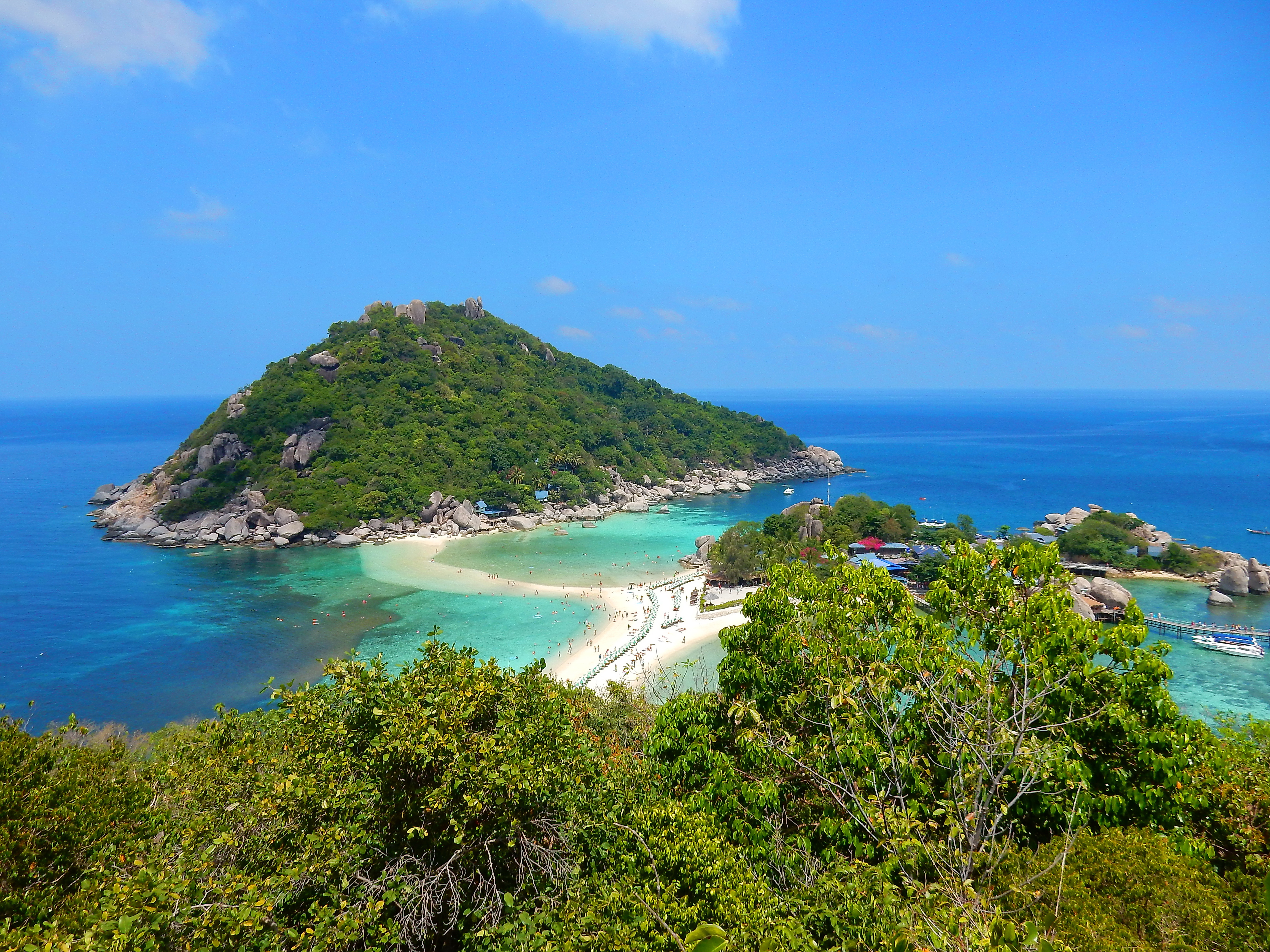
Koh Tao in the Gulf of Thailand, Wikipedia Commons CC BY 3.0, by Roma Neus

Stretched out on the smooth salt and weather worn deck of a converted fishing boat,  we headed to the islands of Samui, and Pha-Ngan, and finally to Tao Island (Koh Tao), and soaked up three lovely days of pleasant, breezy walks through coconut groves and jungle-clad mountains, snorkeling in the clear, silky waters decorated with soft and hard corals, colored fish, giant manta rays, diving on a wreck, and enjoying plenty of fresh seafood. It was wonderfully refreshing to unwind a bit, and to get rested and healthy again!

Stay tuned for more stories, coming soon!

You can read more about Jim’s backstory,  here and here.