North to Alaska (Part Two)

Author’s Note: In July 1983, my brother Dave and I (a.k.a. Joe Juneau and Skookum Jim) pulled on our mukluks, smeared our chins with whale blubber (so to speak), and headed off for a three-week trek into the vast frozen reaches of the Klondike – and lived to tell about it. Our story resumes in the uncharted wilderness of Yukon’s Kluane National Park.

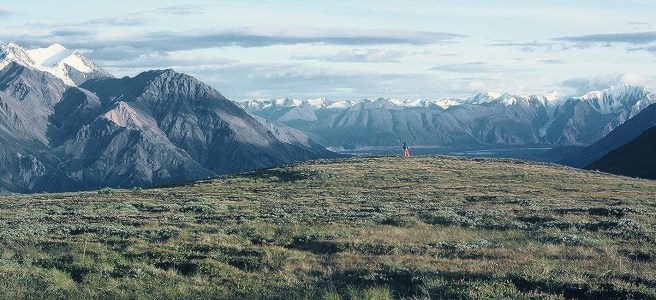
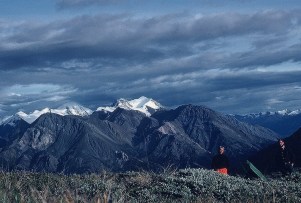
Sharp peaks, glistening snowfields and glaciers reflected the warming sun and piercing blue skies. The days were incredibly long – the sun seemed never to set. Camped on the tundra after full days of hiking, the cool mountain air, rich fragrance of the land on the breeze, and the intoxicating flow of water all around conspired to knock us out each night. 
057c
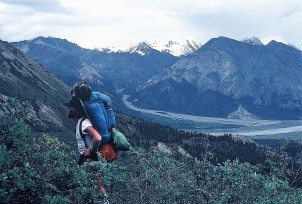
Backpacking in Kluane National Park, Yukon Territory, Canada

An occasional Grizzly moving across the green plateau was a prudent reminder to set the bear bag (with any scented items that might attract bears – food, toothpaste, soap) far out on the tundra at night. There were no trees to hang it from.

Our tent is cozy – a tiny speck in this vast wilderness.  Steady rain slapping the sides of our tent, Joe Juneau and Skookum Jim lay warm in their bags. Cold and windy, at times calm and silent at approximately 5,500 feet elevation, our lonely little tent sat in all its vulnerability on the wide, alpine plateau.

Spectacular 10,000 foot peaks white with glaciers and laced with long, silvery tracks of cascades filled our view. Barren, green tundra everywhere else. But the cold and wet were of small consequence, as it was pure pleasure simply to be there to experience it. Indeed, we were lucky to be alive. Caught on a steep, crumbly precipice above Sheep Creek, I might not have made it had Dave not been there.
059c
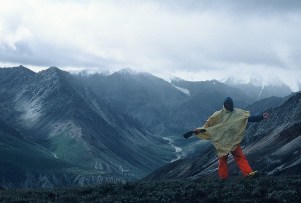
Kluane – a vast wilderness reserve

We got tired of rock-hopping along the creek with full packs and got the bright idea to climb what appeared to be a steep but short bluff at a bend in the stream. But it turned out to be very high, with few sure foot and handholds – one of those never-ending rises that keeps going up the higher you climb.

But Dave managed to make it up, and I was stuck on a slippery ledge, just out of reach of solid handholds. I carefully dug out a foothold, made the move – and missed! With both hands I dug into the loose soil and gripped with all my might while feeling frantically with my feet for a solid hold. But I began to slide – slowly down towards the edge. Had I fallen over that would surely have been the end!

Thankful for another chance at life – to breathe, and smell, and eat, and sleep, and look around at the land, water and sky – to feel the wind and the rain, to bundle against the cold, crawl into a warm, cozy sleeping bag, and share that little tent with Dave, who reached out his hand and pulled me to safety. It was indeed wonderful to be alive and well – we just hoped the Grizzlies wouldn’t bite our asses!
060a
Camped on the tundra

Eventually the sun returned, lighting up the glistening peaks – snow fields and glaciers reflecting the welcome sun and blue sky. Ground squirrels chirped from all reaches of the pock-holed meadow. Delicate butterflies alighting on moist, frail flowers.

Four Mountain (Dall) Sheep scampered from a nearby hillside to become four pure white dots against the dark talus of a distant slope. Bees buzzing, magpies landing close by – fresh bear scat and diggings everywhere.

But the nights were bitter cold. The stars came out and shown despite the brilliance of the moon, which lit up the brief darkness of the snapping, clear cold nights. Dave broke the ice in our precious stream for morning tea. Our tent looks very homey even in its smallness in this vast wilderness.   

Descending to the treeline and into the tall pines lining the windy shores of Kluane Lake, a local pickup brought us along the Alaska-Canadian Highway past rugged peaks of the Alaska Boundary Range in the Coast Mountains to a cold, swampy campsite at Haines Junction

039a
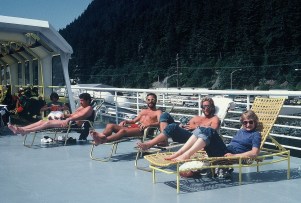
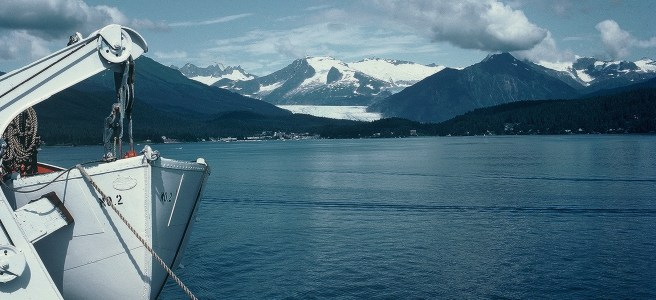
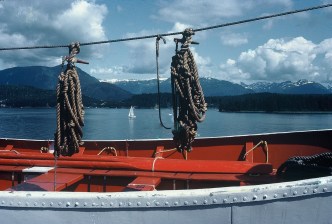
Catching a few rays on board our ferry

After fruitless hitching, we splurged and took a bus over Chilkat Pass back into the USA. Through relentless freezing rain, ice and snow, we followed the Chilkoot River along the back side of Glacier Bay past a native village called Klukwan, and finally to the beautiful little seaport of Haines, Alaska

Four relaxing days on BC Ferries carried us through the Lynn Canal Fjords to Juneau and down the rest of the Inside Passage along the coast of British Columbia to Seattle, USA.

We had survived our Klondike expedition!

Stay tuned for more stories, coming soon!

You can read more about Jim’s backstory, here and here.
North to Alaska (Part One)

Author’s Note: In July 1983, my brother Dave and I (a.k.a. Joe Juneau and Skookum Jim) headed off for a three-week trek into the vast frozen reaches of the Klondike. It was Dave’s first backpacking adventure – and probably his last. He was not big on tent camping in the freezing rain, or surviving on freeze-dried meals for weeks at a time – nor was I. But having recently graduated with a college degree in camping, I was eager to put my new knowledge into practice.

001aa
Sailing deck fare on the BC Ferrys

Departing Seattle at dawn, the ferry carried us north to Alaska through smooth, opaque water in the early morning calm. The Inside Passage weaves through coastal islands on the Pacific coast of North America, and was one of the sea routes carrying prospectors north during the Klondike Gold Rush of 1898. 

Traveling deck fare – warmed at night under heated lamps – we sailed for four days past jagged snow peaks and glaciers flowing in awesome silence down to Spruce and Hemlock-covered ravines, streaming with cascades. A few fellow deck passengers snored easily as we approached Juneau, Alaska’s remote capital.

Camped by Auke Lake at the terminus of Mendenhal Glacier – calving huge chunks of ice into the lake – we broke out our rain gear as a few drops began to fall from an overcast sky and hitched into town for dinner at the Red Dog Saloon. Chatting with a local “fisherman by trade” in the drizzle of Juneau, we met fellow passengers Kate and Terra who saved us deck chairs the following day for our trip to the Tlinket Indian settlement at Sitka City on Baranof Island.

042
Hiking through coastal rain forest

We saw Bald Eagles, Killer Whales, hiked historic trails by Native totem poles carved from massive Red Cedar trees, visited a Russian Orthodox church and climbed Castle Hill, high above the city where Russian Alaska was formally handed over to the United States in 1867.

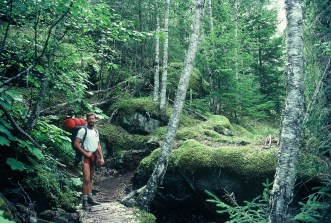
Sailing on to Skagway at the northern turn of the Alaskan panhandle, we hiked through lush, moss-carpeted coastal rain forest bursting with life – eager to live it to the fullest during the short summer season.

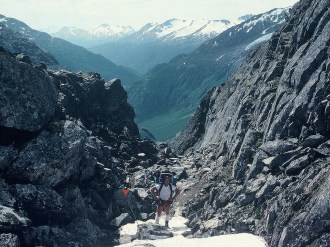
We climbed from sea level up into the snow and ice and finally over the steep 3,500 foot Chilkoot Pass, made famous during the 1898 Gold Rush. Information boards along the trail told the story of that epic journey undertaken by so many hopeful prospectors, including historic photos of the huge loads of supplies and equipment – even horses – being transported over the pass.

046a
Summiting Chilkoot Pass

In winter, Gold Rush stampeders struggled through blizzards, freezing temperatures and avalanches, transporting thousands of pounds up 1500 steps of the “golden staircase” cut in snow and ice. Indeed, many items never made it, including neatly piled caches of long wooden slats wrapped in canvas we passed along the way, that were to be assembled into boats to float down the Yukon River to the gold fields.

Descending into British Colombia, Canada, we entered yet another world of snowy boulder-strewn tundra and moraine. Glaciers flowed in every direction from towering mountains feeding the clearest, coldest cascades of snow melt.

Camped by pristine lakes, twittering loons laughed from across the water. Happy Camp, as it was aptly named, was the first camp established by prospectors as a welcome reward and rest stop after summiting the steep and perilous 26 mile pass, which shoots up a additional 1000 feet in the final half mile. Happy Camp was also reportedly the first camp where prostitutes were available. Although those services were no longer in evidence when we arrived, we did meet two friendly Canadian lasses camped there who joined us for the rest of the journey.

020a
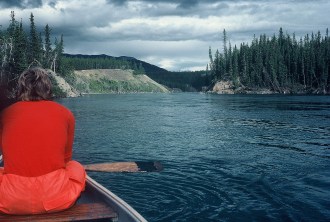
Paddling down the Yukon River

We also met a nice couple in Whitehorse, the capital and only city in Yukon Territory, whose 28,000 people comprise the majority of Yukon’s population. They graciously lent us their canoe and then picked us up downstream a few days later.

So off we went, paddling down the mighty Yukon River – through wide open, empty wilderness – 10,000 square miles of Yukon Territory to every resident. North-country breezes bracing and invigorating, and not a soul in sight.

On the Alaska-Canadian Highway, we hitched to the park entrance and registered the color of our packs at the ranger station for identification in case we did not emerge on time. We were given instructions to be on the lookout for Grizzlies, particularly when hiking through patches of Sedge Grass that the bears like to eat (we soon noticed that stuff was everywhere!) and set out on foot into the uncharted wilderness of Yukon’s Kluane National Park.

Stay tuned for Part Two, coming soon!

You can read more about Jim’s backstory, here and here.
Traveling Road Show USA

Author’s Note: Re-entry into ‘fast lane’ USA after six months exploring the backwaters of Asia was culture shock in reverse – a relief at first, then stressful as time went on. Back on the American diet, I gained 20 pounds in 20 days, and embarked on a six-month around-the-country excursion – hitting 30 states by year’s end.

009ab
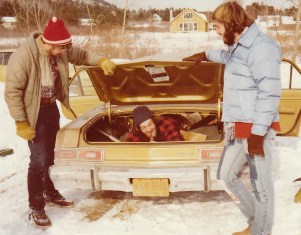
‘Trunkated’ Auto Mechanics

It was a typical road trip back east – traveling in a broken down ‘65 Mercedes with four of my college buddies. We were the Czechoslovakian Bobsled Team running, pushing furiously down icy roads to jump-start it. Then hopping in, we drove merrily on our way from Colorado to Connecticut without a clutch, a faulty electrical system, and through the Pennsylvania hills with no brakes. Somewhere in New York the fuel pump burst.  But eventually we made it home safely for Christmas.

The Traveling Road Show, as we christened ourselves, rolled into the New Year, as our merry band skidded across the frozen northern reaches to descend upon unsuspecting households, picking up and dropping off friends along the way. In Atlantic City, we came out ahead by snagging quarters from the floor by the one-armed bandits.

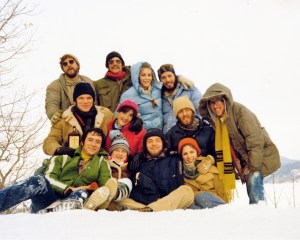
From New York City, we headed to Lake George in the Adirondacks for a grand reunion of Silver Bay YMCA friends on winter break from university. I had just returned from Sri Lanka, and was itching to get back overseas. But these reunions with summertime friends were not to be missed, and there were many others to visit all around the country.

SBA004
Winter reunion at Lake George, NY

But it all ground to a halt suddenly on a cold, dark night of nasty sleet and freezing rain in State College, Pennsylvania. Mononucleosis (also known as “the kissing disease” because the virus is spread through saliva) turned a 3-day visit into three months – sick and stretched out in a sleeping bag for 10 weeks on the floor of a forgotten upstairs closet.

Months of relentless fatigue, illness and gut pain had taken their toll on my body and spirit, as the strength and energy ever so slowly returned to my weary limbs and weakened spirit. A hefty price for that fling with the British girl in Kathmandu!

Indeed, it was the longest Spring in memory, and I wondered if the sun would ever return to the dreary Appalachians. Cold gray skies, relentless rain, and finally a few cautious rays lighting up the dogwood, cherry and apple blossoms – brilliant in the long-awaited sunshine. At last, I was well enough to travel and headed south and then west, visiting YMCAs and summertime friends all along the way.

SilverBay-68ab
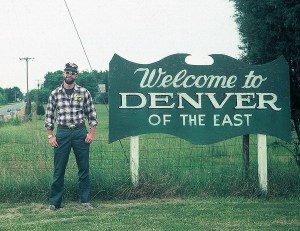
Denver, North Carolina

The train rolled through utterly grim coal-mining towns to Philadelphia, then followed the Delaware river south to Baltimore, Chesapeake Bay, Washington DC, through Virginia and finally to Greensboro, North Carolina to meet a certain southern belle. A couple days in Raleigh, then by car to Boone where we stayed in a cabin overlooking the misty valleys and heavily forested ridges of the Appalachians.

Relaxing on the deck with a guitar, or in total silence but for a few woodland birds, we gazed out over the vast expanse of endless ridges and densely forested valleys. Bright spring flowers beside rustic homes pushing up through pungent, black earth. Eerie mists rising from forgotten valleys. Wondering at all the lost tales of men – their lives and deaths held secret by these, the oldest mountains on earth.

The train out of Charlotte swept south and west through Georgia for more reunions in Atlanta, and on to Alabama and the flats of Tuscaloosa, Meridian and Hattiesburg Mississippi – flat and flooded. Then a five-mile trestle spanning Lake Pontchartrain into Louisiana and New Orleans where the local YMCA hosted me. Another southern belle gave me a wonderful historic and cultural tour of the French Quarter and Bourbon Street, jazz and street parties everywhere, and to the mighty Mississippi for a ride on a grand old paddle boat — all under the full moon of a balmy Louisiana night.

SilverBay-84a
At home in Colorful Colorado

By June I had traveled through 23 states, hitting 30 states by year’s end. Back at home in Colorado, the mountains were as peaceful and magical as ever with summer colors. Beautiful flowers everywhere – there had been plenty of water that year, streams bubbling merrily along. 

Local TV and radio interviews organized by my sponsoring YMCAs in Illinois and Wisconsin helped raise enough money for my assignment with the YMCA of Western Samoa. And again, I had to find a map to see where they were sending me!

I was recharged and ready for more adventure out in the world. But not before taking advantage of the summer months in North America. So my brother Dave and I set off for Alaska and Yukon territory, following the trail of the 1898 Gold Rush. Stay tuned for “North to Alaska” coming soon!

You can read more about Jim’s backstory, here and here


India and Nepal on $3 a Day (Part Two)

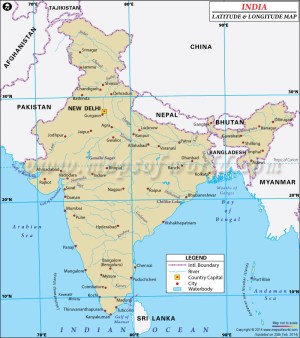
Author’s Note: After two weeks in Nepal, I traveled the length of the Indian subcontinent and across the channel to Sri Lanka (about 4000 kilometers or 2500 miles) for just $30 dollars but it took 12 days.

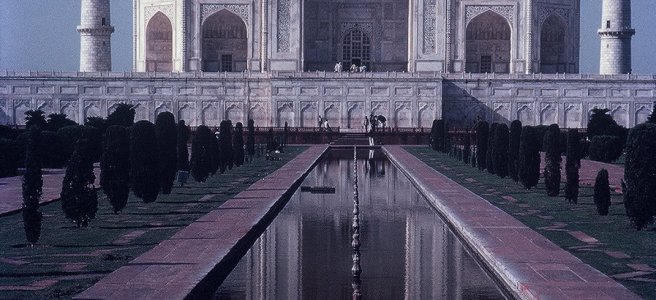
indian-subcontinentIncredible India – you either love it or you hate it. From the Taj Mahal – truly magnificent in the setting sun and reflecting pool, I returned to Delhi and boarded the Taj Express Railway for the southern coastal city of Madras (Chennai). First class passage took three days and three nights and entitled me to one of the four fold-down wooden berths in the compartment. But this was India – with wall-to-wall people. So, each time I returned from the toilet I had to eject one (or more) people from my berth.

Rail stations fronted with dusty, ramshackle housing, and chaotic jumbles of electric power lines. At every stop, a sea of hands thrust through the compartment windows with various snack items for sale. Hot sweetened milk coffee served in a glass swished “clean” with the seller’s finger. Then slowly rolling on past people squatting on the cement rim of a canal wall streaked with lines of shit dribbling down.

042-the-sacred-cow-2
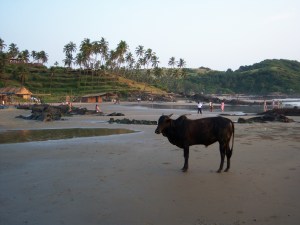
A Sacred Cow at the Beach

Ocean breezes at Madras were pleasant, and the beaches looked inviting from a distance. But I quickly realized swimming was out of the question – with the kids and just about everyone else taking their morning dump on the beach. 

The instant I stepped down from the train, I was hit with the usual frantic press of bicycle rickshaw drivers all insisting you ride with them, and you know none of them can be trusted to give you an honest price, or even a direct ride to where you want to go.

After a few minutes of this madness, I shouldered my rucksack and walked to my guesthouse, which took me past the local bus station (a field strewn with shit), back alleys with pigs rooting in horrible garbage, pitiful dogs hairless with mange, one with prolapsed entrails hanging out its back side, and covered with flies. And yet, colorful and festive processions seemed to fill the streets at almost every turn. 

The best beach scenes were at night – when you can’t see all the rubbish, but then you risk skidding through one of the numerous cow pies, scattered everywhere. But the women were lovely, in colorful saris or loose trousers narrow at the ankles and topped with a tunic, a red dot (bindi) on the forehead, and loads of jewelry – golden nose rings, ear rings, arm rings, wrist bangles, anklets, and toe rings. Villagers skinny with hard work. Sharp, flashing eyes.

img034-3
A  fingerless leper and friends

From Madras I boarded a local train to the southern port at Ramamswaram to catch the ferry for Sri Lanka. But it was a horrible time there. From the moment I stepped off the train I was sick. Fever, sweating, weak, and had to wait four more days to get on the ferry.

With any number of possible causes, and not uncommon among travelers in India, I had developed a bad fever and dysentery and was laid up in a guesthouse while waiting to get on the ferry. Was it that dubious glass of ‘supposedly’ boiled water – discovered only later with mosquito larvae swimming in it – who knows?

Fortunately, another traveler brought me food each day, and together we endured the long lines at the ferry terminal only to be told each time the tickets were sold out – until we realized “grease” money was required. At last we got on the ferry, caught a train to Colombo, and I somehow ended up at a nearby Christian Mission Hospital. I was seriously ill, delirious, and still have no idea how I got there.

img039-2
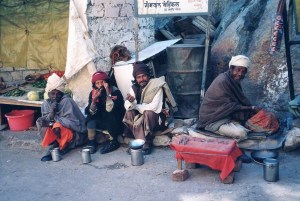
Lunch with a group of Hindu “Sadhus” (holy men)

Local hospitals typically don’t provide food service, so patients must rely on friends and relatives to bring them food and other essentials. While being treated for dysentery, my skinny orderly brought me a large bowl of vegemite (fermented yeast) soup each day, and regularly dragged me out of bed  and onto a scale – I suppose to see if I weighed as much as he did. At that point, I didn’t.

Somehow, the YMCA found out where I was, came to collect me and I recovered at the YMCA.

Still incredibly cheap today, India and Nepal are not easy traveler destinations. And of course, the grim and astonishing poverty is shocking and draining. After a month of hard travel, I was ready to leave. But love it or hate it, I keep returning for more life-changing experiences in these fascinating places.

 Stay tuned for more stories, coming soon!

You can read more about Jim’s backstory, here and here

India and Nepal on $3 a Day (Part One)

By Jmhullot - Own work, CC BY-SA 3.0, httpscommons.wikimedia.orgwindex.phpcurid=40358783

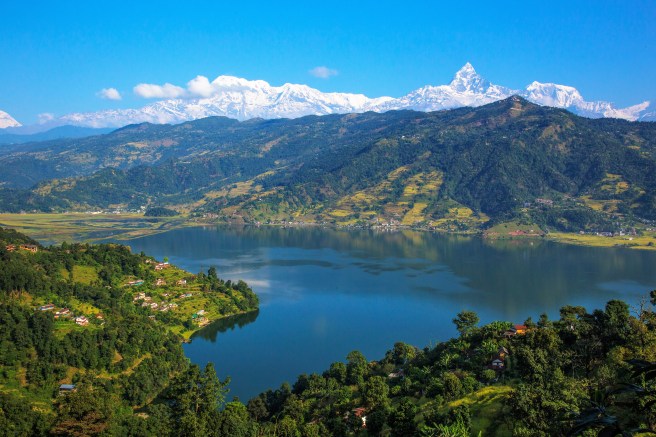
The Annapurna Range behind Phewa Lake, Pokhara (Jmhullot/ Wikimedia Commons) (CC-BY-SA)

Author’s Note: In 1982, after finishing my assignment with the Colombo YMCA in Sri Lanka, I traveled for a month through Nepal and India before returning home to the USA. I flew from Colombo to Kathmandu, and after two weeks in Nepal, traveled the length of the subcontinent to the southern tip of India, and back to Sri Lanka by ferry – averaging about $3 a day – and lived to tell about it!

All roads lead to Kathmandu – really! Very few tar-sealed roads in the this mountain kingdom, and the narrow, winding streets of Kathmandu, stuffed with people in a land of stark contrasts.

028b
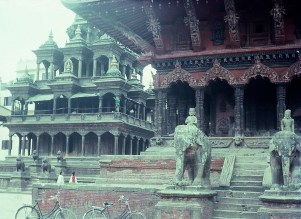
Temples of Patan Durbar Square

I awoke to the sound of vomiting next door. It seems someone is always sick, spitting, gagging, vomiting, or blowing snot from overhanging rooftops. Men, women and children smoking, silver anklets on naked children taking dumps in the street. Old women with boat-anchor earrings, golden nose-rings. Men affectionately holding hands and wearing funny little hats with warm smiles and greetings of “Namaste” everywhere (with wobbling heads).

Many different costumes are worn, depending on the ethnic group. Tibetan women draped in colorful rugs, spitting red betel nut chew (pan), sporting nose rings and ear tacks. Daily baths for the water buffalo. Pagoda-style temples reflect the sense of harmony between Buddhist and Hindu shrines. Nobody hassles you – just pure, simple and open curiosity.

by-bikram-pratap-singh-own-work-cc-by-sa-3-0-httpscommons-wikimedia-orgwindex-phpcurid32713244
Eyes of Boudhanath, Kathmandu. By Bikram Pratap Singh – Own work, CC BY-SA 3.0 commons.wikipedia.org

Meanwhile, “Riders on the Storm” throbs on with the typical Doors sense for the ominous in the residual hippy atmosphere of cheap guesthouses and simple eateries where the backpackers hang out – searching for Oriental philosophy, religion, enlightenment, or just an affordable good time with plenty of dope.

Everything was incredibly cheap – at $4 per night my luxury hotel was a splurge. I was new to the traveler scene and had no idea where to stay, where to go, or what to do – but quickly began meeting travelers from all over the world. Many young Australians or Europeans were on year-long and multi-year trips – and this was a real eye-opener for me.

It was a friendly place, and I soon joined a young Aussie couple for a three-day trek to see Mount Everest (Sagamatha) at dawn – rising in a ring of snow peaks all above 25,000 feet, with the great green expanse of the Kathmandu valley spreading out behind us.

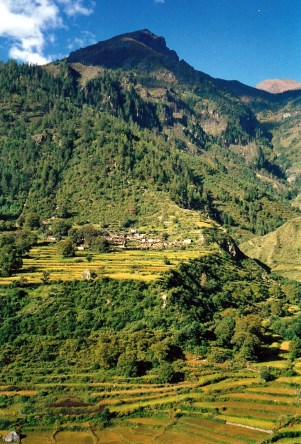
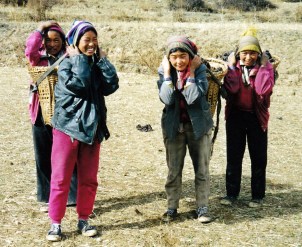
img_013aWe hiked through massive mountains rising out of the greenest valleys painted with meandering streams and morning mist. Tall, sharp, snowy peaks rising above the steep, green terraced and irrigated hillsides of rice and corn, carved and altered all by hand, loads carried on the backs of young and old, usually strapped over the forehead, barefoot.

I carried just a simple day pack with a change of clothes, basic medical supplies and other essentials. In contrast to backpacking in the States, where you carry everything (e.g. food, cook stove, bedding, tent) the villagers living along these mountain footpaths make it easy by providing lodging and food, and for a mere pittance – along these, the main thoroughfares of the region.

It was the height of the rainy season, and leeches were out in force. Rock salt inside our boots did little to deter them, and we carried bottles of salt water and cotton balls in our breast pockets for easy and swift access to dab the blood-swollen bodies that turned up wherever veins were available to latch onto.

We trudged on through the rain, pulling off the blood-swollen worms, skin bloodied with tiny leech cuts. Stands of tall, wet grass were particularly notorious for the tiny parasites which soon became engorged on our blood, and rained down upon us from trees. But the skies cleared on the final morning for spectacular views of the world’s tallest mountain.

img_312a
Nepali girls on the trail

Confident, with the first trek under my belt, I struck out on my own to tackle the Jomson Trail – a 21-day trek around Annapurna, the second tallest mountain on Earth. One is never alone on these trails, with a constant and determined following of kids: “hello rupee”, “one pen”, “what’s your name?”

But a week into my solo trek, the rains, leeches, and finally a frightening rain-soaked mudslide sent me packing out of the bush, and I headed for Pokhara, a laid back, lakeside travelers’ haven about an eight hour bus ride from the bustling capital Kathmandu.

Swimming and boating, lazing in the cool shade of the forest, insects buzzing high in the trees – a silent, empty skiff on the glass surface of the deserted lake reflecting explosions of color, life and enchantment all around. No beggars, no leeches, no urchins no hassles – just quiet solitude and nature’s beauty and mountains all around, snow peaks aglow in the evening twilight.

Stay tuned for Part Two, coming soon!

You can read more about Jim’s backstory, here and here.
Volunteer in Sri Lanka (Part Three)

Author’s Note: At six weeks, our summer internship with the Colombo YMCA was coming to a close, and Michelle was ready to go home. But I was just getting comfortable. So, with the YMCA’s blessing I stayed in Sri Lanka a few more months, and traveled to Nepal and India before returning to the USA.

011-2
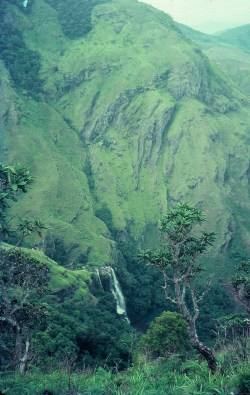
Dramatic mountain scenery

There was so much to see and do. Day trips along the southwest coastal beaches to a 17th Century Dutch fort for perfect sunsets. Crossing the island on a narrow gauge colonial era “toy” train that winds its way through lush, verdant plains into mountain country of breathtaking beauty. Then by bus, through a forested canyon filling with mist like a giant exhaust in the cooling rains, and on to the northeastern port city of Trincomalee. A wonderful sense of unspoiled innocence and friendliness in the villages. An old woman gave us all mangoes from her simple, highland homestead.

Riding high above spectacular waterfalls that empty into deep gorges and feed tiny village hamlets dotting the hillsides below terraced tea plantations, the jungle opened at last to a vast expanse of brilliant, white sand facing the wide blue sea. Not a soul for miles but for a few fishermen heaving on their long dugouts to return to the sea.

A fantastic display of corals and darting schools fish entertained the senses in a circus of colors and shapes in the emerald green water as I swam out to the remnants of a reef (much had been blasted away by fishermen). Huge clams and starfish rested in the rifts and valleys of the sandy bottom.

010-2
Wilderness hiking and camping

My hands were smarting from neat slices laid open by the razor sharp corals as I climbed onto the highest rocks overlooking the bluest sea. Waves broke with sparkling spray in the sunlight as the empty strip of white sand curved away in a neat fringe to the jungle behind. As in the jungle, always on guard for the unknown, and yet, filled with the thrill of fun and adventure!

I never got used to the leeches, which are generally harmless but creepy – particularly when the forest floor would literally appear to be moving as one giant mass of the tiny, but determined blood suckers. No matter how nimble your step, it was impossible to cross that stretch of ground without picking up at least several of the little devils that somehow managed to quickly find a vein to latch onto – even inside your hiking shoes, only to be found later in blood-stained socks, squashed before their presence was known, or swollen, gorged on your blood. Others would drop from above only to be discovered later – blood-gorged in the hair, in the beard – no fun!

020a
Mining for gem stones

And don’t forget the insidious bed bugs that lived in the wooden bed frames and handsome wooden chairs at the YMCA. You could almost gauge the length of a meeting seated in one of those chairs by the extent of bed bug bites along your back and the backs of your legs perfectly in line with the chair’s wooden slats – silently and painlessly sucking your blood, but leaving horrendous red welts that itched for an incredibly long time afterwards!

But my time in Sri Lanka had come to a close. A six week internship had turned into six months, which included some adventure travel and trekking in Nepal, and an amazing journey down the length of the Indian sub-continent (12 days of budget travel cost just $30). The tears choked me as I struggled with my farewell speech – already homesick for Sri Lanka as I said good-bye to my friends, with their endlessly cheerful, open kindness and love, and everlasting smiles and innocent eyes. 

009-2
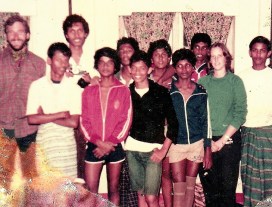
YMCA youth group, with Vaughn, Michelle and Jim

It was terribly hard to leave, but eventually I boarded a plane for Germany to see my sister Jean who was living in Munich at the time. Germany seemed so easy, laid back, quiet – and clean, compared to the madhouse of Colombo. Spectacular alpine hiking in southern Bavaria and Austria and good heavy food and drink were in order before returning to the USA.

My digestion was suffering with another change in diet, but the bathroom was clean, and private. I felt relaxed. And the acrid odor of stale urine in the YMCA men’s room was fast becoming a distant, fading memory.

The stars over Sri Lanka are so different, the kids so delightful, and the women so very lovely, with their colorful parasols and elegant saris. They will all remain in my heart forever.

Stay tuned for “India and Nepal on $3 A Day” coming soon!

 You can read more about Jim’s backstory, here and here

YMCA Volunteer in Sri Lanka (Part Two)

Author’s Note: Sri Lanka’s long and devastating civil war between the predominantly Tamil north and the Sinhalese south began in 1983, disrupting the peace and tranquility of the entire country for the next 26 years. During this time, the YMCA joined other local and international aid agencies to provide support to the many thousands of people affected by the conflict, and continues to engage deeply with young people and their communities as they rebuild their lives. The YMCA has also been quick to respond to natural disasters, including meeting the massive needs that emerged following the 2004 Asian Tsunami.

In 1982, Sri Lanka’s civil war hadn’t started yet, so Michelle and I were able to travel freely throughout the country, savoring the incredible natural beauty, the warmth and friendliness of the people, and the rich religious, social and cultural heritage of this ancient land. 

024c
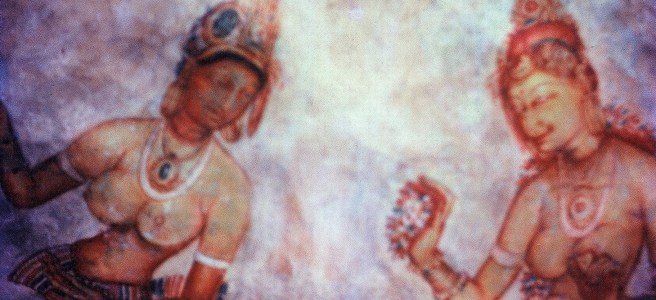
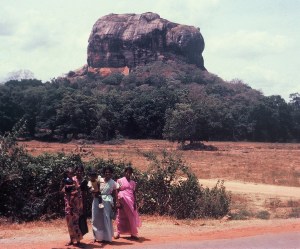
Ancient Rock Fortress at Sigiriya

We visited botanical gardens, spice plantations, highland tea estates, gem mining pits, and toured ancient cities, temples and fascinating ruins dating from 300 BC. At the ancient rock fortress Sigiriya, narrow steps etched into the cliff-side led us up the sheer rock face to the caves housing well-preserved 5th century fresco paintings.

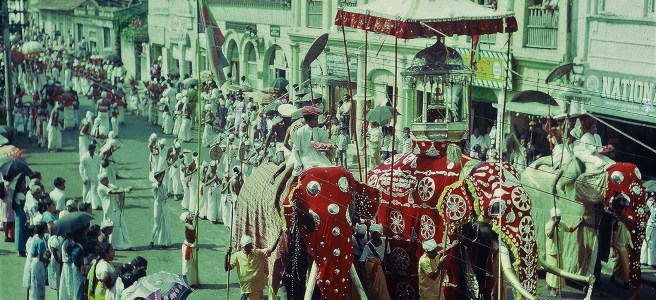
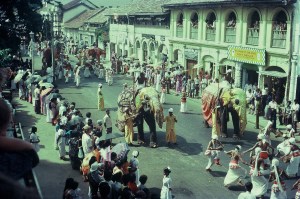
Religious festivals are integral to life in Sri Lanka. High in the easy-going “capital of the hill country” we watched the entire frenetic procession (10 days and nights) of the Full Moon Perahera from the roof of the Kandy YMCA. It was an amazing spectacle of indescribable splendor, including many hundreds of dancers and drummers in dazzling costumes, balancing acts, horns blaring, whips cracking, and over 100 massive elephants in batik robes – the largest one parading the tooth relic of the Buddha.

The predominant religion in Sri Lanka is Theravada Buddhism (over 70% of the population is Buddhist), followed by Hinduism, Islam and Christianity. But 2500 years of history bring a vast array of traditions, rituals, music, dance, legend and mysticism.

016-2
Full Moon Perahera

At the YMCAs in Colombo and Kandy, I taught swimming, first aid, led youth programs and assisted at a camp for disabled children. The Sri Lankan kids were delightful, and amazingly respectful to any “teacher” or adult entering the classroom, immediately and quietly lining up facing the front.

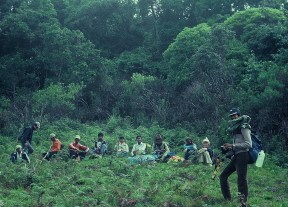
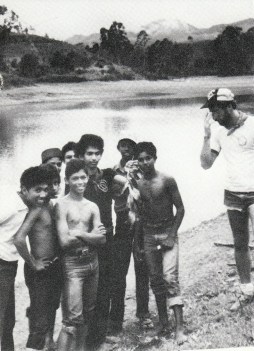
A real highlight was taking inner city kids hiking and camping in the rugged mountains and jungles of the island’s interior, where we caught and cooked fish each night for dinner. These kids had never been out of the impoverished urban center. But several came prepared with a small packet of herbs called a “snake stone” which they insisted would draw the venom from a snake bite wound.

012-2
A fine catch for dinner!

Indeed, on our jungle treks we were in the company of deadly cobras and vipers, which scurried away as we approached. No one was bitten, but one kid had the unfortunate luck to wake up one night with a snake inside his sarong!

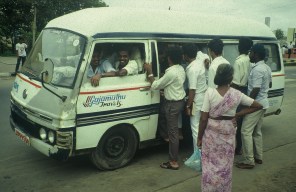
Local transport was “a trip” in itself – enduring all-night train journeys standing packed like sardines in 19th century locomotives sporting “Spitting Prohibited” signs, or in overloaded minivans packed with passengers, blaring music, blasting horns, and speeding as fast as possible over the horrendous roads – more trips translated to more profits.

But ultimately, we were traveling on “Sri Lanka Time” which meant that “you arrive when you arrived” – except for those numerous overturned minivans strewn alongside the roadways. The noisy old government buses weren’t much better as they roared and rattled along at top speed, spewing smelly, black diesel exhaust, and with few rest stops.

There were never any toilets on these stops. Everyone just went behind bushes and women squatted underneath their saris. I learned to carry some extra plastic bags on these overnight trips to use in emergencies, and then toss out the window.

021b
Grab a seat!

One time while riding in a packed and wildly careening bus that seemed committed to making our destination in record time with no stops, I squeezed through the solid mass of passengers to the front of the bus and presented my desperate situation to the driver – who finally stopped, much to the relief of the other passengers who were also suffering in need of a toilet stop.

Once, when returning from a field trip, I was given a different room at the YMCA. It was common to see huge sewer rats scurrying around in the streets and drains beneath old buildings like the YMCA. But that night, while sleeping under a wobbly ceiling fan, I was rudely awakened when one of those hefty fellows fell through a hole opened by the fan and landed right on top of me – whoops!

Stay tuned for Part Three, coming soon!

You can read more about Jim’s backstory, here and here

YMCA Volunteer in Sri Lanka (Part One)

Author’s note: “The YMCA (Young Men’s Christian Association) is one of the oldest and largest movements for youth in the world. Founded in London, England in 1844, it now works in 119 countries, reaching 58 million people. The YMCA works to bring social justice and peace to young people and their communities, regardless of religion, race, class, gender or culture.”  World Alliance of YMCAs

A few pints of Guinness helped calm the nerves on our London layover before flying on to the tropics. Michelle and I were about to embark on a whirlwind of incredible adventures in the steamy heat and strange madness of this exotic third world nation – Sri Lanka!

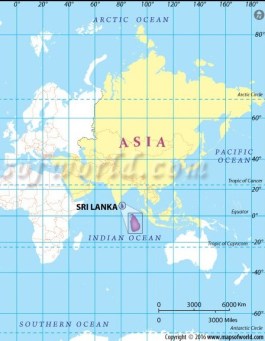
location-map-of-lanka-b
Where is Sri Lanka?

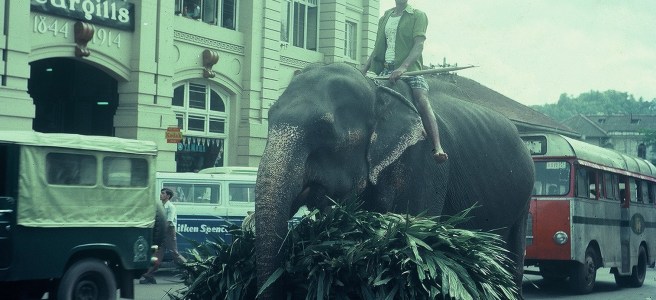
Beginning our descent, we peered anxiously out the window to a sea of coconut palms that opened to narrow, tar-sealed roads lined with smoking piles of coconut husks. The busy thoroughfares were clogged with motor scooters, three-wheeler taxis, bicycles, ox carts piled high, barefoot pedestrians carrying huge loads or pushing overflowing carts – and elephants, meandering as if without a care. Jolts of adrenaline shook me as the surreal scene appeared before us. It was really happening, and we would soon be landing in this strange land – for good or for ill.

It was June 1982, and our first trip to Asia. Michelle and I had volunteered for a six-week summer internship with the Colombo YMCA in Sri Lanka, organized by an American YMCA. We were the only participants in the exchange program and had met just prior to boarding our flight. No formal orientation had been provided prior to our departure to help us prepare for this experience, nor was any financial stipend included. My high school paper route savings had covered the cost of my air ticket. But our food and lodging would be provided at the Colombo YMCA and at home stays with local families.

003a
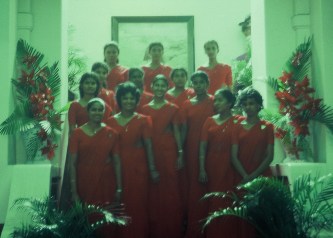
YMCA women in their elegant saris

Our reception at the Colombo YMCA was   genuinely warm and welcoming. We also spent time at the Kandy YMCA in the central highlands, and stayed with families in the northern city of Jaffna, across the strait from India and in the cool, rain washed highlands of Nuara Eliya. Everyone was incredibly friendly and hospitable, with cheerful smiles and laughter all around.

Our arrival coincided with preparations for the YMCA’s “Centenary Celebration” commemorating 100 years of continuous service to the community and the nation, particularly the underprivileged. The President of Sri Lanka was the Chief Guest. A special postal stamp was issued in recognition of the YMCA’s steadfast commitment to youth leadership development, and for its outstanding achievements bringing all communities and religions together in a common fellowship.

002-3
His Excellency J.R. Jayewardene, President of the Socialist Republic of Sri Lanka, addressing the Colombo YMCA Centenary Celebration

One of our first tasks was to help prepare for the event. But it was hot and humid, and the work painstakingly slow – even the smallest task seemed a major undertaking – and almost any time was teatime! I found it necessary to nap in the heat of the day.

Staying three floors above the YMCA kitchen, I was awakened every day by the ominous smell of curry wafting through my shutters and over the tiled roofs above the city’s worn, tired streets. From my window, I could see the sweaty kitchen workers busily wiping dishes “clean” with their bare hands, ready to be used again.

The slightest exertion produced torrents of sweat, and my weight was dropping. I needed to eat more, but even the mildly spiced food was burning holes in me. The sickly sweet, syrupy “Cokes” (a locally produced concoction) did nothing to quench my thirst, and the overly sweetened milk tea brewed from otherwise delicious and wonderfully aromatic black tea, for which Sri Lanka (formerly “Ceylon”) is famous, didn’t help much either. I soon switched to downing gallons of plain bottled soda water whenever possible.

with-host-family
Staying with my host family in Colombo

One of my favorite hangouts was the YMCA cafeteria where my trusty waiter Ratnapala kept me well fed with rice and curry, dahl, curd (yogurt or dahi), egg “hoppers” (crispy-edged crepes filled with a steamed egg), an amazing assortment of succulent fruits, and milk tea. The cafeteria was also popular with old religious zealots eager to spin their yarns to this wide-eyed young Y-guy from America.

Tropical evenings at the bar next to the YMCA were pleasantly cool and refreshing, with ice cold pints of locally brewed lager and heavy, brown stout – thanks to the Brits!

Stay tuned for Part Two coming soon! 

You can read more about Jim’s backstory, here and here

Living and Working Abroad: Is it for you? (Part Two)

Author’s Note: In this “Living and Working Abroad” series, my aim is to demonstrate how anyone can experience genuine fulfillment and self-discovery through different, freer ways of living – ones that are not narrowly focused on blind ambition, resume building, or saving the world, but more so on following your heart, discovering your life’s purpose, moving with the natural flow of your energy as it connects with the universal energy. By keeping it simple, easy and not forced, this may involve “living outside of the box”, experimenting with lifestyles learned from other cultures and different ways of living – being open to other priorities in life.

There are many social and economic benefits to living abroad. The lower cost of living in many countries can be tremendously liberating, no matter what your age or condition. Teaching English is a rewarding way to stack up some chips, and pay off school loans. Teachers are also highly respected, and the respect shown to elders is particularly refreshing. Rather than getting older, you just get better!

You may be considering retiring in a foreign country (full-time or as a seasonal “snow bird”) and in many countries, an investment in your dream retirement home can be a real bargain. Vibrant expat communities are emerging in countries throughout the world. But be prepared for “developments” that may impact your chosen surroundings. Over the years, I have moved from idyllic island hideaways that became too busy, or badly developed. Places tend to change over time, and not always for the better.

Whether you are retired overseas, working as a career expat, a budget traveler, or a young volunteer on your first overseas assignment, see what attachments you can release – how free can you become?  On a limited budget and away from all the luxuries and assumed “necessities”in the West, you can eliminate vast dependence upon material things and lifestyles. For example, in many parts of the world, public transport is widely available, convenient and cheap – so you can easily and happily do without a car. Imagine that!

Raise money and gifts-in-kind fearlessly from other foreigners living abroad. They never feel like they belong, or are truly involved with the populace. In this way, you can give them a chance to enter, and deal with a nagging guilt feeling. The funds you raise will be immense in the local economy, and inspire similar work among the locals. Unemployed (often bored) spouses of expat workers make enthusiastic volunteers as well.

Get a regular physical check up – most of us pick up things overseas, and do not realize we are being dragged down by a new bug. And don’t assume you can more easily get these things taken care of at home. Doctors in the field know the problems better, and state-of-the-art healthcare is available in most countries for a fraction of US healthcare costs.

Be open – so much comes from the “chance things” that come up. Even a dreadful all-night bus or train ride may win you the acceptance for more meaningful work later. Be aware of the frustrations and accept them as a reality to be expected. In this way, you can avoid the creeping dependency on alcohol and other drugs, sex workers, dull routines, or friends who rob you of your fullness. Embrace the wisdom of using daily meditation and yoga (or some form of exercise) for commencing each day with a calm, clear mind.

Keep a journal – it helps you recover and even discover amazing and funny things which happen to you. (My posts here draw from 40 years of personal journal entries!) Remember that the only real learning comes from experience. Rereading it often gives you a sense of gradual progress over time as well. Take pictures early on while it is all still fresh.

Visit a local “backpackers” hostel for a fresh batch of fearless and exciting friends. And when discouraged, visit the lobby and pool of the best hotel in town, and over a drink, ponder the one-day cost of the tourists around you, in order to visit this place where you live absolutely for free. For an added lift, take one to a local eatery for a bowl of noodles and a real view of your country. (This results in a big, free supper for you at the hotel later!) Ponder also the freeing value of this wealthy, retired man’s experience you are able to have while still young. It will always change the way you live for the rest of your life.

Stay tuned for “YMCA Intern in Sri Lanka”, coming soon! 

You can read more about Jim’s backstory, here and here

Living and Working Abroad: Is it for you? (Part One)

Author’s Note: In this series, my aim is to demonstrate how anyone can experience genuine fulfillment and self-discovery through different, freer ways of living – ones that are not narrowly focused on blind ambition, resume building, or saving the world, but more so on following your heart, discovering your life’s purpose, moving with the natural flow of your energy as it connects with the universal energy. By keeping it simple, easy and not forced, this may involve “living outside of the box”, experimenting with lifestyles learned from other cultures and different ways of living – being open to other priorities in life.

Have you ever dreamed of discovering other countries, learning multiple languages, relishing foreign cultures and living abroad like a local? Are you yearning for something beyond your national borders, beyond the mainstream tourist destinations, beyond material lifestyles and empty career paths?

Growing up in the inner city of Buffalo New York, my family took camping trips around the USA and even to Europe. But Hawaii, for example, seemed like a far-off place only for the rich folks – and living in a foreign country was certainly never in my dreams. But all that changed with a six-week internship (that turned into 6 months) with the Sri Lanka YMCA, and 35 years later I’m still out in the world, having lived and worked in over 20 countries so far. I eventually made it to Hawaii for six wonderful years of “simple living” as a grad student at UH, and I currently live in a peaceful seaside setting in southern Thailand.

I have always preferred the far richer experience of living locally. Feeling part of a place, with a clear purpose, rather than simply passing through as a tourist or traveler. My early overseas experiences left me eager for more, but is the “expat” lifestyle really for you? An “expat” (ex-patriot) is someone who has left his or her home country to live temporarily or permanently in another country. This could be for a short-term internship, a professional position lasting several years or more, or retirement overseas.

If you haven’t been to a foreign country, you can’t imagine how slow, how different, how polite it is going to be. Let me help by sharing some of my experiences below, and in the forthcoming posts – as a YMCA volunteer in Sri Lanka and Samoa, then as a modestly compensated aid worker in Thailand, a UN official in Cambodia, a highly paid regional consultant, a beach comber between jobs, and now semi-retired in Thailand.

Forget the West regarding achievement, progress, schedules, freedom of expression, time, religious or other “commonly accepted” concepts. Work closely with a local counterpart for mutual learning and ease of transition upon your departure. Advise in private. Let it ferment in the mind of one person first, allowing your counterpart to save face, or make face – rebut your ideas due to local views or problems. Selflessly give away ownership of your ideas, since it will be more acceptable coming from them anyway.

It’s OK to fail, to get angry, depressed, to start over. One of the great lessons you can teach is to admit “I was wrong and it didn’t work.” This can be a challenge for us Westerners, geared to ever-expanding progress (a myth) without failures. If you don’t fail at least a few times, you are not being daring enough in what you are trying to do.

Remember, the only effective role for the teacher is that of a student. When others sense your willingness to learn, they respond by learning. It takes time, so don’t rush it. Your big results will come with just one or two individuals, at most a handful of people. Things happen one-by-one within the larger contexts. Growth and influence are individual matters.

Work with kids whenever possible. They can assimilate and later use some of your ideas or spirit. And, when you are down, the kids will rejuvenate you. They will also teach you the every day language and idioms which may not be included in formal language training.

The only place to plow forward relentlessly is with the language. Even your mistakes will endear you to them and provide a bit of humor. Know that the most dreaded things are fantasies – unreal. 

And by all means, travel the area where you are. It would cost many hundreds of dollars just to get to this starting point again, and you can travel so much cheaper while young enough to use local transport, eat in street stalls, and use advice from other backpackers.

Stay tuned for Part Two of this series, coming soon!

You can read more about Jim’s backstory, here and here.